
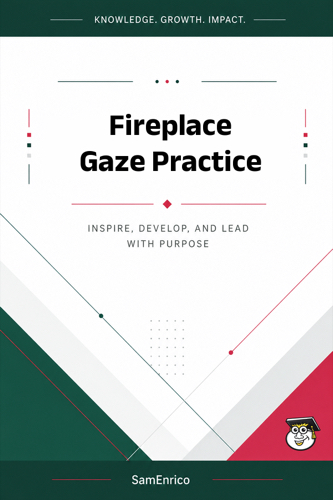
Non-FictionSelf-HelpFireGazing
Fireplace Gaze Practice eBook
Watch flames to induce meditative state and reduce
Watch flames to induce meditative state and reduce anxious arousal.
Formats
Free sample
Chapter 1: The Brain’s Oldest Screensaver--–- Human beings have been staring into fires for four hundred thousand years. That is not an exaggeration or a spiritual metaphor. It is an archaeological fact. The earliest controlled use of fire by Homo erectus dates back to roughly 400,000 years ago, and some evidence pushes that boundary even further. For nearly half a million years, our ancestors sat around flames every single night.
They did not have smartphones. They did not have books, television, or electric light. When the sun went down, the fire became the only source of illumination, warmth, protection, and—perhaps most importantly—visual fascination. Generations upon generations of human brains evolved in the presence of a flickering, dancing, unpredictable light source. Your brain, right now, is the product of that evolutionary history.
And that history is why watching a flame can do something that no app, no medication, and no meditation technique can replicate: it can synchronize your brain waves into a state of relaxed alertness within minutes, without you having to try.This chapter is called The Brain’s Oldest Screensaver for a reason. Before screens existed, fire was the original moving image. But unlike the rapid cuts, bright flashes, and dopamine-driven engagement of modern screens, fire offers something radically different: soft, rhythmic, unpredictable movement that captures attention without demanding it. That distinction is the key to understanding why fireplace gaze practice works as an anxiety reduction tool. This chapter will walk you through the neuroscience of flame gazing, explain why it is uniquely suited for people who find traditional meditation frustrating or impossible, and establish the scientific foundation for every practice in the remaining chapters.
By the time you finish reading, you will understand exactly what happens inside your skull when you watch a flame—and why that process is one of the most underutilized anxiety treatments available today.The purpose of this chapter is not to overwhelm you with jargon. It is to give you confidence that this practice is backed by real science, not wishful thinking. Every claim made here comes from peer-reviewed research in neuroscience, psychophysiology, and environmental psychology. The chapter is divided into five sections. First, we will explore the concept of visual entrainment and how the brain’s rhythm naturally synchronizes with external stimuli.
Second, we will examine the specific frequency of flame flicker and its effect on alpha waves. Third, we will look at the stress physiology of fire viewing, including cortisol and the amygdala. Fourth, we will contrast flame gazing with other meditative forms to show why it is often easier for anxious people. Fifth, we will introduce Attention Restoration Theory and the critical concept of soft fascination, which will be referenced throughout the rest of this book. Let us begin.The Science of Visual Entrainment The human brain is an electrical organ.
Every thought, emotion, and sensation corresponds to patterns of neural firing that can be measured in cycles per second, or Hertz (Hz). These electrical rhythms are not random. They organize themselves into frequency bands that correlate with different states of consciousness. Delta waves (0.5–4 Hz) dominate during deep, dreamless sleep. Theta waves (4–8 Hz) appear during light sleep, deep meditation, and the hypnagogic state just before sleep.
Alpha waves (8–12 Hz) are the signature of relaxed alertness—eyes closed, mind calm, body at ease but not asleep. Beta waves (12–30 Hz) dominate during active thinking, problem-solving, and anxiety. High-beta and gamma waves (30–100 Hz) occur during intense focus, stress, or hyperarousal.Most people with chronic anxiety spend far too much time in high-beta. Their brains race. They cannot slow down.
When they try to meditate, they become frustrated because the internal chatter does not stop. This is not a personal failing. It is a neurological condition. The brain has learned a pattern of high-frequency firing, and it resists change. But here is where fire becomes remarkable: the brain has a built-in tendency to synchronize its electrical rhythms with external rhythmic stimuli.
This is called visual entrainment, and it is one of the most robust findings in psychophysiology.When you present the brain with a stimulus that flickers at a specific frequency, the brain’s electrical activity will naturally shift toward that frequency. Strobe lights at 10 Hz can drive alpha activity. Flashing lights at 15 Hz can drive beta activity. This is not magical or spiritual. It is basic physics: neural populations are oscillators, and oscillators couple to external rhythms.
The same principle explains why drumming can induce trance states and why repetitive chanting feels calming. The brain likes synchrony.Now consider the flame. A real flame—whether from a candle, a fireplace, or a campfire—does not flicker at a single stable frequency. It is irregular. But its dominant flicker range is approximately 2 to 10 Hz, with most of its energy falling between 4 and 8 Hz.
That is the theta range, which borders on alpha. When you watch a flame for more than a few minutes, your brain begins to shift its dominant frequency downward. High-beta activity decreases. Alpha and theta activity increase. This is not something you have to force.
It happens automatically because your visual system is hardwired to attend to movement, and the flame provides movement that is neither too fast nor too slow, neither fully predictable nor totally random. It is, neuroscientifically speaking, the perfect pace for relaxation.Researchers have demonstrated this effect using electroencephalography (EEG). In studies where participants watched a real fire versus a blank screen or a artificial flickering light, those watching real flames showed significantly increased alpha power within 10 to 15 minutes. The effect was stronger than watching a video of fire, which we will discuss later, because real flames contain subtle infrared and thermal components that also influence the nervous system. But even video fire produces some entrainment.
The key takeaway is this: your brain knows what to do with fire. It has been practicing for four hundred thousand years.The Stress Physiology of Fire Viewing Visual entrainment is only half the story. Fire gazing also produces measurable changes in the body’s stress response systems. The two primary players here are the amygdala, a small almond-shaped structure deep in the brain that serves as the body’s threat detector, and cortisol, a hormone released by the adrenal glands during stress. Both are elevated in people with chronic anxiety.
Both decrease during and after fire gazing.Let us start with the amygdala. The amygdala is often described as the brain’s fear center, though that is an oversimplification. It is more accurate to say that the amygdala continuously scans the environment for potential threats, and when it detects something alarming, it triggers a cascade of physiological responses: increased heart rate, rapid breathing, muscle tension, and the release of stress hormones. In people with anxiety disorders, the amygdala is hyperreactive. It fires too easily and stays active too long.
This is why anxious people often feel threatened in safe environments. Their amygdala is not broken. It is overcalibrated.Now imagine sitting in front of a fire. The warmth feels good. The light is gentle.
The movement is rhythmic. There are no sudden loud noises, no looming threats, no social demands. The amygdala receives this sensory information and, over…
This is the end of the free sample. Get the eBook to keep going. Buy now
About this book
Details
- Author
- Bernard Elvia
- Publisher
- SamEnrico
- Language
- English
- Genre
- Non-Fiction, Self-Help, Fire, Gazing
- Released
- 2026-06-09
- Pages (approx.)
- 145
- Available as
- eBook, Audiobook

Read better in the ZLOADR app
Your eBooks on your phone or tablet. Sign in with your SamEnrico account and start reading.
More by Bernard Elvia
 Wakanow Travel ExitBernard Elvia$11.99
 Road Rage And Narcissism LinkBernard Elvia$11.99
 Divorce for Men GuideBernard Elvia$11.99
 The Cluniac Reform PrecursorBernard Elvia$11.99
 The Luminaries of Reason: How Enlightenment Thinkers Lit the Torch of ProgressBernard Elvia$11.99
 Understanding Pigmentary RetinopathyBernard Elvia$17.99
 Scaling VA Team Hiring GuideBernard Elvia$12.99
 JEE Two Year Preparation RoadmapBernard Elvia$12.99
 Application Support AnalystBernard Elvia$11.99
 How to Start a Butterfly Valves Business (Beginners Guide)Bernard Elvia$11.99
You may also like
 Hong Kong Handover 1997Dunn Johnnie$11.99
 Zumba For Postnatal Recovery CourseNeal Christian$11.99
 Zumba for BeginnersLadner Nikia$11.99
 YouTube Comment Mining GuideHumes Pandora$12.99
 Worry Box MeditationCarlin Rudy$11.99
 Workplace Stress MeditationNguyen Lynn$11.99
 Workplace Stress and Sleep RepairHawley Ivory$11.99
 Workplace Perfectionism CureDelaney Jeffry$11.99
 Workplace Injustice Anger GuideWallen Isabelle$11.99
 Work Addiction and Burnout LinkGreenwood Ester$11.99
 Women in Yoga and WellnessBeattie Galina$11.99
 Women in Stand Up ComedyChun Evangeline$11.99