
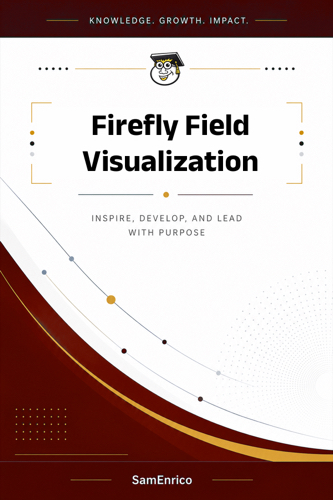
Firefly Field Visualization eBook
Watch thousands of fireflies blink in a dark field
by Coats Ayako
Watch thousands of fireflies blink in a dark field at dusk.
Formats
Free sample
Chapter 1: The First Blink--–- You are standing in a field at dusk. You cannot see the grass beneath your feet, only feel it brush against your ankles. The sky above has drained from blue to violet to a deep, uncertain gray. Somewhere to your left, a cricket tests its legs. Somewhere to your right, the wind settles into the tall grass like a long exhale.
And then—nothing. Then darkness. Then a single point of light, no larger than a pinprick, ignites ten feet in front of your face. It glows for half a second. Maybe less.
Then it vanishes. You wait. The field waits with you. And then another flash, this time to your left, then another behind you, then another, then another, until the darkness is no longer empty but swarming with small, brief, impossible lights.This is not a memory, not yet. It is an invitation.You have picked up this book because something in you already knows that field.
Maybe you have stood in one—as a child chasing jarred light, as a teenager lying in damp grass, as an adult stealing a moment between obligations. Maybe you have only seen fireflies in videos or paintings or the half-remembered stories of grandparents. It does not matter. The field does not require your history. It only requires your attention.This chapter is called The First Blink because that is where every journey begins: not with understanding, not with technique, not with mastery, but with the decision to notice a single point of light in a vast darkness.
Before you learn to breathe with fireflies, before you map them onto your body, before you carry them into cities or defend them against extinction, you must first see them. Really see them. Not as metaphor. Not as therapy. As living creatures engaged in one of the most extraordinary chemical processes on Earth.What You Will Learn in This Chapter By the end of these pages, you will understand:The precise biochemistry that allows a firefly to produce light without heat Why different species flash in different patterns—and why that matters for your visualization practice The critical role of darkness in firefly communication and survival The distinction between biologically accurate visualization and poetic visualization, a framework that will guide every chapter of this book How the firefly's real-world struggles with light pollution and habitat loss connect to your own need for mental darkness Why the first flash you notice—real or imagined—is always, already yours This is not a dry biology lesson.
It is a foundation. Everything else in this book—every breath, every movement, every moment of stillness—rests on what you learn here. So let us begin where the firefly begins: with light, with darkness, and with the space between them where meaning lives.The Chemistry of Wonder Let us be precise. Fireflies are not magical. They are better than magical: they are real.
The light they produce is called bioluminescence—the same phenomenon that lights up deep-sea fish, glowing mushrooms, and certain species of plankton. But fireflies are unique in how efficiently they achieve this glow.Inside a firefly's light organ (located in the lower abdomen), two key molecules meet: luciferin and luciferase. Despite the name, luciferase is not demonic; it is an enzyme, a biological catalyst. When oxygen enters the light organ through a network of tiny tubes called tracheoles, luciferase helps luciferin react with that oxygen. The result is oxyluciferin, carbon dioxide, and—most importantly—a photon of light.Here is what makes fireflies extraordinary: that reaction produces almost no heat.
A standard incandescent light bulb converts about 90 percent of its energy into heat and only 10 percent into light. A firefly converts nearly 100 percent of its energy into light. Touch a firefly while it glows. You will feel nothing. No warmth.
No burn. Just the cool, efficient miracle of cold light.This efficiency is not accidental. Fireflies evolved it over millions of years because wasting energy as heat would be lethal. In the dark field, every flash is a costly signal. It announces the firefly's location to potential mates—and also to predators.
Spiders, birds, and bats all eat fireflies. A flash that lingers too long or burns too hot invites death. So fireflies learned to say exactly what they needed to say, for exactly as long as needed, and then to go dark.That is your first lesson: light without waste. Presence without performance.The Language of Flashes Not all fireflies speak the same language. In North America alone, there are over 170 species, each with its own flash pattern.
Some emit single long glows, lasting a full second or more. Others produce rapid double-blinks, like a heartbeat heard through a stethoscope. The most famous are the synchronous fireflies—Photinus carolinus—found in the Great Smoky Mountains and a handful of other locations. For several seconds, thousands of males will flash in perfect unison, then go dark together, then flash again. Scientists believe this synchrony helps females identify males of their own species amid the chaos of overlapping signals.Why does this matter for visualization?
Because your mind, like a female firefly, needs a pattern to recognize. When you learn to visualize fireflies, you are not just imagining random lights. You are learning to see with the specificity of a creature that must distinguish friend from food, mate from predator, signal from noise.Throughout this book, you will be invited to work with different flash patterns depending on your emotional state. The slow, single glow of a Photinus pyralis (the common eastern firefly) is excellent for calming a racing mind. The rapid double-blink suits moments when you need gentle activation, not sedation.
And the synchronicity of Photinus carolinus—well, that belongs to Chapter 7, where we discuss loneliness and the longing to flash in unison with others.For now, simply know this: the firefly you visualize can be any species you choose. You are not bound to biological accuracy unless you wish to be. And that brings us to the most important distinction in this book.Two Modes of Visualization: Biologically Accurate and Poetic Throughout Firefly Field Visualization, you will encounter two distinct modes of practice. Understanding the difference between them will save you from confusion and frustration.Biologically Accurate Visualization: In this mode, you honor the real constraints of firefly biology. Flashes follow natural patterns.
Dark intervals are respected. You do not force fireflies to move in impossible ways or glow in colors they cannot produce. This mode is essential for grounding, for ecological empathy, and for the conservation work in Chapter 11. Use it when you need to remember that you are part of a real, fragile, astonishing world.Poetic Visualization: In this mode, you are free to manipulate imagined fireflies for therapeutic goals. You can make them spiral, trace figure-eights, change color, blink on command, or gather in your chest as a swarm of comfort.
This mode is essential for cognitive reframing (Chapter 5), body mapping (Chapter 10), and emergency regulation (Chapter 12). Use it when you need to reshape your inner landscape, not when you need to honor an outer one.Neither mode is superior. They are different tools for different…
This is the end of the free sample. Get the eBook to keep going. Buy now
About this book
Details
- Author
- Coats Ayako
- Publisher
- SamEnrico
- Language
- English
- Genre
- Non-Fiction, Self-Help, Wonder Calm
- Released
- 2026-06-06
- Pages (approx.)
- 105
- Available as
- eBook, Audiobook

Read better in the ZLOADR app
Your eBooks on your phone or tablet. Sign in with your SamEnrico account and start reading.
More by Coats Ayako
 Transparency Codes AbroadCoats Ayako$11.99
 Assertive Conflict Resolution GuideCoats Ayako$11.99
 The Confusion InductionCoats Ayako$11.99
 The Coparenting Stress Relief GuideCoats Ayako$11.99
 Lorde: The Quiet Storm: How a Kiwi Teen Took Over the WorldCoats Ayako$11.99
 Understanding Renal Dysplasia Megalocystis SirenomeliaCoats Ayako$17.99
 IOT Software DeveloperCoats Ayako$11.99
 Graduate Work Stream RequirementsCoats Ayako$12.99
 Advertising Tools ComparisonCoats Ayako$12.99
 How to Become a Ornamental-iron WorkerCoats Ayako$11.99