
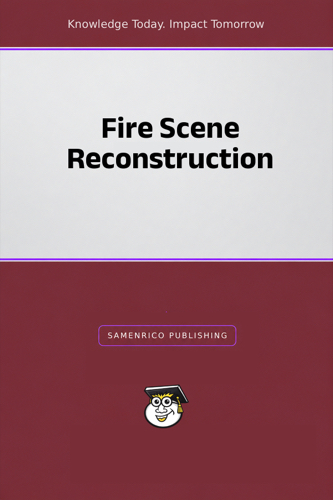
Non-FictionTrue Crime / Arson Investigation
Fire Scene Reconstruction eBook
Determines origin and cause of suspicious fires fr
by Farmer Homer
Determines origin and cause of suspicious fires from burn patterns and debris.
Formats
Free sample
Chapter 1: The Ashes Lie...--The body was discovered at 4:47 a.m., curled on the linoleum floor of a kitchen that no longer existed. The fire had burned so hot that the refrigerator had melted into a puddle of enamel and steel. The victim’s hands were raised in front of her face—the pugilistic stance that every firefighter recognizes but few truly understand. The first responding officer wrote in his report: “Deceased appears to have been overcome by smoke while attempting to escape. Origin likely kitchen.
Cause undetermined pending further investigation.”That report was wrong.Not maliciously wrong. Not negligently wrong, at least not in the way the law defines negligence. It was wrong in the way that fire investigations had been wrong for decades—because the officer had looked at the scene without knowing how to read it. He saw a dead woman in a burnt kitchen and told himself a story: she was cooking, something caught fire, she tried to run, the smoke got her. The story made sense.
It was simple. It was almost certainly false.Three weeks later, an arson investigator named Elena Vasquez arrived at the site. The structure had been boarded up. The smell of wet charcoal and melted wiring still hung in the air. She spent four hours walking the grid, photographing every V-pattern on the surviving walls, measuring the depth of calcination on the gypsum board, and mapping the protected areas behind where the refrigerator had stood.
She found something the first responders had missed: a series of irregular, puddle-shaped burns on the linoleum floor, with sharp lines of demarcation, located in a depression behind the kitchen island. Those puddles were not consistent with a cooking fire. They were consistent with an ignitable liquid—something like gasoline or lacquer thinner—poured onto the floor and ignited.The victim had not been cooking. She had been doused. The fire had been set.
And the officer who wrote “origin likely kitchen” had unintentionally helped a killer walk free for three extra weeks.This book is about learning to see what that officer could not. It is about the transformation from firefighter—someone who extinguishes fires—to forensic investigator—someone who reads the story the fire left behind. And it begins, as all scientific inquiry must begin, with the recognition that your instincts will lie to you, your experience will betray you, and the only path to the truth is the systematic, dispassionate application of the scientific method.The Firefighter’s Instinct Versus the Investigator’s Discipline If you come to this work from the fire service—and most fire investigators do—you bring an invaluable asset: you understand fire. You know how it moves, how it breathes, how it seeks oxygen and consumes fuel. You have felt its heat through your turnout gear and heard its roar through your facepiece.
That experience is not irrelevant. It is, in fact, essential.But it is also dangerous.The firefighter is trained to attack the fire, to find its seat, to knock it down as quickly as possible. That means the firefighter develops a heuristic—a mental shortcut—for identifying where the fire is most intense. In a working structure fire, you look for the hottest area, the deepest char, the most complete consumption. That is where you aim your hose line.
That is how you save the building.The fire investigator does the opposite.The investigator looks for the area of least damage—the farthest point from the origin, the place where the fire barely touched before it ran out of fuel or oxygen or both. Then the investigator works backward, tracing the fire’s path from the periphery to the center. The investigator’s goal is not to suppress the fire. It is to reconstruct it in reverse. And that requires suppressing something else entirely: the instinct to go where the damage is worst.This inversion of perspective is the first and most difficult psychological hurdle for new investigators.
Your brain has been trained for years—perhaps decades—to move toward the heat. Now you must train yourself to move away from it. You must learn to walk past the blackened, collapsed center of the room and instead study the relatively untouched corner where the fire barely kissed the wall. That corner, not the charred pit, holds the first clue.Elena Vasquez learned this lesson on her third year on the job. She had been called to a garage fire that had destroyed two cars and melted the vinyl siding off the back of a house.
Her initial walkthrough took her straight to the most damaged area: a burned-out sedan with its tires consumed and its engine block sagging. She spent an hour documenting that car, convinced the fire had started in the engine compartment. Then she stopped herself, stepped back, and forced herself to walk the perimeter. Twenty feet from the car, against the back wall of the garage, she found an intact electrical outlet with a melted plug still inserted. The pattern of char on the wall behind the outlet told her that the fire had started there—in the outlet—and spread to the car, not the other way around.
She had nearly made the classic error: mistaking the area of greatest damage for the area of origin.The firefighter’s instinct is not your enemy. It is your raw material. But it must be disciplined by a method that is older and more reliable than any instinct: the scientific method.The Scientific Method: Observing, Hypothesizing, Testing, Concluding The scientific method is not a mysterious ritual performed by people in white lab coats. It is simply a way of answering questions that minimizes the influence of human bias. It has four steps, and every fire scene reconstruction must follow them in order.Step One: Observe.
You document everything. You photograph every wall, every piece of debris, every burn pattern. You measure distances. You collect samples. You do not interpret yet.
You simply record. The observation phase is the foundation of everything that follows, and it must be as complete and unbiased as possible. If you miss an observation now, you cannot go back and make it later—because the scene will have been altered by excavation, weather, or time.Step Two: Hypothesize. Based on your observations, you propose a possible explanation for how the fire started. A hypothesis is not a guess.
It is an informed proposition that is consistent with all the observed evidence so far. In a fire scene, you will typically have multiple hypotheses. For example: Hypothesis A—the fire started when a cigarette ignited a upholstered chair in the living room. Hypothesis B—the fire started when an electrical fault in the wall wiring ignited the wood studs. Hypothesis C—the fire was intentionally set using an ignitable liquid poured on the floor.
All three hypotheses might be consistent with the initial observations. That is fine. The scientific method does not demand that you choose one immediately. It demands that you test them.Step Three: Test. This is where fire investigation becomes genuinely scientific.
You test each hypothesis by asking: If this hypothesis were true, what evidence would I expect to find? And what…
This is the end of the free sample. Get the eBook to keep going. Buy now
About this book
Details
- Author
- Farmer Homer
- Publisher
- SamEnrico
- Language
- English
- Genre
- Non-Fiction, True Crime / Arson Investigation
- Released
- 2026-06-07
- Pages (approx.)
- 160
- Available as
- eBook, Audiobook

Read better in the ZLOADR app
Your eBooks on your phone or tablet. Sign in with your SamEnrico account and start reading.
More by Farmer Homer
 Shopping Addiction Holiday SurvivalFarmer Homer$11.99
 Pet Anticipatory Grief GuideFarmer Homer$11.99
 Nap Timing Circadian GuideFarmer Homer$11.99
 Body Language for SoldiersFarmer Homer$11.99
 The Postpartum and Partner RelationshipFarmer Homer$11.99
 Self Hypnosis for Gambling HabitsFarmer Homer$11.99
 SMART Goal Tracker GuideFarmer Homer$11.99
 The Battle of Tabora: The Last Stand of the Maji Maji ResistanceFarmer Homer$11.99
 The Ballad of the Running Pen: How Malaysian Sports Journalism Defied CensorshipFarmer Homer$11.99
 A Beginners Guide to Seven-ball (Volume 1)Farmer Homer$11.99
 How to Produce a CultipackerFarmer Homer$11.99
 A Collector's Handbook to the Vauxhall ViscountFarmer Homer$11.99
You may also like
 Hong Kong Handover 1997Dunn Johnnie$11.99
 Zumba For Postnatal Recovery CourseNeal Christian$11.99
 Zumba for BeginnersLadner Nikia$11.99
 YouTube Comment Mining GuideHumes Pandora$12.99
 Worry Box MeditationCarlin Rudy$11.99
 Workplace Stress MeditationNguyen Lynn$11.99
 Workplace Stress and Sleep RepairHawley Ivory$11.99
 Workplace Perfectionism CureDelaney Jeffry$11.99
 Workplace Injustice Anger GuideWallen Isabelle$11.99
 Work Addiction and Burnout LinkGreenwood Ester$11.99
 Women in Yoga and WellnessBeattie Galina$11.99
 Women in Stand Up ComedyChun Evangeline$11.99