
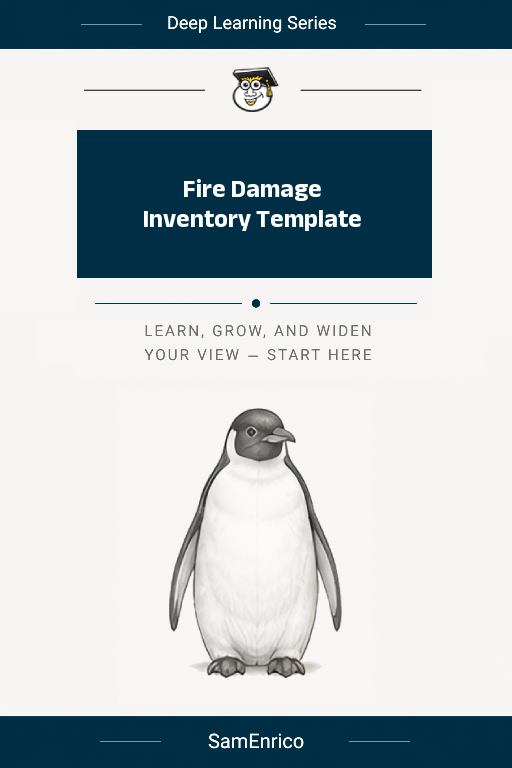
Fire Damage Inventory Template eBook
Create room by room spreadsheet with item descript
Create room by room spreadsheet with item descriptions quantities and estimated values for insurance.
Formats
Free sample
Chapter 1: The Amnesia Economy--–- On a Tuesday afternoon in October, a woman named Sarah stood in front of what used to be her living room. The fire had started in the garage from a faulty battery charger—a device she had owned for eight years and replaced twice, though she could not remember either purchase at that moment. The flames had climbed the walls, melted the ceiling fan into a dripping plastic fossil, and reduced her grandmother’s walnut hope chest to a pile of blackened splinters. The fire department had arrived within twelve minutes, but the damage was done. Sarah was alive.
Her two children were safe. And she was about to lose an additional $147,000 without ever knowing it.That number—147,000—wasnotthevalueofherhome’sstructure.Thatwasthevalueofherpersonalpropertythatshewouldfailtoclaimoverthefollowingsixmonths.Notbecauseshewasdishonest.Notbecauseshewaslazy.Butbecauseherbrain,underthecrushingweightoftrauma,simplyerasedthoseitemsfromhermemory.Sheforgotthepowertoolsinthegarage.Sheforgottheseasonaldecorationsintheattic.Sheforgotthespicerack,thelinenscloset,thecampinggear,theboxofantiqueornaments,thebackupphonecharger,thehumidifier,thethreewintercoatshangingintheguestroomcloset,andthehundredotherthingsthatmadeherhouseahome.Bythetimeherinsuranceadjusterclosedthefile,Sarahhadbeenpaid147,000—was not the value of her home’s structure. That was the value of her personal property that she would fail to claim over the following six months. Not because she was dishonest. Not because she was lazy.
But because her brain, under the crushing weight of trauma, simply erased those items from her memory. She forgot the power tools in the garage. She forgot the seasonal decorations in the attic. She forgot the spice rack, the linens closet, the camping gear, the box of antique ornaments, the backup phone charger, the humidifier, the three winter coats hanging in the guest room closet, and the hundred other things that made her house a home. By the time her insurance adjuster closed the file, Sarah had been paid 147,000—wasnotthevalueofherhome’sstructure.Thatwasthevalueofherpersonalpropertythatshewouldfailtoclaimoverthefollowingsixmonths.Notbecauseshewasdishonest.Notbecauseshewaslazy.Butbecauseherbrain,underthecrushingweightoftrauma,simplyerasedthoseitemsfromhermemory.Sheforgotthepowertoolsinthegarage.Sheforgottheseasonaldecorationsintheattic.Sheforgotthespicerack,thelinenscloset,thecampinggear,theboxofantiqueornaments,thebackupphonecharger,thehumidifier,thethreewintercoatshangingintheguestroomcloset,andthehundredotherthingsthatmadeherhouseahome.Bythetimeherinsuranceadjusterclosedthefile,Sarahhadbeenpaid38,000 for contents.
A public adjuster hired by her neighbor—a man who lost nearly identical property in the same fire—secured $185,000.The difference was not luck. It was the inventory.The Amnesia Economy Insurance companies understand something that most homeowners do not: trauma destroys memory. This is not a metaphor or a psychological observation. It is a biological fact. When a person experiences a catastrophic event—a fire, a flood, a burglary, a natural disaster—the brain floods with cortisol, the primary stress hormone.
Cortisol has many functions, but one of its most immediate effects is the suppression of hippocampal activity. The hippocampus is the part of your brain responsible for forming and retrieving declarative memories—the kind of memories that answer questions like “What did I own?” and “Where did I put it?” Under extreme stress, your hippocampus quite literally works less effectively.This is why witnesses to crimes cannot remember the perpetrator’s face. This is why car accident victims often cannot recall the seconds leading up to the collision. And this is why fire victims, standing in the ashes of their homes, forget 50 to 70 percent of their non-daily-use possessions within the first three weeks.Insurance companies do not cause this amnesia, but they have built their claims processes around it. Actuaries have quantified it.
Adjusters are trained to recognize it. The standard timeline of a fire claim—initial inspection within 72 hours, sworn proof of loss within 60 days, settlement within six months—is designed to operate inside the window of maximum memory degradation. The longer you wait to document what you owned, the less you will remember. And the less you remember, the less the insurance company pays.This is not conspiracy. This is the Amnesia Economy—a system in which insurers profit from the predictable failure of human memory under stress.
The only way to beat it is to understand it, prepare for it, and build your inventory before your brain erases the evidence of your own life.Why Your Brain Erases Your Possessions Let us be precise about what happens neurologically. In a typical, non-traumatic state, your brain encodes memories through a process called consolidation. Information moves from short-term sensory buffers into long-term storage via the hippocampus. When you later need to remember something—say, the brand of your coffee maker or the number of pairs of shoes you own—your brain reconstructs that memory from distributed neural networks. This process is not perfect, but it works reasonably well for most everyday tasks.Under extreme stress, however, the body releases cortisol and norepinephrine.
These hormones prioritize survival functions over memory encoding. Your brain decides, in a fraction of a second, that remembering where you left your power drill is less important than escaping a burning building. This is a sensible survival mechanism. It is also a financial disaster.The result is a phenomenon psychologists call “post-event memory degradation.” In the days and weeks following a traumatic event, your ability to recall non-essential details—including the contents of your home—declines sharply. Studies of disaster survivors have shown that memory recall for possessions drops by approximately 30 percent within the first week, 50 percent within the first month, and 70 percent within three months.
The items you use every day—your phone, your keys, your wallet, your coffee mug—tend to survive because they are reinforced by daily use. But the items you own but do not interact with daily? The holiday decorations, the tools, the spare linens, the pantry items, the attic storage bins? Those memories fade fastest.There is a second mechanism at work as well: source amnesia. Even when survivors remember that they owned something, they often cannot remember what it was or where they got it.
A victim might recall having “a set of tools” but cannot remember whether they owned a circular saw, a jigsaw, or both. They might recall “some holiday decorations” but cannot visualize the inflatable snowman or the box of heirloom ornaments. This is not ordinary forgetfulness. This is the brain’s protective machinery, and it is working against your financial interest.The 48-Hour Window: Understanding the Two Phases of Inventory This brings us to the most important operational rule in this entire book: the inventory process has two distinct phases, and you must begin Phase One within 48 hours of the fire.Phase One: The Mental Inventory (Hours 0-48)Phase One does not require entering the damaged structure. It does not require putting on PPE or waiting for the Fire Marshal.
It requires only a pen, paper, and your surviving memory. Within 48 hours of the fire—ideally within 24—you will sit down in a quiet place and write down every possession you can remember owning. You will do this before the adjuster arrives. You will do this before the cortisol has fully consolidated its hold on your hippocampus. You will do this while the memories are still fresh.Phase One is not about accuracy.
It is about volume. You are trying to capture as many category-level memories as possible: “kitchen appliances,” “bedroom linens,” “garage tools,” “attic decorations.” Do not worry about brands, models, or prices yet. Do not worry about spelling or organization. Just write. Stream of consciousness.
Room by room. Draw a floorplan from memory if it helps. Label each room and list every category of item you recall owning there.The goal of Phase One is to create a skeleton—a container that you will later fill with detailed information. Most victims…
This is the end of the free sample. Get the eBook to keep going. Buy now
About this book
Details
- Author
- Ballard Lorena
- Publisher
- SamEnrico
- Language
- English
- Genre
- Non-Fiction, Crisis Management
- Released
- 2026-05-30
- Pages (approx.)
- 122
- Available as
- eBook, Audiobook

Read better in the ZLOADR app
Your eBooks on your phone or tablet. Sign in with your SamEnrico account and start reading.
More by Ballard Lorena
 Musician Practice Distraction GuideBallard Lorena$11.99
 The Car Wash PrisonerBallard Lorena$11.99
 Chronic Illness Stress MarriageBallard Lorena$11.99
 The Italian PostmanBallard Lorena$11.99
 Retrieval Practice GuideBallard Lorena$11.99
 Listening For First RespondersBallard Lorena$11.99
 The Quit Smoking Stroke RiskBallard Lorena$11.99
 EQ for Adolescents GuideBallard Lorena$11.99
 Affordable Counseling GuideBallard Lorena$11.99
 Soul on Fire: The Untold Story of the Watts UprisingBallard Lorena$11.99
 Lumumba’s Lens: How African Filmmakers Reclaimed the NarrativeBallard Lorena$11.99
 Juanelo Turriano: The Clockmaker to KingsBallard Lorena$11.99
You may also like
 Hong Kong Handover 1997Dunn Johnnie$11.99
 Zumba For Postnatal Recovery CourseNeal Christian$11.99
 Zumba for BeginnersLadner Nikia$11.99
 YouTube Comment Mining GuideHumes Pandora$12.99
 Worry Box MeditationCarlin Rudy$11.99
 Workplace Stress MeditationNguyen Lynn$11.99
 Workplace Stress and Sleep RepairHawley Ivory$11.99
 Workplace Perfectionism CureDelaney Jeffry$11.99
 Workplace Injustice Anger GuideWallen Isabelle$11.99
 Work Addiction and Burnout LinkGreenwood Ester$11.99
 Women in Yoga and WellnessBeattie Galina$11.99
 Women in Stand Up ComedyChun Evangeline$11.99