
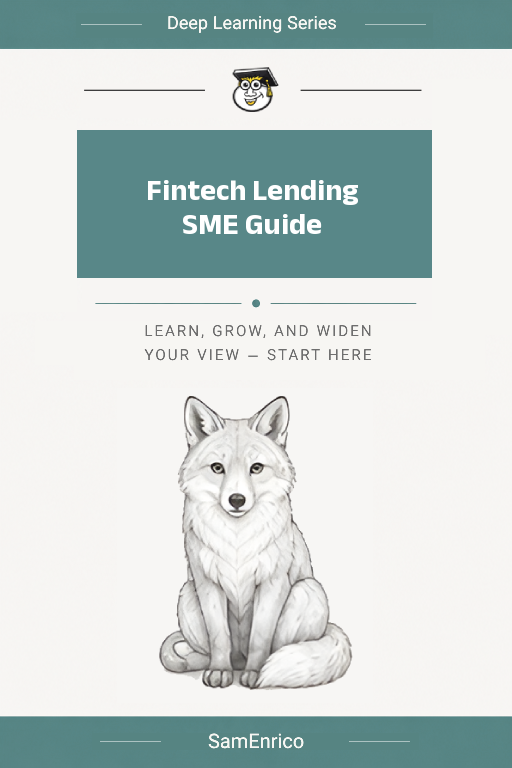
Non-FictionForecast & OutlookSME Lending
Fintech Lending SME Guide eBook
Discover invoice financing, working capital loans,
Discover invoice financing, working capital loans, and credit scoring for small businesses via digital platforms.
Formats
Free sample
Chapter 1: The 90-Day Time Bomb--–- The voicemail that changed everything came in at 4:47 PM on a Tuesday. Mark, who had built a commercial cleaning company from a single used van into a 4millionoperationservingfifty−sevenofficebuildings,heardthewordseveryfounderdreads:"Mr.Hendricks,thisis Karenfrom Bay State Bank.I′mcallingtoletyouknowthatyourlineofcreditrenewalhasbeendeniedduetoinsufficientcollateralcoverage.Pleasecallmetodiscussyouroutstandingbalanceof4 million operation serving fifty-seven office buildings, heard the words every founder dreads: "Mr. Hendricks, this is Karen from Bay State Bank. I'm calling to let you know that your line of credit renewal has been denied due to insufficient collateral coverage. Please call me to discuss your outstanding balance of 4millionoperationservingfifty−sevenofficebuildings,heardthewordseveryfounderdreads:"Mr.Hendricks,thisis Karenfrom Bay State Bank.I′mcallingtoletyouknowthatyourlineofcreditrenewalhasbeendeniedduetoinsufficientcollateralcoverage.Pleasecallmetodiscussyouroutstandingbalanceof187,000, which is now due in full within thirty days."Mark sat in his truck, watching the rain streak across the windshield, and did the math.
He had 42,000inhisoperatingaccount.Payrollwas Friday:42,000 in his operating account. Payroll was Friday: 42,000inhisoperatingaccount.Payrollwas Friday:68,000. His largest client, a regional medical system, was consistently late on their 210,000invoice—nowatninety−threedaysoverdue.Thebankwanted210,000 invoice—now at ninety-three days overdue. The bank wanted 210,000invoice—nowatninety−threedaysoverdue.Thebankwanted187,000 in thirty days. He had negative $26,000 before paying a single supplier.
By every accounting measure, his company was profitable. By every practical measure, he was four weeks from bankruptcy.This is not a story about a failing business. This is a story about the single greatest blind spot in small business finance: the difference between profit and liquidity. Mark's company would have shown a healthy 18% net profit margin on his year-end tax return. His accountant would have called him successful.
But success on paper does not keep the lights on when your largest client pays late, your bank pulls your credit line, and your employees expect their checks every other Friday.Mark eventually survived—not because a bank saved him, but because a fintech lender approved him for invoice financing in thirty-seven minutes while he sat in that same truck. He learned, through desperation, what this book will teach you systematically: the rules of lending have changed, the gatekeepers have been replaced by algorithms, and the most dangerous thing you can do as a founder is confuse profitability with liquidity.The Great Abandonment: How Banks Left Small Business Behind To understand where fintech lending came from, you have to understand what happened to traditional banks. The story begins not with a technology, but with a trauma: the 2008 financial crisis.Before the crash, small business lending was a boring, predictable business. A local bank branch manager knew the pizza shop owner, saw the delivery trucks on the road, and could make a character-based decision on a $50,000 line of credit. The bank held that loan on its books, collected the interest, and the relationship continued for years.
It was slow, inefficient, and expensive for the bank to service—but it worked.Then the crisis hit. Between 2008 and 2010, commercial bank lending to small businesses fell by more than 40billion.Thebanksthatsurvivedfacedanewreality:regulatorsdemandedtheyholdmorecapitalagainsteveryloan,andthecostoforiginatinga40 billion. The banks that survived faced a new reality: regulators demanded they hold more capital against every loan, and the cost of originating a 40billion.Thebanksthatsurvivedfacedanewreality:regulatorsdemandedtheyholdmorecapitalagainsteveryloan,andthecostoforiginatinga100,000 small business loan was nearly identical to the cost of originating a $10 million corporate loan. The math became brutal. Why would a bank spend weeks underwriting a restaurant when they could spend the same time underwriting a real estate developer and make ten times the fee income?The abandonment was not announced.
It happened quietly, through policy changes and internal memos. Banks raised minimum loan sizes. They required two or three years of audited financials that most small businesses did not have. They demanded personal guarantees and collateral that wiped out any limited liability protection. They stopped sending loan officers to visit small businesses and started routing everyone to automated phone trees.By 2015, the statistics were devastating.
According to the Federal Reserve's Small Business Credit Survey, only 30% of small businesses who applied for bank financing received everything they requested. Nearly 40% of applicants reported that their bank had reduced their credit line or revoked it entirely—not because the business was failing, but because the bank was systematically exiting the small business market. The remaining banks specialized in SBA loans, which required weeks of paperwork and government guarantees to make the math work.This created what economists call the "SME credit gap": a multi-billion dollar chasm between the financing that small businesses needed and the financing that banks were willing to provide. Into this gap stepped a new kind of lender—one that did not rely on branch networks, loan officers, or even human underwriters.The API Revolution: When Software Learned to Lend The term "fintech" is overused and often meaningless. But one concept, above all others, explains the revolution in small business lending: the Application Programming Interface, or API.An API is a set of rules that allows one software program to talk to another.
When you log into a website using your Google account, that is an API. When your smartphone weather app pulls data from a national forecasting service, that is an API. And when a fintech lender evaluates your business for a loan, the API is the invisible engine that makes instant underwriting possible.Before APIs, applying for a loan meant downloading PDF forms, printing bank statements, scanning them back in, faxing tax returns, and waiting for a human to manually enter data into a spreadsheet. A typical small business loan application required the borrower to produce documents from six or seven different sources: bank accounts, credit card processors, accounting software, tax authorities, landlord references, and supplier payment histories. The process took weeks because the information was siloed and the transfer was manual.APIs changed everything.
When you grant a fintech lender permission to connect to your Quick Books account, their API pulls your chart of accounts, your uncategorized expense history, your accounts receivable aging report, and your cash flow trends. When you connect your Stripe or Square account, the API pulls your daily sales volume, your refund rate, your customer chargeback history, and your seasonal patterns. When you connect your business bank account through a service like Plaid or Yodlee, the API pulls twelve to twenty-four months of transaction data, categorizes each line item, and calculates your average daily balance, your overdraft frequency, and your revenue volatility.All of this happens in seconds. Not hours, not days, not weeks. Seconds.
The data that would have taken a bank underwriter three days to collect and verify flows automatically into an algorithm that can evaluate fifty thousand variables in the time it takes you to type your name.This is not incremental improvement. This is a fundamental shift in the economics of lending. A traditional bank might spend 2,000to2,000 to 2,000to5,000 in labor costs to underwrite a single small business loan. A fintech lender spends pennies in computing costs to underwrite the same business. The bank needs the loan to be large enough to justify the fixed cost.
The fintech lender can profitably lend $5,000 because the marginal cost of underwriting is effectively zero.Embedded Finance: The Loan That Finds You The most powerful manifestation of the API revolution is a concept called embedded finance. The term sounds technical, but the experience is almost…
This is the end of the free sample. Get the eBook to keep going. Buy now
About this book
Details
- Author
- Wagoner Camie
- Publisher
- SamEnrico
- Language
- English
- Genre
- Non-Fiction, Forecast & Outlook, SME Lending
- Released
- 2026-06-01
- Pages (approx.)
- 144
- Available as
- eBook, Audiobook

Read better in the ZLOADR app
Your eBooks on your phone or tablet. Sign in with your SamEnrico account and start reading.
More by Wagoner Camie
 Senior Online Dating Self Esteem HandbookWagoner Camie$11.99
 Workplace Anger Boundaries CourseWagoner Camie$11.99
 Gig Platforms ComparisonWagoner Camie$11.99
 School Teacher De escalationWagoner Camie$11.99
 The Estonian E Residency Business GuideWagoner Camie$11.99
 The Architect and the Emperor: A Love Letter to RomeWagoner Camie$11.99
 Horizontal IntegrationWagoner Camie$11.99
 Executive Summary For ConsultingWagoner Camie$12.99
 Understanding LymphangiomyomatosisWagoner Camie$17.99
 How to Become a Drainage-design CoordinatorWagoner Camie$11.99
You may also like
 Hong Kong Handover 1997Dunn Johnnie$11.99
 Zumba For Postnatal Recovery CourseNeal Christian$11.99
 Zumba for BeginnersLadner Nikia$11.99
 YouTube Comment Mining GuideHumes Pandora$12.99
 Worry Box MeditationCarlin Rudy$11.99
 Workplace Stress MeditationNguyen Lynn$11.99
 Workplace Stress and Sleep RepairHawley Ivory$11.99
 Workplace Perfectionism CureDelaney Jeffry$11.99
 Workplace Injustice Anger GuideWallen Isabelle$11.99
 Work Addiction and Burnout LinkGreenwood Ester$11.99
 Women in Yoga and WellnessBeattie Galina$11.99
 Women in Stand Up ComedyChun Evangeline$11.99