
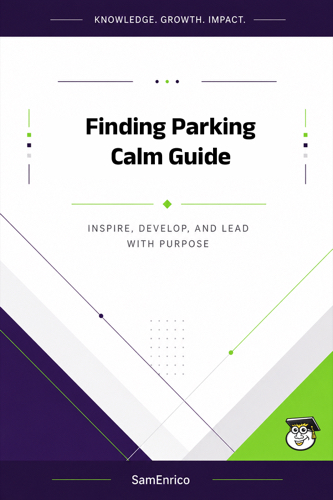
Non-FictionSelf-HelpUrban Parking
Finding Parking Calm Guide eBook
Reduces anger circling for spots with acceptance s
Reduces anger circling for spots with acceptance strategies.
Formats
Free sample
Chapter 1: The Gap That Honks--–- The first time I screamed at a pregnant woman in a parking lot, I was not angry at her. I was angry at the universe for refusing to obey me.It was a Tuesday afternoon in July. The asphalt shimmered with heat. I had been circling the outpatient medical plaza for eleven minutes—I know the exact number because I checked my phone’s clock three times, each time with increasing disbelief. I had a routine checkup scheduled for 2:15 PM.
Nothing urgent. Nothing heroic. Just a blood pressure follow-up that my doctor had suggested six months ago and I had been avoiding ever since.But in that moment, circling that lot, the routine nature of the appointment evaporated. What remained was something primal, something ancient, something that felt like survival itself. Every spot was taken.
Every SUV seemed to be backing out at the exact moment I passed it, only to have the reverse lights click off as a pedestrian waved to the driver and they stayed put. Every compact car was parked six inches over the line, creating a spot-sized void that was not actually a spot at all.Then I saw her. A woman, maybe thirty weeks pregnant, walking slowly toward a car that was parallel to mine but three rows ahead. She was not rushing. She was talking on her phone.
She was laughing. She was—and I remember this with a shame that still colors my cheeks—taking forever to get to her door. When she finally reached it, she did not get in immediately. She leaned against the driver’s side door and continued her conversation. I waited.
I watched. My turn signal blinked like a metronome counting down my remaining civility.When she finally got in, started the engine, and began to back out, I crept forward, positioning myself to claim what was rightfully mine. And then—then—a sedan slid into the spot from the opposite direction. The driver, a man in mirrored sunglasses, did not look at me. He did not wave an apology.
He simply parked, got out, and walked toward the medical building without breaking stride.I lost my mind.I did not honk. I did not gesture. I did something worse. I followed him. Not to fight him—I am not a fighter—but to confront him.
To tell him that I had been waiting. That I had seen the pregnant woman leaving. That he had broken the unspoken code of parking lot etiquette that every decent human being is supposed to know.I caught up with him in the vestibule of the building. I tapped his shoulder. He turned around, and I saw that the mirrored sunglasses were not a style choice.
He was blind. The glasses were prescription. He had a white cane folded in his other hand."I'm sorry," I said. "I thought you—never mind."He said, "Did I take your spot? I'm sorry.
My wife is in labor upstairs. I wasn't paying attention."I walked back to my car. I found a spot on the fourth level of the parking garage, four tenths of a mile from the entrance by my phone's pedometer. I made it to my appointment twelve minutes late. My blood pressure was 148/92.
The nurse asked if I had run up the stairs."No," I said. "I just tried to park."That was the day I realized that parking rage is not about parking. It is about something far deeper, far more irrational, and far more fixable than asphalt and empty spaces. This chapter is about what that something is.The Psychology of the Scream Let me tell you a story about two drivers. Both are circling the exact same full parking lot on the exact same Saturday afternoon.
Both have the exact same goal: to find a spot near the entrance of a busy shopping mall. Both have the exact same amount of time before their movie starts. Both are, by any objective measure, in the exact same situation.Driver A thinks: I would really like a spot close to the entrance. That would be convenient. But if I don't find one in the next minute or two, I will park farther away and walk.
The walk might even be good for me. I have been sitting all day.Driver B thinks: I need a spot right now. There should be spots available. This lot should not be this full at this time of day. Whoever designed this lot is an idiot.
The universe owes me a spot because I am already late and I cannot be late again.Which driver gets angry?Driver B, of course. Every time.But why? The situation is identical. The lot is identical. The stakes are identical.
The only variable that changed is the story Driver B told themselves about the situation. Driver A expressed a preference—a flexible, healthy desire for something convenient. Driver B issued a demand—a rigid, unhealthy requirement that reality conform to their expectations.This distinction between preferences and demands is not pop psychology. It is the central insight of Rational Emotive Behavior Therapy (REBT), developed by psychologist Albert Ellis in the 1950s and validated by thousands of clinical studies since. Ellis argued that human beings do not get angry because of events.
They get angry because of the beliefs they hold about those events. And the most toxic belief of all is the demand—the insistence that reality must be a certain way, and that any deviation from that way is unacceptable.In the world of parking, demands take a very specific shape. They sound like this:"I must find a spot in the next thirty seconds.""That driver should have seen me waiting.""This lot should never be this full at this time.""The universe owes me a convenient parking experience because I am a good person who has had a hard week."Each of these statements contains a hidden word. That word is should. And should is the gasoline that fuels the fire of parking rage.The Hierarchy of Demands Here is where many self-help books get stuck.
They tell you that "demands are bad" and that you should "stop making demands." But that advice is incomplete, and sometimes it is just wrong.Not all demands are created equal. In fact, some demands are not only reasonable but necessary for functioning in the world. The key is learning to distinguish between demands that serve you and demands that destroy you.Let me introduce you to the Hierarchy of Demands—a framework that will appear throughout this book whenever you feel anger rising.Level 1: Reasonable Demands These are demands on yourself and on controllable circumstances. They are rooted in reality and accompanied by backup plans.Examples:"I demand that I leave ten minutes early so I have buffer time for parking.""I demand that I know where the overflow lot is before I need it.""I demand that I arrive at my job interview on time, which means I will park in the first available spot regardless of distance."Reasonable demands are not the enemy. They are the scaffolding of a functional life.…
This is the end of the free sample. Get the eBook to keep going. Buy now
About this book
Details
- Author
- Perryman Karon
- Publisher
- SamEnrico
- Language
- English
- Genre
- Non-Fiction, Self-Help, Urban Parking
- Released
- 2026-06-06
- Pages (approx.)
- 145
- Available as
- eBook, Audiobook

Read better in the ZLOADR app
Your eBooks on your phone or tablet. Sign in with your SamEnrico account and start reading.
More by Perryman Karon
 Networking Event Conversation ScriptsPerryman Karon$11.99
 Mentorship for Project ManagersPerryman Karon$11.99
 The Workplace Belonging GuidePerryman Karon$11.99
 Spin Heart Rate Zone TrainingPerryman Karon$11.99
 Wholesaling Lease Options GuidePerryman Karon$11.99
 Stress Weight Gain BiologyPerryman Karon$11.99
 Pregnancy Breath for CalmPerryman Karon$11.99
 Carlos Ghosn NissanPerryman Karon$11.99
 The Spies Who Won the War: Culper’s Secret NetworkPerryman Karon$11.99
 The Pillars of Perfection: The Architects of Classical GreecePerryman Karon$11.99
 The Van Gogh Code: Unlocking the Hidden Secrets of Starry NightPerryman Karon$11.99
 How to Start a Composition Cork Business (Beginners Guide)Perryman Karon$11.99
You may also like
 Hong Kong Handover 1997Dunn Johnnie$11.99
 Zumba For Postnatal Recovery CourseNeal Christian$11.99
 Zumba for BeginnersLadner Nikia$11.99
 YouTube Comment Mining GuideHumes Pandora$12.99
 Worry Box MeditationCarlin Rudy$11.99
 Workplace Stress MeditationNguyen Lynn$11.99
 Workplace Stress and Sleep RepairHawley Ivory$11.99
 Workplace Perfectionism CureDelaney Jeffry$11.99
 Workplace Injustice Anger GuideWallen Isabelle$11.99
 Work Addiction and Burnout LinkGreenwood Ester$11.99
 Women in Yoga and WellnessBeattie Galina$11.99
 Women in Stand Up ComedyChun Evangeline$11.99