
Non-FictionSelf-HelpSpiritual Recovery
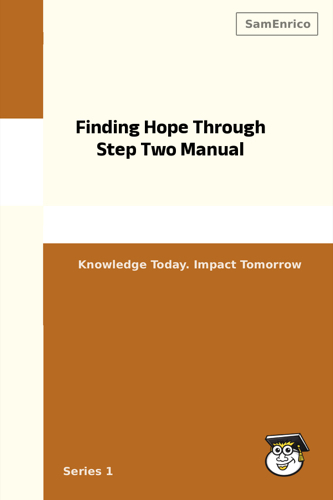
Finding Hope Through Step Two Manual eBook
Explore the concept of a higher power in twelve st
Explore the concept of a higher power in twelve step programs using this nonsectarian workbook for seekers.
Formats
Free sample
Chapter 1: Turning The Handle...–- The first time someone told me to “just use a doorknob as your Higher Power,” I nearly walked out of the meeting and never came back. I was three days sober, shaking, furious, and desperate enough to try anything—but not that. Not a piece of cold, brass hardware bolted to a wooden door. The suggestion felt like an insult wrapped in a platitude, delivered by people who had clearly never spent a sleepless night arguing with the ceiling about whether there was anything, anywhere, that gave a damn whether I lived or died. A doorknob doesn't care.
A doorknob has never answered a prayer, interrupted a craving, or pulled anyone out of a bottom. And yet, here it was, offered as the secret key to the second of Twelve Steps that had already begun to feel like a door slammed in my face.But here is what I did not understand then, and what I have come to see after fifteen years of working with skeptics, agnostics, and the religiously traumatized: the doorknob was never supposed to be the Higher Power. The person who gave me that advice had explained it badly. What they were reaching for was the idea that the action of turning a handle—the willingness to reach, to connect, to open—is itself a power greater than the isolated, addicted self. The doorknob is not the point.
The turning is the point. The reaching is the point. The willingness to believe that there might be something on the other side of the door—that is the point.This chapter is not about defending the doorknob as a deity. It is about understanding why that suggestion fails for so many intelligent, skeptical, traumatized, and thoughtful seekers—and what to do instead. It is about reclaiming the wisdom buried inside the bad advice, discarding the absurdity, and arriving at a functional, honest, nonsectarian understanding of what Step Two actually asks of you.
Because the truth is, you have been using powers greater than yourself your entire life. You just have not called them that. And once you see that, the door begins to open.Why the Doorknob Advice Hurts More Than It Helps Let me be direct: the doorknob suggestion, as it is usually given in Twelve Step meetings, is bad advice. It is well-intentioned, but it is bad. And it is important to name that clearly before we try to salvage anything from it.The suggestion fails for three specific reasons that matter deeply to the kind of person who picks up a book like this.First, a doorknob has no agency.
Agency is the capacity to act independently, to make choices, to respond to circumstances. A doorknob cannot decide to help you. It cannot hear you. It cannot change its behavior based on your needs. If you are in the grip of a craving that feels like a tidal wave, calling out to a doorknob is like shouting at a rock.
The rock does not care. The rock cannot care. And pretending otherwise feels like gaslighting yourself. The addicted mind already lives in a fog of self-deception; adding a new layer of absurdity is not recovery. It is confusion.Second, a doorknob has no wisdom.
The Twelve Steps do not just ask you to believe that something exists; they ask you to believe that something can restore you to sanity. Restoration implies intelligence, pattern recognition, the ability to distinguish helpful from harmful. A doorknob cannot teach you anything. It cannot guide you. It cannot offer perspective when your own perspective has collapsed into the narrow tunnel of “I need a drink right now.” You cannot ask a doorknob, “What should I do when my boss yells at me?” and receive anything useful.
Wisdom requires experience, memory, and the capacity to synthesize. A doorknob has none of these.Third, a doorknob has no capacity to produce lasting change. If you pray to a doorknob for sobriety, nothing happens. If you turn a doorknob, a door opens—but that is mechanics, not transformation. Step Two is not about mechanics.
It is not about learning how to operate hardware. It is about a fundamental reorganization of how you relate to your own thoughts, cravings, and behaviors. A doorknob cannot do that work. It cannot accompany you through the difficult hours. It cannot hold you accountable.
It cannot offer comfort when the shame rolls in.The doorknob suggestion fails because it confuses a symbol with a source. It takes a metaphor for connection and literalizes it into absurdity. And for the seeker who has already been burned by literalism—by Bible-thumping certainty, by religious dogma that demanded swallowing absurdity whole—the doorknob feels like more of the same. Just another demand to pretend. Just another reason to walk out and never come back.But here is what the person who gave you that advice was trying to say.
They were trying to say that you do not need to have the right theology. They were trying to say that the specifics of your Higher Power matter less than your willingness to reach for something outside yourself. They were trying to lower the barrier to entry. And they fumbled it. Badly.
The rest of this chapter is going to give you the language and the concepts that person lacked. We are going to build a framework that honors your intelligence, respects your skepticism, and still opens the door to recovery.The Real Question: What Is a Higher Power, Anyway?Before we can fix the doorknob problem, we have to ask a more fundamental question. What does Step Two actually mean when it says “a Power greater than ourselves”?Let us look at the text. The full wording of Step Two, as it appears in Twelve Step literature, is: “Came to believe that a Power greater than ourselves could restore us to sanity.”Notice what it does not say. It does not say “God.” It does not say “deity.” It does not say “supreme being.” It does not say “theistic entity.” It does not say “all-powerful.” It does not say “all-knowing.” It does not say “loving” or “personal” or “responsive to prayer.” The language is deliberately open-ended.
The writers of the Twelve Steps, coming out of the Oxford Group in the 1930s, had their own theistic assumptions. But they chose words that could accommodate a wide range of interpretations. They built a door, not a cage.Let us break it down word by word.“Power.” A power is simply something that can cause an effect. Electricity is a power. Gravity is a power.
The collective will of a group is a power. The force of a habit is a power. The word does not require consciousness, personality, or divinity. It only requires the capacity to produce a result.“Greater than ourselves.” Greater does not mean better in a moral sense. It does not mean holier.
It means exceeding the capacity of your individual will, operating at a scale or intensity that you cannot match alone. A single person cannot stop a hurricane. A single person cannot overturn a law. A single person, trapped in addiction, cannot…
This is the end of the free sample. Get the eBook to keep going. Buy now
About this book
Details
- Author
- Joyner Scottie
- Publisher
- SamEnrico
- Language
- English
- Genre
- Non-Fiction, Self-Help, Spiritual Recovery
- Released
- 2026-06-06
- Pages (approx.)
- 160
- Available as
- eBook, Audiobook

Read better in the ZLOADR app
Your eBooks on your phone or tablet. Sign in with your SamEnrico account and start reading.
More by Joyner Scottie
 Personal Ing For Success Career PivotJoyner Scottie$11.99
 Intuitive Eating Body Trust WorkbookJoyner Scottie$11.99
 The Startup Visa Talent FlowJoyner Scottie$11.99
 Opioid Constipation ReliefJoyner Scottie$11.99Opioid Constipation ReliefJoyner Scottie$11.99
 The Last Witness of the Trial of the CenturyJoyner Scottie$11.99
 The Last Broadcast: The 1938 War of the Worlds PanicJoyner Scottie$11.99
 Understanding Bhaskar Jagannathan SyndromeJoyner Scottie$17.99
 Manufacturing Cost Accounting AIJoyner Scottie$12.99
 Nevada LLC for Asset ProtectionJoyner Scottie$12.99
 Product Manufacturing EngineerJoyner Scottie$11.99
 How to Start a Sales Financing BusinessJoyner Scottie$11.99
You may also like
 Hong Kong Handover 1997Dunn Johnnie$11.99
 Zumba For Postnatal Recovery CourseNeal Christian$11.99
 Zumba for BeginnersLadner Nikia$11.99
 YouTube Comment Mining GuideHumes Pandora$12.99
 Worry Box MeditationCarlin Rudy$11.99
 Workplace Stress MeditationNguyen Lynn$11.99
 Workplace Stress and Sleep RepairHawley Ivory$11.99
 Workplace Perfectionism CureDelaney Jeffry$11.99
 Workplace Injustice Anger GuideWallen Isabelle$11.99
 Work Addiction and Burnout LinkGreenwood Ester$11.99
 Women in Yoga and WellnessBeattie Galina$11.99
 Women in Stand Up ComedyChun Evangeline$11.99