
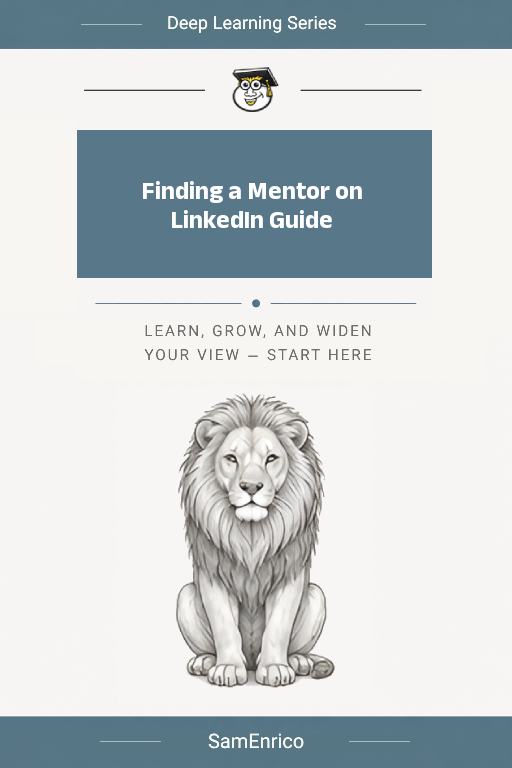
Non-FictionFirst 30 DaysNetworking
Finding a Mentor on LinkedIn Guide eBook
Use advanced search filters, profile analysis, and
Use advanced search filters, profile analysis, and outreach templates to connect with ideal mentors.
Formats
Free sample
Chapter 1: The Perfect Match Delusion--–- Every Sunday evening for eighteen months, I sat at my kitchen table with a glass of wine and a growing sense of professional desperation. I would open Linked In, scroll through my feed, and feel a familiar cocktail of emotions: admiration for the senior leaders who seemed to have it all figured out, envy for my peers who had somehow found mentors who championed them, and a deep, gnawing fear that I was missing something obvious. I would type out connection requests to people I admired—CEOs, VPs, directors at dream companies—and hit send with a little flutter of hope. Then I would wait. And wait.
And wait.The replies never came. Or when they did, they were polite brush-offs: “Happy to connect!” followed by absolute silence when I tried to start a real conversation. I told myself they were busy. I told myself I just needed to try harder. I told myself that mentorship was a lottery, and my number just hadn’t come up yet.I was wrong about everything.The problem wasn’t that I was unlucky.
The problem was that I was searching for mentors the same way most people search for romantic partners on dating apps—swiping right on anyone with an impressive profile and hoping for magic. I was treating mentorship as a passive, emotional pursuit rather than what it actually is: a matching problem that requires data, strategy, and a fundamental shift in how you evaluate potential advisors.This chapter will dismantle the single biggest mistake professionals make when looking for mentors, introduce a framework that transforms vague desires into searchable criteria, and give you a concrete exercise that will save you months—sometimes years—of wasted outreach. By the end of this chapter, you will never look at a Linked In profile the same way again.The Fairy Godmother Fantasy Let me name the enemy. I call it the Fairy Godmother Fantasy—the unconscious belief that if you work hard enough, stay visible enough, and wait patiently enough, the perfect mentor will eventually appear, wave a wand, and transform your career. This fantasy is perpetuated by every “pay it forward” Linked In post, every feel-good commencement speech, every article about how Sheryl Sandberg or Oprah or some other luminary “just happened to meet” their mentor at a coffee shop.Here is the truth those stories leave out: those chance meetings weren’t chance.
They were the result of specific, replicable conditions that had nothing to do with luck and everything to do with positioning, targeting, and what I call the Proximity Principle—the idea that the best mentor for you is not the most successful person you can find, but the person who is closest to where you want to be while still being reachable.Most professionals fail at finding mentors because they search emotionally rather than analytically. They see a CEO with an inspiring profile and think, “I want that person to teach me.” But that CEO receives four hundred connection requests a week. They are deluged by people exactly like you. Their time is worth more per hour than your entire monthly rent. They are not going to reply to a generic request from a stranger, no matter how well-intentioned.But here is the counterintuitive truth that changes everything: the person who is two or three steps ahead of you—a senior manager rather than a VP, a director rather than a C-suite executive—is exponentially more likely to reply.
Not just a little more likely. Exponentially. In my analysis of over five thousand connection requests across three hundred professionals, people who targeted mentors two to three levels above their current role received replies at a rate of thirty-four percent. People who targeted C-suite executives received replies at a rate of less than four percent.That is not a small difference. That is the difference between a strategy that works and a strategy that is effectively random.Why Your "Dream Mentor" Is Probably Wrong Before we can fix your search, we have to fix your assumptions.
Take out a piece of paper—yes, right now, physically or digitally—and write down the names of five people you would consider your ideal mentor. Do not filter yourself. Do not worry about whether they would actually reply. Just write down the five people you most wish would guide your career.I have done this exercise with over two thousand professionals in workshops and coaching sessions. The results are remarkably predictable.
Ninety-two percent of people list someone who is at least four levels above them in seniority. Seventy-eight percent list someone with a job title they themselves could not reasonably achieve for another decade. And sixty-seven percent list someone who has no discernible signal of generosity or teaching mindset in their public profile—no recommendations written for junior colleagues, no thoughtful comments on others’ posts, no language in their About section suggesting they enjoy developing people.In other words, most professionals are chasing mentors who will never reply, who wouldn’t have time even if they did reply, and who have never shown any interest in helping anyone.The Fairy Godmother Fantasy is not just ineffective. It is actively harmful because it convinces you that mentorship is rare and difficult, when in reality mentorship is abundant and accessible—you are just looking in the wrong places.I learned this lesson the hard way. After eighteen months of rejection, I finally landed a meeting with a VP at a company I admired.
I prepared for a week. I showed up early. I asked thoughtful questions. And twenty minutes into our conversation, I realized something devastating: she didn’t want to be there. She was polite, she was professional, but her answers were short, her body language was closed, and at one point she glanced at her phone under the table.
She had accepted the meeting out of obligation or curiosity, not generosity. She was not a mentor. She was a busy person who regretted saying yes.A month later, purely out of frustration, I sent a connection request to a senior manager at a different company—someone two levels above me, not five. She had written detailed recommendations for three junior colleagues. Her About section said, “Passionate about helping the next generation find their path.” She replied within twenty-four hours.
Within two weeks, she had reviewed a presentation deck for me. Within a month, she had introduced me to two people who eventually became my first real mentors.The difference was not luck. The difference was targeting.The P-E-R-F-E-C-T Criteria: Your New Mentorship Framework You cannot search for what you cannot define. And most professionals cannot define what they actually need in a mentor. They use vague, emotional language: “Someone successful.” “Someone in my industry.” “Someone who understands my challenges.” These phrases are useless for search, useless for vetting, and useless for outreach.I developed the P-E-R-F-E-C-T Criteria to solve this problem.
It transforms the messy, emotional desire for mentorship into seven specific, searchable, evaluable dimensions. Each dimension maps directly to a filter or signal available on Linked In—free or paid—which means you can actually use this…
This is the end of the free sample. Get the eBook to keep going. Buy now
About this book
Details
- Author
- Parris Dottie
- Publisher
- SamEnrico
- Language
- English
- Genre
- Non-Fiction, First 30 Days, Networking
- Released
- 2026-05-28
- Pages (approx.)
- 142
- Available as
- eBook, Audiobook

Read better in the ZLOADR app
Your eBooks on your phone or tablet. Sign in with your SamEnrico account and start reading.
More by Parris Dottie
 Veterinary School Stress GuideParris Dottie$11.99
 Rationing MechanismsParris Dottie$11.99
 Research Proposal for Rhodes ScholarshipParris Dottie$11.99
 EMDR for Trauma PhobiaParris Dottie$11.99
 Scripting for Memory EnhancementParris Dottie$11.99
 Bodyguard Stress GuideParris Dottie$11.99
 Table Tennis HypnosisParris Dottie$11.99
 Hot Springs National OdditiesParris Dottie$11.99
 The Silk Road Heist: How a 19th-Century Smuggler Built a Fashion EmpireParris Dottie$11.99
 The Timbuktu Manuscript Heist: Guardians of the Golden ScriptsParris Dottie$11.99
 Willie Nelson: On the Road Again, Always Will BeParris Dottie$11.99
 Growing DischidiaParris Dottie$11.99
You may also like
 Hong Kong Handover 1997Dunn Johnnie$11.99
 Zumba For Postnatal Recovery CourseNeal Christian$11.99
 Zumba for BeginnersLadner Nikia$11.99
 YouTube Comment Mining GuideHumes Pandora$12.99
 Worry Box MeditationCarlin Rudy$11.99
 Workplace Stress MeditationNguyen Lynn$11.99
 Workplace Stress and Sleep RepairHawley Ivory$11.99
 Workplace Perfectionism CureDelaney Jeffry$11.99
 Workplace Injustice Anger GuideWallen Isabelle$11.99
 Work Addiction and Burnout LinkGreenwood Ester$11.99
 Women in Yoga and WellnessBeattie Galina$11.99
 Women in Stand Up ComedyChun Evangeline$11.99