
Non-FictionAnnual CheckupDatabase AccessPrivacy
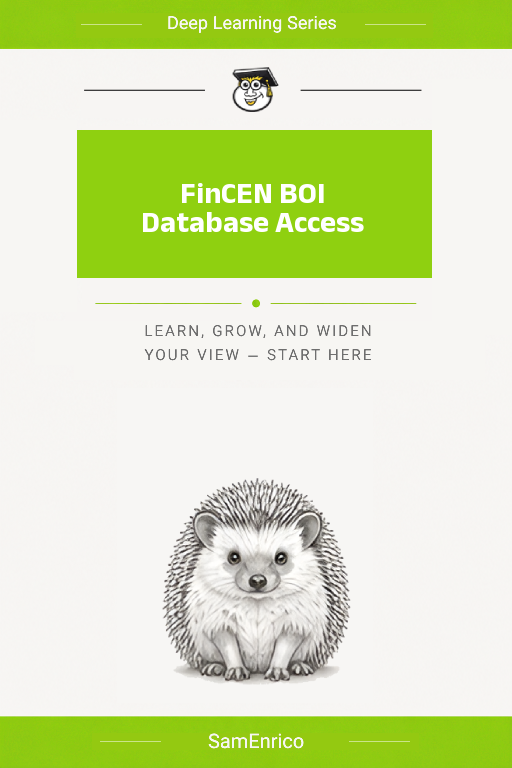
FinCEN BOI Database Access Audiobook
Understand who can access FinCEN beneficial owners
Understand who can access FinCEN beneficial ownership database including law enforcement and financial institutions.
Formats
Free sample
Chapter 1: The Transparency Mandate...–- On a freezing morning in February 2019, a federal prosecutor in Manhattan made a discovery that would eventually help rewrite American corporate law. She was reviewing bank records linked to a suspected money laundering network operating through a dozen limited liability companies, all registered in Delaware. Each LLC had a different name, a different registered agent, and what appeared to be different owners. But the money flowing through their accounts told a different story. It converged, again and again, into a single account controlled by a foreign national who had been denied entry to the United States three years earlier on suspicion of organized crime ties.
The prosecutor knew, with the certainty that comes from following money long enough, that one person owned all twelve companies. She could prove it with bank records, with email traffic, with surveillance. But she could not prove it quickly. To identify the actual human being behind each LLC, she would have to subpoena each company's formation documents from Delaware, then trace each to its nominee director, then subpoena bank records linking the nominee to the beneficial owner. That process would take months.
The money would be gone in days.That prosecutor's frustration was not unique. It was repeated thousands of times each year across every federal, state, and local law enforcement agency in the United States. The problem had a name, though no single agency had created it. The problem was the American shell company, and for nearly a century, it had been the preferred vehicle for everyone from tax evaders to terrorists to oligarchs seeking to park wealth beyond the reach of creditors, ex-spouses, or prosecutors.The Problem That Required a New Database Before understanding who may access the Fin CEN Beneficial Ownership Information database, one must first understand why the database exists at all. The Corporate Transparency Act, enacted on January 1, 2021, as part of the National Defense Authorization Act, represented the single most significant change to American anti-money laundering law since the USA PATRIOT Act of 2001.
But unlike the PATRIOT Act, which focused primarily on financial institutions as gatekeepers, the CTA focused on the point of creation: the formation of legal entities themselves.The core problem the CTA sought to solve was stunning in its simplicity and devastating in its consequences. Prior to the CTA, there was no federal requirement for any corporation, LLC, or similar entity to disclose…
This is the end of the free sample. Get the Audiobook to keep going. Buy now
About this book
Details
- Author
- Starnes Trinh
- Publisher
- SamEnrico
- Language
- English
- Genre
- Non-Fiction, Annual Checkup, Database Access, Privacy
- Released
- 2026-05-30
- Pages (approx.)
- 159
- Available as
- eBook, Audiobook

Listen in the VoxFlicks app
Audiobooks and audio dramas wherever you go. Sign in with your SamEnrico account and press play.
More by Starnes Trinh
 Energy Insurance Agency DatabaseStarnes Trinh$11.99
 Beginner Fitness Goal SettingStarnes Trinh$11.99
 Success Without Exhaustion ManualStarnes Trinh$11.99
 Loneliness and the Working ParentStarnes Trinh$11.99
 Retirement Storage Cost AnalysisStarnes Trinh$11.99
 The Lost Ship of the Azores: A Castaway’s Miracle in the Age of DiscoveryStarnes Trinh$11.99
 The Silk Code: How a Secret Network of Female Entrepreneurs Built a Global EmpireStarnes Trinh$11.99
 Video GamingStarnes Trinh$11.99
 Artificial Intelligence CertsStarnes Trinh$12.99
 Understanding Dextrocardia With Situs InversusStarnes Trinh$17.99
 How to Become a Charge Preparation TechnicianStarnes Trinh$11.99
You may also like
 Hong Kong Handover 1997Dunn Johnnie$11.99
 Zumba For Postnatal Recovery CourseNeal Christian$11.99
 Zumba for BeginnersLadner Nikia$11.99
 YouTube Comment Mining GuideHumes Pandora$12.99
 Worry Box MeditationCarlin Rudy$11.99
 Workplace Stress MeditationNguyen Lynn$11.99
 Workplace Stress and Sleep RepairHawley Ivory$11.99
 Workplace Perfectionism CureDelaney Jeffry$11.99
 Workplace Injustice Anger GuideWallen Isabelle$11.99
 Work Addiction and Burnout LinkGreenwood Ester$11.99
 Women in Yoga and WellnessBeattie Galina$11.99
 Women in Stand Up ComedyChun Evangeline$11.99