
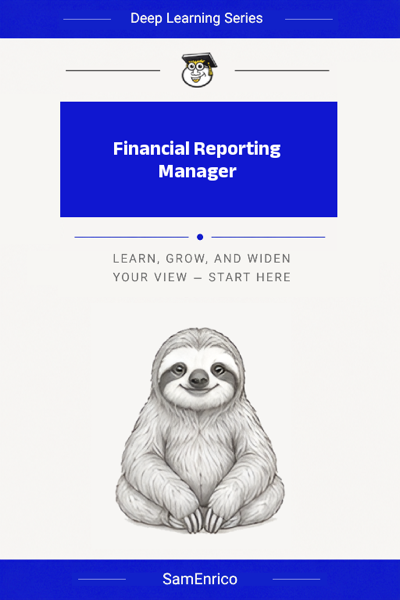
Non-FictionInformativeEducational
Financial Reporting Manager eBook
A Coursebook on Financial Reporting Manager
by Doe Adriene
A Coursebook on Financial Reporting Manager
Formats
Free sample
Chapter 1: Beyond the Ledger--The email arrived at 4:47 PM on a Friday. Subject line: “Earnings are off by $8 million. Fix it by Monday.”For Sarah Chen, a Financial Reporting Manager at a mid-sized public company, that moment became the dividing line in her career. On one side was the person she had been—a meticulous, technically excellent accountant who prided herself on error-free reconciliations and on-time filings. On the other side was the person she was about to become: a strategic leader who understood that financial reporting was not about getting the numbers right.
It was about protecting the company from bad decisions,丑陋 truths, and career-ending surprises.Sarah had done everything by the book. She had closed the books on schedule, reviewed every journal entry over 50,000,andconfirmedthatallintercompanyaccountsbalanced.Herteamhadworkedsixty−hourweekstodeliveraclean,audit−readytrialbalance.Andyet,hereitwas:amysterious50,000, and confirmed that all intercompany accounts balanced. Her team had worked sixty-hour weeks to deliver a clean, audit-ready trial balance. And yet, here it was: a mysterious 50,000,andconfirmedthatallintercompanyaccountsbalanced.Herteamhadworkedsixty−hourweekstodeliveraclean,audit−readytrialbalance.Andyet,hereitwas:amysterious8 million gap between the preliminary income statement and what the sales team had told investor relations to expect. The CFO was already on a plane to a conference.
The CEO was hosting a dinner for analysts. And Sarah was staring at a spreadsheet that refused to balance.Over the next seventy-two hours, Sarah would learn something that no textbook had ever taught her. She would discover that the role of a Financial Reporting Manager had almost nothing to do with debits and credits and everything to do with people, processes, and the courage to ask the right questions before it was too late.This chapter is about that discovery. It is about the evolution of a role that has been misunderstood for a century, the strategic importance of financial reporting in modern organizations, and the framework that will guide you through the rest of this book. By the time you finish reading, you will never think of yourself as “just the accounting person” again.The Death of the Bookkeeper Let us begin with an uncomfortable truth.
For most of corporate history, the person responsible for financial reporting was valued for exactly three things: speed, accuracy, and obedience. They were expected to close the books quickly, report numbers that agreed with the general ledger, and never challenge the decisions of senior leadership. In short, they were expected to be excellent scorekeepers.That world is gone.It began to disappear in the early 2000s, when scandals at Enron, World Com, and Tyco revealed that scorekeeping alone could not protect investors or companies. The Sarbanes-Oxley Act of 2002 demanded that financial reporting managers become guardians of internal controls, certifying under penalty of criminal law that their numbers could be trusted. Then came the 2008 financial crisis, which exposed how little even sophisticated investors understood about the quality of earnings behind the reported numbers.
More recently, the rise of environmental, social, and governance (ESG) reporting has demanded that financial reporting managers become experts in carbon emissions, diversity metrics, and supply chain ethics—topics that no accounting textbook covered a decade ago.The result is a role that has been completely transformed. Today’s Financial Reporting Manager is expected to be:A strategic partner who helps leadership understand the operational drivers of financial performance A data analyst who can spot anomalies, predict trends, and communicate insights to non-financial stakeholders A control expert who designs processes that prevent fraud while enabling efficient operations A cross-functional leader who works effectively with FP&A, Treasury, Tax, Operations, and Investor Relations An ethical compass who knows when to say no and how to say it without getting fired If this sounds like a lot, that is because it is. And yet, most companies still train their Financial Reporting Managers as if the world had not changed since 1995. Technical accounting skills remain necessary, but they are no longer sufficient. The managers who thrive are those who understand something deeper: that every number in a financial statement tells a story about decisions made, risks taken, and trade-offs accepted somewhere in the organization.The Great Misunderstanding: Why Most Executives Don’t Understand Reporting Here is a second uncomfortable truth.
Most executives outside of finance do not understand what you do. Worse, many of them do not want to understand.The CEO sees financial reporting as a compliance exercise—something the company must do to satisfy auditors and regulators. The head of sales sees it as an obstacle, a series of inconvenient rules that prevent him from recognizing revenue when he feels it has been “earned.” The head of operations sees the month-end close as a black hole where good operational data goes to die, re-emerging weeks later in a format no one can use. And the board of directors? They see whatever the CFO wants them to see.This misunderstanding is not accidental.
It is the predictable result of a profession that has historically communicated poorly, prioritized technical precision over business relevance, and positioned itself as a necessary evil rather than a strategic asset.Consider the language we use. “Deferred revenue,” “amortization of intangibles,” “allowance for doubtful accounts,” “accumulated other comprehensive income”—these terms are precise, legally defensible, and completely opaque to anyone who did not spend three years studying for the CPA exam. When a Financial Reporting Manager explains that “the variance in gross margin is driven by an unfavorable mix shift and a $2 million reserve adjustment,” the head of sales hears “blah blah blah sales is to blame.” The head of operations hears “blah blah blah the numbers are wrong.” And the CEO hears “blah blah blah we have a problem but I don’t know what it is.”The result is a profession that is simultaneously indispensable and ignored. Companies cannot function without financial reporting. And yet, the people who do it are rarely invited to strategy meetings, rarely consulted on major decisions, and rarely promoted beyond the controller’s office.This book is designed to change that.
It begins with a promise: by the time you finish these twelve chapters, you will have the tools not only to prepare accurate financial reports but to use them as leverage for strategic influence. You will learn to speak the language of business, not just the language of accounting. And you will understand something that Sarah Chen discovered during her $8 million weekend: that the most important skill of a Financial Reporting Manager is not technical mastery but the ability to ask the right questions before the numbers become final.The Three Pillars of the Modern Financial Reporting Manager Throughout this book, we will organize our learning around three interconnected pillars. Every chapter, every tool, and every case study will trace back to one of these three domains. Together, they form the complete skill set of the modern Financial Reporting Manager.Pillar One: Technical Stewardship This is the foundation.
Without accurate, compliant financial data, nothing else matters. Technical stewardship includes:Mastery of the accounting cycle and the “Big Three” financial statements (covered in Chapter 2)Understanding of GAAP vs. IFRS and the regulatory environment (this chapter)Variance analysis and ratio interpretation (Chapter 3)Quality of earnings assessment and cash flow management (Chapter 4)Internal controls and SOX compliance (Chapter 9)Tax and…
This is the end of the free sample. Get the eBook to keep going. Buy now
About this book
Details
- Author
- Doe Adriene
- Publisher
- SamEnrico
- Language
- English
- Genre
- Non-Fiction, Informative, Educational
- Released
- 2026-05-06
- Pages (approx.)
- 147
- Available as
- eBook, Audiobook

Read better in the ZLOADR app
Your eBooks on your phone or tablet. Sign in with your SamEnrico account and start reading.
More by Doe Adriene
 Family Conflict De escalation HandbookDoe Adriene$11.99
 Startup Founder PrioritizationDoe Adriene$11.99
 Parental Anger And Screen TimeDoe Adriene$11.99
 Self Hypnosis Phone Addiction GuideDoe Adriene$11.99
 Franchising Your Local Brand Across Borders Transfer Pricing DocumentationDoe Adriene$11.99
 The Storm Chasers of the Ice Age: Tracking the Arctic's Ancient RageDoe Adriene$11.99
 Echoes of the Deep: The Titanic’s Final WhispersDoe Adriene$11.99
 State Annual Report FilingDoe Adriene$12.99
 Community Live Events GuideDoe Adriene$12.99
 Understanding Deafness Congenital Onychodystrophy RecessiveDoe Adriene$17.99
 How to Become a Diesel-plant OperatorDoe Adriene$11.99
You may also like
 Hong Kong Handover 1997Dunn Johnnie$11.99
 Zumba For Postnatal Recovery CourseNeal Christian$11.99
 Zumba for BeginnersLadner Nikia$11.99
 YouTube Comment Mining GuideHumes Pandora$12.99
 Worry Box MeditationCarlin Rudy$11.99
 Workplace Stress MeditationNguyen Lynn$11.99
 Workplace Stress and Sleep RepairHawley Ivory$11.99
 Workplace Perfectionism CureDelaney Jeffry$11.99
 Workplace Injustice Anger GuideWallen Isabelle$11.99
 Work Addiction and Burnout LinkGreenwood Ester$11.99
 Women in Yoga and WellnessBeattie Galina$11.99
 Women in Stand Up ComedyChun Evangeline$11.99