
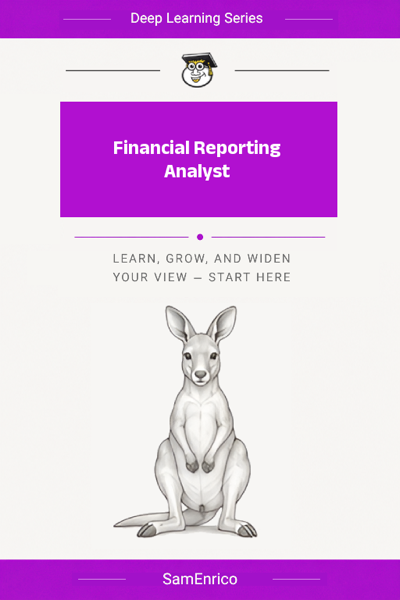
Non-FictionInformativeEducational
Financial Reporting Analyst eBook
A Coursebook on Financial Reporting Analyst
A Coursebook on Financial Reporting Analyst
Formats
Free sample
Chapter 1: The Scoreboard Lies...--Every investor, analyst, and board member has stared at a set of financial statements and assumed they were looking at reality. They were not. They were looking at a carefully constructed narrative—one shaped by bonus targets, debt covenants, and the inherent ambiguities of accounting rules. This chapter does not teach you how to read financial statements. It teaches you why the people who write them have incentives to make them say something other than the truth—and how you can protect yourself by understanding those incentives before you analyze a single number.I learned this lesson the hard way early in my career.
I was a junior analyst covering a mid-sized manufacturing company that had reported fourteen consecutive quarters of earnings growth. The numbers were beautiful. The return on equity was consistently above eighteen percent. The gross margins were stable. The stock had tripled in three years.
I wrote a buy recommendation. Three months later, the company restated five years of financials, the CEO resigned, and the stock lost eighty percent of its value. What did I miss? I missed the incentives. I assumed the numbers were neutral.
They never are.The fundamental argument of this chapter—and indeed of this entire book—is that financial reporting is not a neutral reflection of economic activity. It is a strategic communication tool, shaped by the people who control it, responding to the incentives they face. Once you understand those incentives, you will never look at a balance sheet the same way again. You will stop asking "What do the numbers say?" and start asking "What do the people behind the numbers want me to believe?"The Two Information Problems That Created Financial Reporting To understand why financial reporting exists in its current form, we must first understand two fundamental problems that arise whenever one person entrusts money to another. These problems are not accounting problems.
They are human problems that accounting was designed to solve—imperfectly.Adverse Selection: The Problem of Hidden Information Imagine you are considering buying a used car. The seller knows everything about that car: the engine trouble last winter, the flood damage from two years ago, the strange noise that starts at sixty miles per hour. You know almost nothing. The seller has an incentive to tell you the car is in excellent condition, because they want the highest possible price. You, knowing this, will offer less than you would if you had perfect information.
In extreme cases, the market can break down entirely—a phenomenon economists call the "lemons problem."The same dynamic exists in financial markets. Corporate managers know more about their company's prospects, risks, and true financial condition than outside investors do. This information asymmetry creates adverse selection: investors cannot distinguish between a well-managed company with bright prospects and a poorly managed company hiding problems. As a result, investors discount the price they are willing to pay for any company, because they assume the worst. Well-managed companies become undervalued.
Capital becomes more expensive for everyone.Financial reporting is the primary solution to adverse selection. By mandating regular, standardized disclosures, regulators force managers to reveal information they would otherwise keep private. When a company publishes its financial statements, it is voluntarily—or involuntarily—reducing the information gap. The balance sheet tells you what the company owns and owes. The income statement tells you how profitable it was.
The cash flow statement tells you whether those profits turned into cash.But here is the critical insight: managers still control the timing and presentation of that information. They choose which accounting methods to use. They make estimates about bad debts, useful lives, and pension returns. They decide when to recognize revenue and when to impair assets. Adverse selection is reduced, but it is never eliminated.
The analyst's job is to understand where discretion remains and to look for signs that managers are using that discretion to hide adverse information.Moral Hazard: The Problem of Hidden Action The second problem is moral hazard. Once you have given money to a manager—whether as an equity investor or a lender—you cannot watch everything they do. The manager might take excessive risks, knowing that they will share in the upside but that you will bear most of the downside. They might shirk their responsibilities, knowing that their compensation is guaranteed. They might transfer wealth to themselves through lavish perks, excessive salaries, or self-dealing transactions.Financial reporting is also the primary solution to moral hazard, but in a different way.
By tying managerial compensation to reported earnings—through bonus plans, stock options, and performance shares—boards of directors create an incentive for managers to maximize reported profits. In theory, this aligns the interests of managers and shareholders. In practice, it creates a powerful motivation for earnings management.Consider a typical executive bonus plan. The CEO receives a bonus if reported earnings per share (EPS) exceed a target, often with a cap beyond which no additional bonus is paid. This creates three distinct zones of behavior.
Below the minimum threshold, there is no bonus, so managers may take a "big bath"—recognizing all possible losses and expenses in a single year to clear the decks for future years. Above the cap, there is no additional bonus, so managers may "smooth" earnings by deferring revenue or accelerating expenses into a year where they have already exceeded the target. Between the threshold and the cap, managers have a powerful incentive to push earnings upward by any means available, including aggressive accounting choices.Debt covenants create similar incentives, but in the opposite direction. Most corporate debt agreements require the borrower to maintain certain financial ratios: a minimum interest coverage ratio, a maximum debt-to-equity ratio, a minimum current ratio. If the borrower violates a covenant, the lender can demand immediate repayment, raise the interest rate, or take control of the company.
This creates a powerful incentive to avoid covenant violations—even if that means manipulating the numbers. A company with a debt-to-equity covenant of 2.0 that is approaching 1.9 has every incentive to push debt off the balance sheet (through operating leases, securitizations, or special purpose entities) or to inflate equity (by overstating assets or understating liabilities).The analyst who ignores these incentives is like a doctor who ignores a patient's medical history. You cannot diagnose the numbers without understanding the pressures that shaped them.The Three Statements and How They Connect Before we dive deeper into incentives, we need a common language. This section provides a high-level tour of the three core financial statements. If you are already familiar with these basics, consider this a refresher.
If you are new to financial reporting, this will be your foundation.The Balance Sheet: The Scoreboard at a Moment in Time The balance sheet, also known as the statement of financial position, answers one question: what does the company own, and what does it owe, right now?The fundamental accounting equation is deceptively simple:Assets = Liabilities + Shareholders' Equity Assets are economic resources controlled by the company as a result of past events. They include cash, accounts receivable (money customers owe), inventory, property and equipment, intangible assets like patents and goodwill, and investments in other companies.Liabilities…
This is the end of the free sample. Get the eBook to keep going. Buy now
About this book
Details
- Author
- Mccullough Leann
- Publisher
- SamEnrico
- Language
- English
- Genre
- Non-Fiction, Informative, Educational
- Released
- 2026-06-02
- Pages (approx.)
- 157
- Available as
- eBook, Audiobook

Read better in the ZLOADR app
Your eBooks on your phone or tablet. Sign in with your SamEnrico account and start reading.
More by Mccullough Leann
 The Anger Time-Out ProtocolMccullough Leann$11.99
 Accountant Interruption ManualMccullough Leann$11.99
 Self Hypnosis Induction Techniques CourseMccullough Leann$11.99
 Language Acquisition ChunkingMccullough Leann$11.99
 Beginner Bodyweight WorkoutMccullough Leann$11.99
 The Phoenix Protocol: How a 19th-Century Fire Code Saved a CityMccullough Leann$11.99
 The Billion-Dollar Bubble: How a Math Genius and a Wall Street Whiz Kid Blew Up the WorldMccullough Leann$11.99
 Understanding Emphysema-penoscrotal Web-deafness-mental RetardationMccullough Leann$17.99
 Dangerous Goods LogisticsMccullough Leann$12.99
 Bookkeeping Automation GuideMccullough Leann$12.99
 How to Start a Process Pressure Sphere Business (Beginners Guide)Mccullough Leann$11.99
You may also like
 Hong Kong Handover 1997Dunn Johnnie$11.99
 Zumba For Postnatal Recovery CourseNeal Christian$11.99
 Zumba for BeginnersLadner Nikia$11.99
 YouTube Comment Mining GuideHumes Pandora$12.99
 Worry Box MeditationCarlin Rudy$11.99
 Workplace Stress MeditationNguyen Lynn$11.99
 Workplace Stress and Sleep RepairHawley Ivory$11.99
 Workplace Perfectionism CureDelaney Jeffry$11.99
 Workplace Injustice Anger GuideWallen Isabelle$11.99
 Work Addiction and Burnout LinkGreenwood Ester$11.99
 Women in Yoga and WellnessBeattie Galina$11.99
 Women in Stand Up ComedyChun Evangeline$11.99