
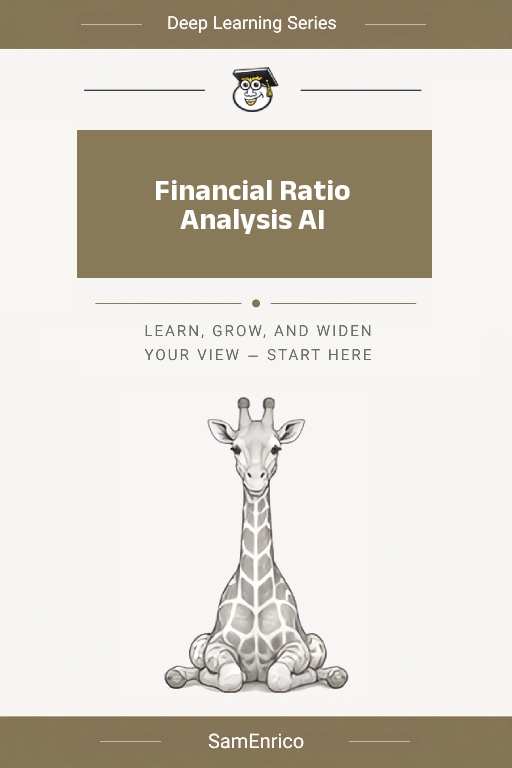
Non-FictionBusiness BriefFinancial Analysis
Financial Ratio Analysis AI
Calculate liquidity, profitability, and efficiency
Calculate liquidity, profitability, and efficiency ratios automatically from your statements. Compare against industry benchmarks and get AI-generated insights.
Formats
About this book
Free sample
Chapter 1: The Data Swamp-- The email arrived at 4:47 PM on a Friday. Sarah, a senior financial analyst at a mid-sized manufacturing firm, had been asked to deliver liquidity and efficiency ratios for the board meeting on Monday morning. She had three financial statements—a scanned PDF of the annual report, an export from the company's legacy ERP system with columns that didn't align, and a spreadsheet from the CFO with handwritten notes in the margins. Twelve hours later, at 4:47 AM on Saturday, she found the error: a transposed number in cell B47 had thrown off the entire current ratio calculation. She started over.This scenario plays out thousands of times every day in finance departments around the world.
The dirty secret of financial ratio analysis is that the calculation itself—the division of one number by another—takes less than a second. The other 99.9% of the time is spent on data collection, cleaning, and standardization. Spreadsheets were supposed to solve this problem. Instead, they became the problem: fragmented, error-prone, and impossible to scale.This chapter kills the spreadsheet pipeline for good. You will build an automated ingestion and standardization system that takes raw financial data from any source—PDFs, APIs, ERPs, scanned documents—and outputs a clean, comparable, auditable Golden Source.
By the end of this chapter, you will never manually copy a number from a PDF into a spreadsheet again.The Anatomy of the Data Wasteland Before you can automate anything, you must understand what you are up against. Financial data arrives in three primary forms, each with its own pathologies.The Scourge of the PDFMost financial statements are still distributed as PDFs—sometimes born-digital, sometimes scanned from paper. The problems are legion: tables that span multiple pages, negative numbers shown in parentheses or with a trailing minus sign, merged cells that break simple parsing, footnotes that contain important adjustments, and OCR errors that turn "1,000" into "1.000" or "O" into "0". A typical annual report might contain fifty pages of narrative before the financial statements appear, and the statements themselves might use different formatting across years.Consider a typical 10-K filing. Page…
This is the end of the free sample. Get the eBook to keep going. Buy now
Contents
- Chapter 1
- Chapter 2
- Chapter 3
- Chapter 4
- Chapter 5
- Chapter 6
- Chapter 7
- Chapter 8
- Chapter 9
- Chapter 10
- Chapter 11
- Chapter 12
Details
- Author
- Mclaurin Yong
- Publisher
- SamEnrico
- Language
- English
- Genre
- Non-Fiction, Business Brief, Financial Analysis
- Released
- 2026-06-01
- Pages (approx.)
- 129
- Available as
- eBook, Audiobook

Read better in the ZLOADR app
Your eBooks on your phone or tablet. Sign in with your SamEnrico account and start reading.
More by Mclaurin Yong
 The Endowment Effect in SalesMclaurin Yong$11.99
 Thyroid Mood Regulation GuideMclaurin Yong$11.99
 Female Monarch Succession PlanningMclaurin Yong$11.99
 Workplace Stress and HumorMclaurin Yong$11.99
 Max Reinhardt: The Magician of the Stage Who Conquered HollywoodMclaurin Yong$11.99
 How to Start a Picture Transmitter Business (Beginners Guide)Mclaurin Yong$11.99
 Branch Office AdministratorMclaurin Yong$11.99
 How to Produce Artificial Grass and Sports FlooringMclaurin Yong$11.99
You may also like
 Hong Kong Handover 1997Dunn Johnnie$11.99
 Zumba For Postnatal Recovery CourseNeal Christian$11.99
 Zumba for BeginnersLadner Nikia$11.99
 YouTube Comment Mining GuideHumes Pandora$12.99
 Worry Box MeditationCarlin Rudy$11.99
 Workplace Stress MeditationNguyen Lynn$11.99
 Workplace Stress and Sleep RepairHawley Ivory$11.99
 Workplace Perfectionism CureDelaney Jeffry$11.99
 Workplace Injustice Anger GuideWallen Isabelle$11.99
 Work Addiction and Burnout LinkGreenwood Ester$11.99
 Women in Yoga and WellnessBeattie Galina$11.99
 Women in Stand Up ComedyChun Evangeline$11.99