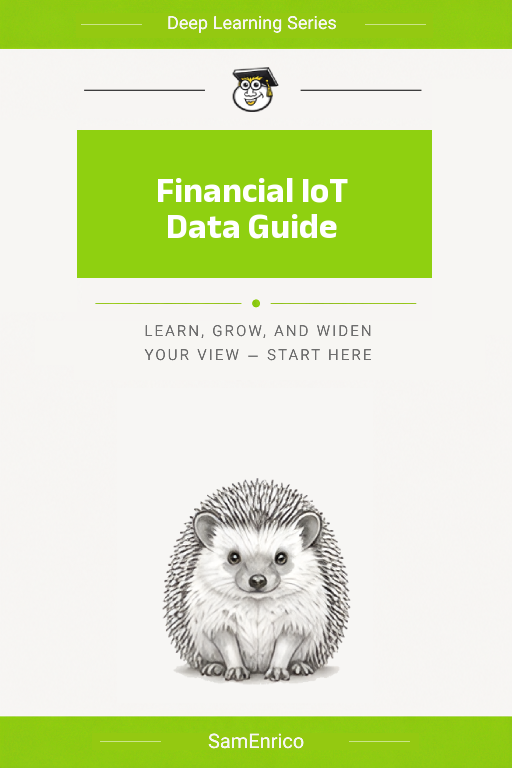
Financial IoT Data Guide Audiobook
Explore machine-generated data from connected cars
Explore machine-generated data from connected cars, smart homes, and wearables for usage-based insurance and lending.
Formats
Free sample
Chapter 1: The Quiet Collapse--–- On a humid Tuesday morning in July 2023, a forty-three-year-old delivery driver named Marcus pulled his aging sedan into a Progressive Insurance claims center in Columbus, Ohio. He had not been in an accident. He was not filing a claim. He was there to surrender his Snapshot device—the small telematics dongle that had been plugged into his OBD-II port for the previous eight months—because his premium had gone up seventeen dollars per month despite what he believed to be perfectly safe driving. The agent behind the counter pulled up his driving record on a tablet and showed him the data: three hard-braking events, one instance of aggressive acceleration, and a pattern of late-night driving between 11:00 PM and 1:00 AM on weekends.
Marcus protested. He braked hard because a deer had run across the road. He accelerated quickly because a merging semi-truck was about to sideswipe him. He drove late at night because he worked a second shift at a warehouse. The agent shrugged.
The algorithm, she said, did not care about context. Marcus left the device on the counter and walked out. He never enrolled in a telematics program again.That story, which I heard directly from a claims adjuster who witnessed it, captures something essential about the collision now underway between traditional finance and the Internet of Things. Marcus was not wrong to feel betrayed. The algorithm that judged him was not malicious.
The agent was not incompetent. The system simply reflected the assumptions of an earlier era: that driving behavior could be reduced to a handful of metrics, that those metrics could be scored without context, and that consumers would accept black-box decisions as long as they received a modest discount. Marcus walked away because the system asked for surveillance but offered neither explanation nor trust in return. His departure represents a warning. The financial Io T revolution will not fail because the technology is inadequate.
It will fail, or succeed, based entirely on whether insurers and lenders can solve the consent paradox that Marcus embodied: consumers want lower rates, but they refuse to be judged by machines they do not understand.This chapter lays the foundation for everything that follows. Before we can discuss connectivity protocols, underwriting algorithms, or parametric triggers, we must understand the fundamental shift that makes this book necessary. The traditional financial services industry—insurance, banking, lending—has operated for centuries on…
This is the end of the free sample. Get the Audiobook to keep going. Buy now
About this book
Details
- Author
- Gilson Marget
- Publisher
- SamEnrico
- Language
- English
- Genre
- Non-Fiction, Forecast & Outlook, IoT Finance
- Released
- 2026-05-30
- Pages (approx.)
- 149
- Available as
- eBook, Audiobook

Listen in the VoxFlicks app
Audiobooks and audio dramas wherever you go. Sign in with your SamEnrico account and press play.
More by Gilson Marget
 Momentum AR VR Brand ExposureGilson Marget$11.99
 AA For Atheists And AgnosticsGilson Marget$11.99
 From Employee to Franchise OwnerGilson Marget$11.99
 Time Blocking For Sales ProfessionalsGilson Marget$11.99
 The Great Escape: The Untold Story of the 1971 Andes Plane Crash SurvivorsGilson Marget$11.99
 Understanding Hyperphenylalaninemia Due to Pterin-4-alpha-carbinGilson Marget$17.99
 Catering ManagerGilson Marget$11.99
 NGO Grant Writing Career GuideGilson Marget$12.99
 How to Start a Casting of Iron Products (finished or Semi-finished) Business (Beginners Guide)Gilson Marget$11.99