
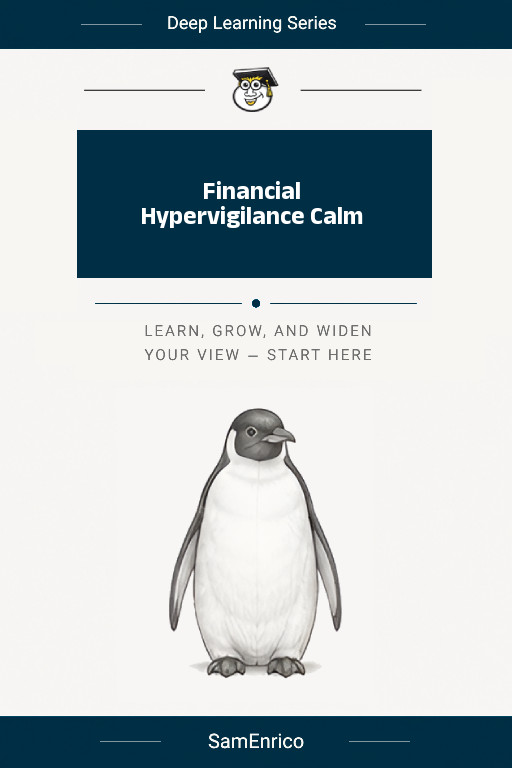
Non-FictionMental WealthHypervigilance
Financial Hypervigilance Calm eBook
Soothe constant money scanning from an unpredictab
Soothe constant money scanning from an unpredictable childhood using safety statements and system automation.
Formats
Free sample
Chapter 1: The Cracked Antenna...--–- The first time Sarah opened her banking app at a red light, she told herself it was efficiency. The second time, while waiting for her coffee, she called it awareness. By the tenth time—in the bathroom at her sister’s wedding, hiding in a stall with her phone brightness turned down—she stopped naming it altogether. She just did it. Checking her balance had become as automatic as breathing, and just as necessary for survival.
Or so her nervous system believed.This is not a book about budgeting. It is not about getting out of debt, investing in crypto, or retiring at forty-five. Thousands of books already cover those topics, and you have probably read several of them. They did not work—not because you are lazy or undisciplined, but because they were written for a different nervous system. They were written for people who check their accounts once a week and feel a mild, manageable curiosity.
They were not written for people who check their accounts three times before noon and feel a low hum of dread with every login.You are not bad with money. You are scared of money. And there is a profound difference.The Cracked Antenna: A Metaphor for Your Nervous System Imagine, for a moment, that your brain is equipped with a radar system. This radar’s sole job is to scan the environment for threats. When the radar is functioning normally, it beeps occasionally—when a car swerves into your lane, when a deadline approaches, when your rent is due.
You notice the beep, you address the threat, and the radar goes quiet.Now imagine that radar is cracked.It does not beep only when there is a real threat. It beeps constantly, frantically, at everything. A slightly lower balance than yesterday? BEEP. A bill you forgot to auto-pay?
BEEP. A friend mentioning they are struggling financially? BEEP. A news headline about inflation? BEEP BEEP BEEP.The cracked antenna does not distinguish between a wolf at the door and a shadow on the wall.
It only knows one instruction: scan, scan, scan, because safety is never guaranteed.This is financial hypervigilance. It is not a personality flaw, not a lack of willpower, and not something you can think your way out of. It is a neurobiological adaptation—your brain’s best attempt to keep you alive in an environment where money was unpredictable, inconsistent, or weaponized.The Childhood Training Ground If you are reading this book, there is a high probability that you grew up in a home where money did not behave reliably. Perhaps one parent lost jobs frequently. Perhaps there was addiction or gambling that siphoned funds unpredictably.
Perhaps your parents fought about money in ways that left you hiding in your room, trying to piece together whether the family was going to be okay. Perhaps you heard “we can’t afford it” for things you needed, followed by a surprise purchase for something no one needed at all.Your nervous system was watching. And it learned a specific, devastating lesson: safety requires constant vigilance.The author and trauma researcher Dr. Bessel van der Kolk wrote in The Body Keeps the Score that trauma is not the event itself—it is the body’s response to the event. For a child growing up with financial unpredictability, the trauma is not any single moment.
It is the cumulative, daily experience of not knowing whether there will be enough, whether the utilities will stay on, whether a parent’s mood will shift based on the balance of a checking account.Your nervous system learned to predict the unpredictable. It learned that the only way to avoid disaster was to watch, to check, to calculate, to stay one step ahead of the next financial ambush.Prudent Awareness vs. Hypervigilance: The Crucial Distinction Let us be extremely clear about something that will matter for every chapter that follows. There is a difference between prudent financial awareness and financial hypervigilance. They can look identical from the outside—both involve checking accounts, paying bills, and tracking spending.
But they are neurologically and emotionally opposite experiences.Prudent financial awareness sounds like this: “I check my accounts once a week on Sunday morning with my coffee. I feel curious and calm. If I see something unexpected, I note it and address it during business hours. The rest of the week, I do not think about money.”Financial hypervigilance sounds like this: “I check my accounts multiple times a day, often without realizing I am doing it. My chest tightens before I open the app.
I feel relief when I see the balance hasn’t dropped, but that relief lasts minutes. Then I check again. I cannot fall asleep before payday. I open my banking app in the middle of the night when I wake up anxious.”The distinction is not about frequency. Some people with hypervigilance check once a day but spend the other twenty-three hours catastrophizing.
Some people with prudent awareness check daily but do so without emotional activation. The difference is why you check and how you feel when you check.Prudent awareness asks, “What do I need to know?” Hypervigilance asks, “Am I safe yet?”—and the answer is always no, because the question itself assumes danger.The 23 Percent: You Are Not Alone If you have been carrying this alone, convinced that you are uniquely broken or unusually anxious, let the numbers reassure you. Research on financial trauma and money disorders suggests that approximately 23 percent of Americans exhibit symptoms consistent with financial PTSD, with hypervigilance being one of the most persistent and debilitating markers.Twenty-three percent is not a small minority. It is tens of millions of people. It is your neighbor, your coworker, your sister-in-law who seems to have everything together but confesses over wine that she cannot sleep three days before rent is due.
It is a quiet epidemic, made quieter by shame.Financial hypervigilance is rarely discussed in polite company. We talk about budgeting and investing and debt payoff—the mechanics of money. We do not talk about the way money makes us feel: the nausea before opening a bill, the compulsive checking, the secret belief that one wrong move will send us back to poverty. We do not talk about it because we think it is just us.It is not just you.The Physical Toll: Where Hypervigilance Lives in the Body Hypervigilance is not merely a thought pattern. It is a full-body experience.
The same nervous system that kept you scanning for danger as a child is still firing, still flooding your body with cortisol and adrenaline at the mere suggestion of financial threat.You may notice this in specific, recurring ways. Perhaps your jaw clenches when you swipe your card at the grocery store. Perhaps your shoulders rise toward your ears when you open your banking app. Perhaps your breath becomes shallow when you pay bills. Perhaps you have insomnia the night before payday, even though you know the money is coming.These are not random physical reactions.
They are the somatic signature of a nervous system that learned, long ago, that money equals survival and survival is…
This is the end of the free sample. Get the eBook to keep going. Buy now
About this book
Details
- Author
- Mccallister Machelle
- Publisher
- SamEnrico
- Language
- English
- Genre
- Non-Fiction, Mental Wealth, Hypervigilance
- Released
- 2026-05-30
- Pages (approx.)
- 114
- Available as
- eBook, Audiobook

Read better in the ZLOADR app
Your eBooks on your phone or tablet. Sign in with your SamEnrico account and start reading.
More by Mccallister Machelle
 Senior Identity Theft ProtectionMccallister Machelle$11.99
 Emotional Intelligence for Remote TeamsMccallister Machelle$11.99
 Sleep Hygiene for MenopauseMccallister Machelle$11.99
 Emergency Contraception GuideMccallister Machelle$11.99
 Shopping Addiction AffirmationsMccallister Machelle$11.99
 Shame and Addiction LinkMccallister Machelle$11.99
 Difficult Conversations about Pet EuthanasiaMccallister Machelle$11.99
 Self Hypnosis for TinnitusMccallister Machelle$11.99
 The Impossible Comeback: Eliud Kipchoge's Marathon MasteryMccallister Machelle$11.99
 The Amsterdam Art Heist: The Victim Who Outsmarted the ThievesMccallister Machelle$11.99
 How to Produce Peaches and NectarinesMccallister Machelle$11.99
 How to Produce Crib Conversion KitsMccallister Machelle$11.99
You may also like
 Hong Kong Handover 1997Dunn Johnnie$11.99
 Zumba For Postnatal Recovery CourseNeal Christian$11.99
 Zumba for BeginnersLadner Nikia$11.99
 YouTube Comment Mining GuideHumes Pandora$12.99
 Worry Box MeditationCarlin Rudy$11.99
 Workplace Stress MeditationNguyen Lynn$11.99
 Workplace Stress and Sleep RepairHawley Ivory$11.99
 Workplace Perfectionism CureDelaney Jeffry$11.99
 Workplace Injustice Anger GuideWallen Isabelle$11.99
 Work Addiction and Burnout LinkGreenwood Ester$11.99
 Women in Yoga and WellnessBeattie Galina$11.99
 Women in Stand Up ComedyChun Evangeline$11.99