
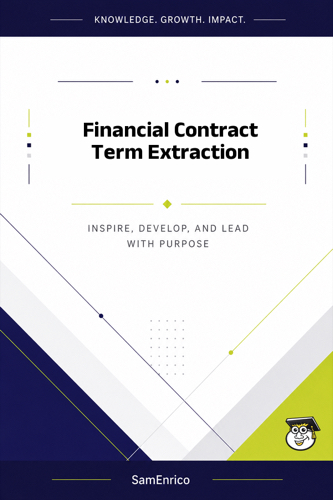
Non-FictionAI OperatorFinance Law
Financial Contract Term Extraction eBook
Automate abstraction of interest rates, default cl
Automate abstraction of interest rates, default clauses, and covenant terms from loan and credit agreements.
Formats
Free sample
Chapter 1: The $2M Typo--–- The email arrived at 11:47 PM on a Tuesday. Attached was a single PDF: a 412-page credit agreement for a middle-market leveraged loan. The associate who sent it had highlighted exactly one sentence on page 312, buried in the definitions section under "Applicable Margin." The highlighted text read: "…at a rate per annum equal to the greater of (a) Term SOFR and (b) 0.50%." That was it. No cover note, no explanation. Just a PDF and a highlighting.The hedge fund partner who opened that email had been in credit for twenty-two years.
He had reviewed thousands of loan agreements. He knew the difference between a floor and a collar, between cross-default and cross-acceleration, between a maintenance covenant and an incurrence covenant. But on that Tuesday night, sitting in his corner office overlooking midtown Manhattan, he did not realize that he was looking at $2 million.The floor of 0.50% had been in the agreement for three years. Every quarter, the fund's operations team manually entered interest rate data from a spreadsheet that someone had built in 2019. That spreadsheet had a column for "Base Rate," a column for "Spread," and a column for "All-in Rate." It did not have a column for "Floor." No one had thought to add one.
No one had thought to read the definition section after the first closing. The loan was performing. The borrower made payments. The audits passed. Everything looked fine.Except for three years, Term SOFR had averaged 0.32%.
The floor of 0.50% meant the fund should have received interest calculated at 0.50%, not 0.32%. The difference was 18 basis points per quarter, compounding. Over three years across a portfolio of forty-seven loans with similar floors, the total underpayment was $2.1 million.No one was fired because no one even knew. The fund's CFO discovered the discrepancy during a routine internal audit triggered by the LIBOR-to-SOFR transition. When she ran a script to identify all contracts containing the phrase "greater of" within fifty words of a rate definition, she found seventeen loans with unextracted floors.
The partner who received the email had approved every one of them.This book is about building the systems that catch these errors before the P&L bleeds.The Silent Data Crisis Credit agreements are the lifeblood of private credit, syndicated lending, and corporate finance. In the United States alone, the leveraged loan market exceeds $1.4 trillion in outstanding volume. The private credit market has grown to over $1.5 trillion. Each of these loans is governed by a contract that averages 300 to 500 pages. Each contract contains dozens of defined terms, multiple interest rate mechanics, a cascade of default clauses, and financial covenants with embedded calculations that would challenge a spreadsheet engineer.Yet the vast majority of financial institutions analyze these contracts using a combination of human reading and manual data entry into spreadsheets.
A typical credit analyst might review fifty to one hundred loan agreements per year. A portfolio manager overseeing five hundred loans relies on a team of analysts to abstract terms, track amendments, and monitor covenant compliance. The error rate for manual abstraction of complex clauses is estimated to be between 5% and 15%, depending on the clause type and the experience level of the analyst.These errors are not theoretical. They manifest as mispriced risk, missed covenant breaches, and regulatory fines. They compound over time.
And they are almost never caught until someone—an auditor, a regulator, or a sophisticated counterparty—points them out.The LIBOR-to-SOFR transition, which serves as a recurring case study throughout this book, exposed the fragility of manual and semi-automated systems. When the world's most widely used interest rate benchmark was phased out beginning in 2021, financial institutions were forced to review thousands of loan agreements to identify fallback language. Those with manual processes spent millions of dollars on legal review. Those with automated extraction—even basic keyword searches—were able to prioritize their review and remediate contracts in weeks rather than months.But keyword searches are not enough. A search for "LIBOR" in a contract that defines the term as "London Interbank Offered Rate" will miss the clause entirely.
A search for "successor rate" will capture some fallback provisions but miss others that use "alternative rate" or "benchmark replacement." The difference between catching a clause and missing it can be millions of dollars in mispriced interest, as the opening example demonstrates.Why This Book Exists The existing literature on financial document analysis falls into two inadequate categories. The first category consists of legal treatises that explain what covenants mean, how defaults are triggered, and the legal history of loan agreements. These books are essential for lawyers but useless for engineers trying to build extraction systems. They do not explain where in a contract a defined term is likely to appear, how to resolve cross-references, or how to handle nested conditions.The second category consists of high-level data science books that cover natural language processing for finance. These books explain transformer models, attention mechanisms, and fine-tuning strategies.
They provide code examples for sentiment analysis of earnings calls or named entity recognition for company names. But they do not address the specific challenges of loan agreements: the density of defined terms, the logical structure of covenants, the temporal nature of testing dates, or the need for auditable provenance.This book bridges that gap. It assumes you have basic familiarity with Python and some exposure to NLP concepts. It does not assume you have legal training or experience in credit analysis. By the end of this book, you will be able to build a system that:Takes a PDF of a credit agreement (scanned, digitally generated, or otherwise)Extracts the interest rate components: base rate, spread, floor, frequency, and fallback Extracts default clauses: payment defaults, bankruptcy, cross-defaults, and their associated grace periods Extracts financial covenants: metric, operator, threshold, testing frequency, and cure rights Resolves defined terms to their source definitions Validates extracted terms for internal consistency Links terms to real-world entities (borrowers, guarantors, governing law)Outputs structured JSON following a unified schema Provides provenance for every extracted value (page, line, section)This is not a theoretical exercise.
The code patterns, algorithms, and architectures presented in this book have been deployed in production systems at asset managers, banks, and fintech companies. The methods have been tested on thousands of real loan agreements, ranging from simple one-page term sheets to 800-page credit facilities with dozens of amendments.Who This Book Is For This book is written for three audiences.The first audience is data engineers and software developers working in financial services. You have been asked to build a contract extraction pipeline. You know how to parse PDFs and call LLM APIs, but you are discovering that off-the-shelf solutions fail on the specific structure of loan agreements. You need a systematic approach that combines traditional NLP with domain-specific logic.The second audience is credit analysts and portfolio managers.
You are tired of manual abstraction. You have seen errors creep into your models. You want to understand what automation can and cannot do so you can work effectively with engineering teams. You do not need to write code, but you need to speak the language of extraction: precision, recall, provenance, and validation.The third audience is founders and…
This is the end of the free sample. Get the eBook to keep going. Buy now
About this book
Details
- Author
- Sinclair Adena
- Publisher
- SamEnrico
- Language
- English
- Genre
- Non-Fiction, AI Operator, Finance Law
- Released
- 2026-06-11
- Pages (approx.)
- 134
- Available as
- eBook, Audiobook

Read better in the ZLOADR app
Your eBooks on your phone or tablet. Sign in with your SamEnrico account and start reading.
More by Sinclair Adena
 Turning the MindSinclair Adena$11.99
 World Geography PalaceSinclair Adena$11.99
 Self Esteem for Financial AdvisorsSinclair Adena$11.99
 Anger Management for OCD at WorkSinclair Adena$11.99
 Champollion BiographySinclair Adena$11.99
 Mindful Breathing For KidsSinclair Adena$11.99
 Treasure Diver's Ethics GuideSinclair Adena$11.99
 Legacy Without BurnoutSinclair Adena$11.99
 The Green Book of Greenwood: How a Black-Owned Insurance Empire Defied the OddsSinclair Adena$11.99
 The Frozen Plague Hunters: Arctic Spice Routes and the Birth of Pandemic ScienceSinclair Adena$11.99
 Silent Witness: The Trial That Shook the VaticanSinclair Adena$11.99
 Nigeria VAT Penalties And Interest GuideSinclair Adena$12.99
You may also like
 Hong Kong Handover 1997Dunn Johnnie$11.99
 Zumba For Postnatal Recovery CourseNeal Christian$11.99
 Zumba for BeginnersLadner Nikia$11.99
 YouTube Comment Mining GuideHumes Pandora$12.99
 Worry Box MeditationCarlin Rudy$11.99
 Workplace Stress MeditationNguyen Lynn$11.99
 Workplace Stress and Sleep RepairHawley Ivory$11.99
 Workplace Perfectionism CureDelaney Jeffry$11.99
 Workplace Injustice Anger GuideWallen Isabelle$11.99
 Work Addiction and Burnout LinkGreenwood Ester$11.99
 Women in Yoga and WellnessBeattie Galina$11.99
 Women in Stand Up ComedyChun Evangeline$11.99