
Non-FictionSelf-Help / Finance
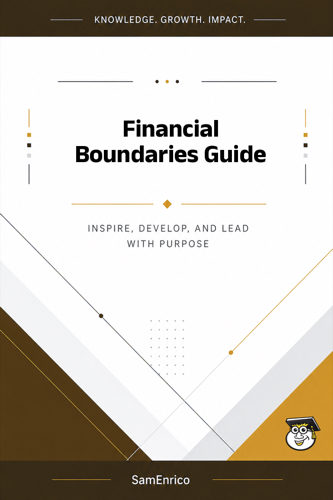
Financial Boundaries Guide eBook
Says no to lending money, covering costs, or being
Says no to lending money, covering costs, or being taken advantage of.
Formats
Free sample
Chapter 1: The Silent Leak--–- The money leaves your account quietly. There is no alarm. No notification that says, "Warning: You are about to transfer your peace of mind to someone who will not protect it." There is just the beep of a card reader, the click of a "Send" button on a banking app, or the rustle of bills leaving your hand and entering someone else's. And then, in the days and weeks that follow, a low-grade fever of resentment settles into your chest. You check your balance more often.
You say yes to fewer invitations because you are not sure you can afford to go out. You lie awake at 2:00 AM replaying the conversation, recalculating the math, wondering why they have not texted to say thank you—or to say they are sending the money back.This is the silent leak. It is not a bankruptcy. It is not a job loss. It is not a medical emergency or a market crash.
It is something far more insidious because it happens in plain sight, disguised as kindness, masked as love, dressed up in the language of family obligation and friendship loyalty. You are not losing money to bad investments or unexpected bills. You are losing money to people who ask. And because they ask, and because you are the kind of person who says yes, you have convinced yourself that the problem is not a problem at all. It is just who you are.But who you are is not fixed.
Who you are has been shaped by decades of conditioning, guilt, and fear. And who you are is about to change.The Scene That Plays on Repeat Let me describe a scene. Read it carefully. See if it feels familiar.A notification lights up your phone. It is a message from a specific person—you know which one.
Your stomach tightens before you even read the words. You open the message. It says something like: "Hey, I hate to ask, but I'm short on rent this month. Can you spot me $300? I'll get you back on the 15th, I promise."You read it once.
Twice. Three times. Your brain begins a frantic calculation. You have $800 in checking. You need $400 for your own rent in five days.
You have a credit card payment due. You wanted to put $200 into savings this month. The numbers do not add up. Giving $300 means you cannot save. Giving $300 means you are one small emergency away from disaster.But the person on the other end of the message is not asking about your savings.
They are not asking about your credit card payment. They are asking about their rent. And their rent feels more urgent than your future because their rent is happening now, and your savings is happening later.You type: "Yeah, I can do that. No worries."You hit send. The relief lasts approximately four seconds.
Then the resentment begins.This scene plays out millions of times every day, in every country, in every language. It plays out between siblings and parents, between childhood friends and new romantic partners, between coworkers and neighbors and people who sit in the same pew at church. It is the most common financial transaction that almost never gets discussed. And it is quietly, systematically, destroying the financial futures of the people who say yes.Why This Book Is Not About Budgeting If you have read other personal finance books, you have noticed a pattern. They tell you to track your spending.
They tell you to cut out coffee and avocado toast. They tell you to automate your savings and invest in index funds. All of that advice is fine. All of that advice is also useless if you are leaking money to other people.You cannot budget your way out of a problem that is not about your spending habits. You cannot track your way out of a problem that is about your inability to say no.
And you certainly cannot invest your way out of a problem that is draining your accounts before the money ever has a chance to grow.The person who spends $5 a day on coffee is losing $150 a month to a habit they can see. The person who lends $200 here and $300 there, who covers a friend's dinner "just this once" and pays for a sibling's car repair "as a favor," is often losing twice that—and they cannot see it because it does not show up on a budget line item called "Money I Gave Away and Will Never See Again."This book is not a budget book. It is a boundaries book. It is about the psychological mechanisms that turn kind people into doormats. It is about the cultural scripts that tell you that saying no to family is betrayal.
It is about the fear, buried so deep you almost cannot feel it, that if you stop giving, you will be alone.And it is about what happens when you learn to say no. Not a weak, apologetic, "I'm so sorry but I just can't this time" no. A real no. A no that does not require an explanation. A no that does not invite negotiation.
A no that leaves your peace intact and your wallet full.The Four Faces of the Taker Before you can set a boundary, you have to know what you are up against. The people who ask for money are not all the same. They have different motivations, different patterns, and different responses to the word no. Understanding who you are dealing with is the first step toward protecting yourself.The Entitled Sibling. This person grew up in the same household as you but developed a radically different relationship with money.
Somewhere along the way, they decided that the family pot is infinite and that your success is their safety net. They do not ask with embarrassment. They ask with expectation. And when you say no, they do not get angry—they get confused. Because in their mind, your money is not really yours.
It is the family's money. You are just the one holding it right now.The Forgetful Friend. This person is not malicious. They genuinely believe they will pay you back. They have every intention of sending that $50 on Friday.
But Friday comes, and their brain categorizes your loan as "soft debt"—unimportant, unenforceable, easy to forget. The bank's credit card bill arrives with a late fee, and they pay that first. Their car payment is due, and they pay that second. Your loan? It floats in a mental space labeled "I'll get to it." And often, they never do.The Romantic Partner.
This person does not ask for money so much as they absorb it. They suggest dinners at restaurants you cannot afford, then look at you when the check arrives. They talk about "our" vacation plans, then assume you will pay for the flights. They move into your apartment and never offer to split the utilities. They are not necessarily malicious—they have simply decided, consciously or not, that your income is shared and theirs is private.The Weaponized Incompetent.
This is the most dangerous face because it is the hardest to recognize. The Weaponized Incompetent does not ask for…
This is the end of the free sample. Get the eBook to keep going. Buy now
About this book
Details
- Author
- Magana Cleotilde
- Publisher
- SamEnrico
- Language
- English
- Genre
- Non-Fiction, Self-Help / Finance
- Released
- 2026-06-06
- Pages (approx.)
- 132
- Available as
- eBook, Audiobook

Read better in the ZLOADR app
Your eBooks on your phone or tablet. Sign in with your SamEnrico account and start reading.
More by Magana Cleotilde
 Anger De escalation for LeadersMagana Cleotilde$11.99
 The Awkward Silence Breaker HandbookMagana Cleotilde$11.99
 Nightmare Processing Support GroupsMagana Cleotilde$11.99
 Distant Parent Emotional NeglectMagana Cleotilde$11.99
 Group Project Dubai GuideMagana Cleotilde$11.99
 Human Trafficking ConnectionMagana Cleotilde$11.99
 Cognitive Interview TechniqueMagana Cleotilde$11.99
 Blood & Bronze: The Forbidden Olympics of 388 BCMagana Cleotilde$11.99
 The Gates of Babylon: Cyrus the Great's Conquest of Lydia (547 BC)Magana Cleotilde$11.99
 How to Become a Roller-bearing InspectorMagana Cleotilde$11.99
 Understanding Trigeminal NeuralgiaMagana Cleotilde$11.99
 Eu Domain Value Appraisal GuideMagana Cleotilde$12.99
You may also like
 Hong Kong Handover 1997Dunn Johnnie$11.99
 Zumba For Postnatal Recovery CourseNeal Christian$11.99
 Zumba for BeginnersLadner Nikia$11.99
 YouTube Comment Mining GuideHumes Pandora$12.99
 Worry Box MeditationCarlin Rudy$11.99
 Workplace Stress MeditationNguyen Lynn$11.99
 Workplace Stress and Sleep RepairHawley Ivory$11.99
 Workplace Perfectionism CureDelaney Jeffry$11.99
 Workplace Injustice Anger GuideWallen Isabelle$11.99
 Work Addiction and Burnout LinkGreenwood Ester$11.99
 Women in Yoga and WellnessBeattie Galina$11.99
 Women in Stand Up ComedyChun Evangeline$11.99