
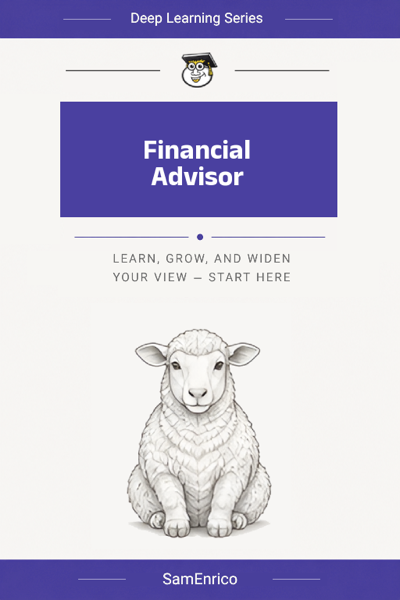
Non-FictionInformativeEducational
Financial Advisor eBook
A Coursebook on Financial Advisor
A Coursebook on Financial Advisor
Formats
Free sample
Chapter 1: The Empathy Advantage--The traditional financial advisor is vanishing. Not because the markets have become too complex, and not because robo-advisors are cheaper. The advisor is disappearing because the old value proposition—picking stocks, beating benchmarks, timing markets—has been exposed as a fiction that no one can sustain. For decades, the industry sold a lie: that a smart person with a Bloomberg terminal could predict the future and outsmart the collective wisdom of millions of other investors. The data has never supported this claim.
Yet the lie persisted because it was profitable. Clients wanted to believe someone had a crystal ball. Advisors wanted to believe they were special. The truth is far less glamorous but far more useful: investment returns are largely a function of asset allocation, costs, and luck. Everything else is noise.This chapter makes a provocative claim that will unsettle many readers.
The claim is this: your technical skills as a financial advisor are nearly worthless. Not completely worthless, but commoditized to the point where they no longer differentiate you from a smartphone application. The software that runs on a $5 per month app can now perform tax-loss harvesting, rebalance portfolios, calculate retirement probabilities, and optimize asset allocation. These tasks, which required a team of analysts twenty years ago, are now automated features. If you are competing on the basis of your investment acumen, you are competing with software that never sleeps, never has a bad day, and charges less for a year than you charge for an hour.So what is left?
What can a human advisor do that software cannot? The answer is simple but difficult to execute: manage human behavior. Software can calculate the mathematically optimal portfolio. Software cannot prevent a client from selling that portfolio at the bottom of a panic. Software can generate a perfect financial plan.
Software cannot convince a client to follow that plan when their neighbors are getting rich off cryptocurrency. Software can send automated reminders. Software cannot sit across a table, look a widow in the eyes, and say the exact words she needs to hear to avoid making a catastrophic decision.This chapter is the foundation of everything that follows. If you reject its premise—if you believe that your value lies in your ability to pick stocks or time markets—then the remaining eleven chapters will feel irrelevant. But if you accept that the future of this profession belongs to behavioral coaches rather than product pushers, then you are ready to build a practice that cannot be automated, cannot be outsourced, and cannot be replicated by a competitor with a cheaper fee schedule.The Uncomfortable Truth About Investment Returns Let us begin with data that every advisor should memorize but few actually cite.
The SPIVA Scorecard, published twice annually by S&P Dow Jones Indices, tracks the percentage of actively managed funds that outperform their benchmarks. Over a fifteen-year horizon, more than ninety percent of active fund managers underperform the S&P 500. Not slightly underperform—dramatically underperform after fees. This is not a controversial finding; it is one of the most replicated results in financial economics. The Efficient Market Hypothesis, despite its flaws and critics, has proven remarkably durable at predicting one thing: most professionals cannot beat the market consistently.The reasons are mathematical rather than personal.
Markets are zero-sum before costs. For every buyer who beats the average, there must be a seller who underperforms. After accounting for management fees, trading costs, and taxes, the average dollar in active management will underperform the average dollar in passive management. This is not a critique of any specific manager's skill. It is a mathematical certainty that applies to every market participant simultaneously.What does this mean for a financial advisor?
It means that if you are charging clients one percent of assets under management to deliver returns that are statistically indistinguishable from what they could get from a Vanguard index fund for 0.03 percent, you are charging a premium for something you are not actually providing. Your clients are paying 97 basis points for the privilege of underperforming the market after fees. This is not a sustainable business model. Eventually, the math becomes undeniable.But here is the twist that most critics of the advisory industry miss. Clients do not leave advisors because of underperformance.
They leave because of fear, confusion, and a sense that no one is listening. The academic literature on investor behavior shows that the average individual investor underperforms the very funds they own by a significant margin—not because the funds are bad, but because investors buy high and sell low. They chase performance. They panic at bottoms. They time the market poorly.
The gap between the return of an investment and the return actually earned by the investor who owns it is called the "behavior gap." It is typically two to three percent annually. That gap is where the financial advisor creates value.Think carefully about what this means. A client who invests in a simple three-fund portfolio and does nothing else will outperform a client who hires a brilliant active manager but panics every two years and changes strategies. The calm index investor beats the frantic active investor every time. The role of the advisor, therefore, is not to find better investments.
The role is to prevent the client from making themselves poorer through emotional decisions. An advisor who stops a client from selling at the bottom has just created more value than any stock picker could ever generate.This reframing changes everything. The advisor's primary job is no longer portfolio management. That is a commodity, best handled by low-cost index funds or software. The advisor's primary job is behavior management.
And behavior management requires a completely different skill set than investment analysis. It requires empathy, patience, active listening, and the ability to translate complex concepts into simple narratives. These skills cannot be automated. They cannot be outsourced to a lower-cost competitor. They are the only defensible moat in a world of free software.The Commoditization Curve Let us be specific about what software can now do, because many advisors are willfully ignorant about the capabilities of modern technology.
They comfort themselves with stories about how "robos are only for simple clients" or "no algorithm can understand a complex family situation." These stories are delaying tactics. The software is improving rapidly, and the gap between what it can do and what it will do in five years is shrinking.Tax-loss harvesting, once a sophisticated strategy that required daily monitoring, is now automated by platforms like Betterment and Wealthfront. The software scans portfolios daily, identifies losses, and executes replacement purchases automatically. It does this without emotion, without error, and without billing an extra fee. Asset allocation models that once required a team of quants are now generated by algorithms that update continuously based on market conditions and client goals.
Rebalancing, a tedious but essential task, is now a button click in most custodial platforms. Financial planning software like e Money and Right Capital can model retirement scenarios, Social Security claiming strategies, and Roth conversion schedules with a level of detail that would have required weeks of manual work a decade ago.Generative AI has accelerated…
This is the end of the free sample. Get the eBook to keep going. Buy now
About this book
Details
- Author
- Ragsdale Jerri
- Publisher
- SamEnrico
- Language
- English
- Genre
- Non-Fiction, Informative, Educational
- Released
- 2026-05-04
- Pages (approx.)
- 155
- Available as
- eBook, Audiobook

Read better in the ZLOADR app
Your eBooks on your phone or tablet. Sign in with your SamEnrico account and start reading.
More by Ragsdale Jerri
 TM Healthcare ProviderRagsdale Jerri$11.99
 Async Penetration Test Reporting GuideRagsdale Jerri$11.99
 Emotional Intelligence in NetworkingRagsdale Jerri$11.99
 Public Speaking with Imposter SyndromeRagsdale Jerri$11.99
 Naloxone Copay Assistance GuideRagsdale Jerri$11.99
 The Icebox Murders: How a Forensic Breakthrough Exposed a Killer in the ArcticRagsdale Jerri$11.99
 The Vanishing Billionaire: Inside the Hunt for Jho LowRagsdale Jerri$11.99
 Understanding Cranioectodermal DysplasiaRagsdale Jerri$17.99
 Landlord Disclosure COVID RulesRagsdale Jerri$12.99
 Instagram Shoppable FreeRagsdale Jerri$12.99
 How to Start a Preserved Pastry Goods and Cakes Business (Beginners Guide)Ragsdale Jerri$11.99
You may also like
 Hong Kong Handover 1997Dunn Johnnie$11.99
 Zumba For Postnatal Recovery CourseNeal Christian$11.99
 Zumba for BeginnersLadner Nikia$11.99
 YouTube Comment Mining GuideHumes Pandora$12.99
 Worry Box MeditationCarlin Rudy$11.99
 Workplace Stress MeditationNguyen Lynn$11.99
 Workplace Stress and Sleep RepairHawley Ivory$11.99
 Workplace Perfectionism CureDelaney Jeffry$11.99
 Workplace Injustice Anger GuideWallen Isabelle$11.99
 Work Addiction and Burnout LinkGreenwood Ester$11.99
 Women in Yoga and WellnessBeattie Galina$11.99
 Women in Stand Up ComedyChun Evangeline$11.99