

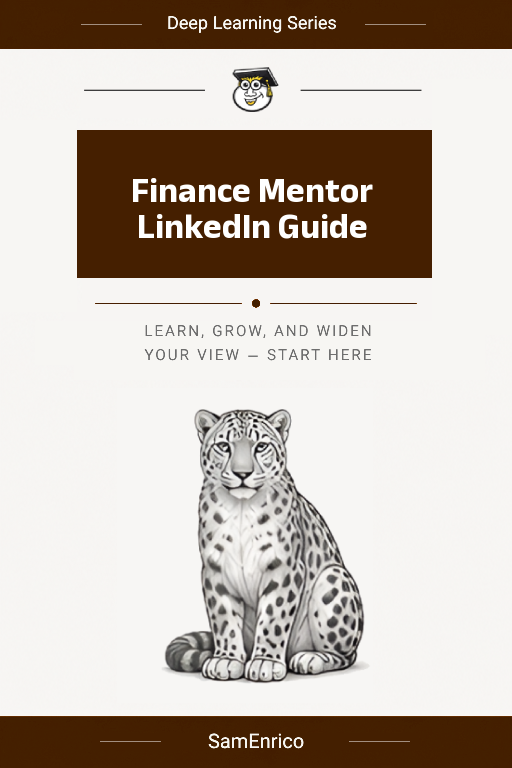
Non-FictionFirst 30 DaysFinance
Finance Mentor LinkedIn Guide eBook
Connect with finance, accounting, and investment m
Connect with finance, accounting, and investment mentors. Leverage certifications and industry groups for targeting.
Formats
Free sample
Chapter 1: The Trust Algorithm--The finance world runs on a single, unspoken currency: trust. A certified public accountant signs off on a quarterly report, and investors move millions. A chartered financial analyst recommends a stock, and portfolios shift. A chief financial officer presents earnings guidance, and markets react. In every case, the transaction is not just about numbers—it is about whether the person behind those numbers is believed.
Yet when finance professionals open Linked In, they suddenly forget this fundamental truth. They write profiles that sound like résumés written by robots. They list certifications as if they were collectible badges. They wait for mentors to discover them, as if trust could be broadcast instead of earned.This chapter reveals why your Linked In profile is not a digital filing cabinet. It is a trust machine.
And if you do not understand how Linked In’s algorithm rewards trust—and punishes vagueness—you will remain invisible to the very mentors you need most.The Algorithm’s Dirty Secret: It Mimics Human Judgment Linked In processes over a billion daily interactions across nearly a billion members. But here is what no one tells you: the algorithm is not a neutral calculator. It is a mirror of human psychology. The engineers who built it did not program it to favor “popular” people. They programmed it to favor what real humans already find trustworthy.
This is not a coincidence. Linked In’s entire business model depends on keeping professionals engaged, and professionals engage more with people they know, like, and trust.The three signals that drive every decision the algorithm makes are:Profile completeness – Does every section tell a coherent story?Engagement velocity – How quickly do people respond to your content or messages?Dwell time – How long do visitors stay on your profile before clicking away?Each of these maps directly onto how a senior finance professional evaluates a junior colleague in real life. A VP of Finance who skims your résumé for ten seconds and tosses it aside is no different from a Linked In user who lands on your profile, sees nothing compelling, and leaves immediately. The algorithm watches that behavior and concludes: This person is not worth showing to others.Conversely, when a mentor lands on your profile and spends sixty seconds reading your “About” section—because it is specific, credible, and relevant—the algorithm notes that dwell time and boosts your visibility. Your profile rises in search results.
You appear in more “People You May Know” suggestions. Your posts reach more viewers. The algorithm is not being mysterious. It is being human.The Trust Gap Audit Before you read another sentence, complete this thirty-second audit. Open your Linked In profile in a separate tab.
Look at your headline, your “About” section, and your experience descriptions. Count how many of the following generic phrases appear:“Results-driven professional”“Detail-oriented”“Strategic thinker”“Excellent communication skills”“Proven track record”Now count how many specific, verifiable claims appear. For example: “Reduced monthly close from ten days to four” or “Built three financial models that guided a $50M investment decision” or “Passed CFA Level 2 in the 90th percentile.”If your generic count is higher than your specific count, you have a trust gap. And the algorithm knows it. Every generic phrase you write tells a mentor that you are either too inexperienced to have real accomplishments, too lazy to articulate them, or too insecure to claim them.
None of those messages get you a mentorship meeting.Why Finance Is Different: The Fiduciary Standard of Profiles Marketing professionals can post lifestyle photos and call it personal branding. Software engineers can share code snippets and call it thought leadership. But finance professionals operate under a different rulebook. Whether you work in audit, corporate finance, investment banking, or wealth management, you are judged by the fiduciary principle: you manage something valuable—money, data, reputation—on behalf of someone else. Trust is not a nice-to-have.
It is a license to operate.When a potential mentor looks at your Linked In profile, they are not scanning for charisma. They are scanning for signals of competence and integrity. They want to know: Would I trust this person with a confidential model? Would I feel comfortable introducing them to my own mentors? Would I stake my reputation on their work?This is why a finance profile cannot look like a creative portfolio.
It must look like a verification document. Every certification must be displayed not as a trophy but as a proof of rigorous standards. Every accomplishment must be quantified not as a boast but as evidence of repeatable results. Every connection request must reference not admiration but specific shared ground.The algorithm of authority, therefore, is not a game you play against the machine. It is a game you play against the expectations of senior finance professionals.
The algorithm simply aggregates their behavior. If you engineer your profile to earn their trust, you automatically earn the algorithm’s favor.Signal One: Profile Completeness as a Trust Proxy Linked In’s algorithm gives a completeness score to every profile. But completeness is not about filling every field like a tax form. It is about narrative coherence. A profile that has every field filled but tells five different stories is actually less trustworthy than a profile with three well-integrated sections.The Non‑Negotiable Sections for Finance Professionals You must complete these seven sections, in this order of priority:Headline – This is not your job title.
It is your value proposition. “Financial Analyst at XYZ Corp” tells me nothing. “Financial Analyst | CPA Candidate | FP&A Mentor Seeker” tells me your role, your trajectory, and your intention. The algorithm prioritizes headlines that include keywords mentors actually search for: certification acronyms (CPA, CFA, CMA, FPAC), role levels (Senior, Lead, Vice President), and functional areas (Audit, Tax, Corporate Finance, Risk).About Section – This is the single most important trust signal on your entire profile. A weak “About” section is like a handshake with no grip.
A strong one follows a three‑act narrative: (a) the problem you solve for your organization, (b) the credentials that prove you can solve it, and (c) the specific mentor you are seeking. Example: “I help mid‑cap manufacturing firms reduce working capital drag by optimizing inventory turnover. As a CPA with six years in public audit, I have seen how inefficient processes destroy cash flow. I am now seeking a mentor who has transitioned from audit to corporate FP&A at a Fortune 500 company.”Experience Descriptions – Each role must have at least three bullet points. Each bullet point must follow the “Action + Metric + Outcome” formula.
“Prepared monthly reports” is useless. “Redesigned the monthly reporting package, cutting preparation time by 40% and reducing errors by 85%” is trust‑building.Skills Section – List no fewer than five and no more than fifteen skills. Prioritize hard skills (Financial Modeling, ASC 842, Hyperion, Tableau) over soft skills (Leadership, Communication). The algorithm uses skills to match you with mentors who have endorsed those same skills.Certifications Section – Never bury certifications in a single line. List each certification separately with the issuing body and date earned or expected.
For candidates, include “In Progress” with an expected completion date. This signals seriousness, not incompleteness.Education – Include your degree, institution…
This is the end of the free sample. Get the eBook to keep going. Buy now
About this book
Details
- Author
- Ouellette Marisa
- Publisher
- SamEnrico
- Language
- English
- Genre
- Non-Fiction, First 30 Days, Finance
- Released
- 2026-06-01
- Pages (approx.)
- 152
- Available as
- eBook, Audiobook

Read better in the ZLOADR app
Your eBooks on your phone or tablet. Sign in with your SamEnrico account and start reading.
More by Ouellette Marisa
 Cybersecurity Spending ForecastOuellette Marisa$11.99
 Affirmations For Patience WorkbookOuellette Marisa$11.99
 Remote Review for DesignersOuellette Marisa$11.99
 Leg and Foot Position Cues GuideOuellette Marisa$11.99
 Surgery Trauma TriggersOuellette Marisa$11.99
 The Vanishing Scientist: Australia's Cold War Espionage MysteryOuellette Marisa$11.99
 Construction and Materials ESG GuideOuellette Marisa$12.99
 Understanding ParaplegiaOuellette Marisa$17.99
 Financial Systems ManagerOuellette Marisa$11.99
 How to Become a Sewer-line RepairerOuellette Marisa$11.99
You may also like
 Hong Kong Handover 1997Dunn Johnnie$11.99
 Zumba For Postnatal Recovery CourseNeal Christian$11.99
 Zumba for BeginnersLadner Nikia$11.99
 YouTube Comment Mining GuideHumes Pandora$12.99
 Worry Box MeditationCarlin Rudy$11.99
 Workplace Stress MeditationNguyen Lynn$11.99
 Workplace Stress and Sleep RepairHawley Ivory$11.99
 Workplace Perfectionism CureDelaney Jeffry$11.99
 Workplace Injustice Anger GuideWallen Isabelle$11.99
 Work Addiction and Burnout LinkGreenwood Ester$11.99
 Women in Yoga and WellnessBeattie Galina$11.99
 Women in Stand Up ComedyChun Evangeline$11.99