
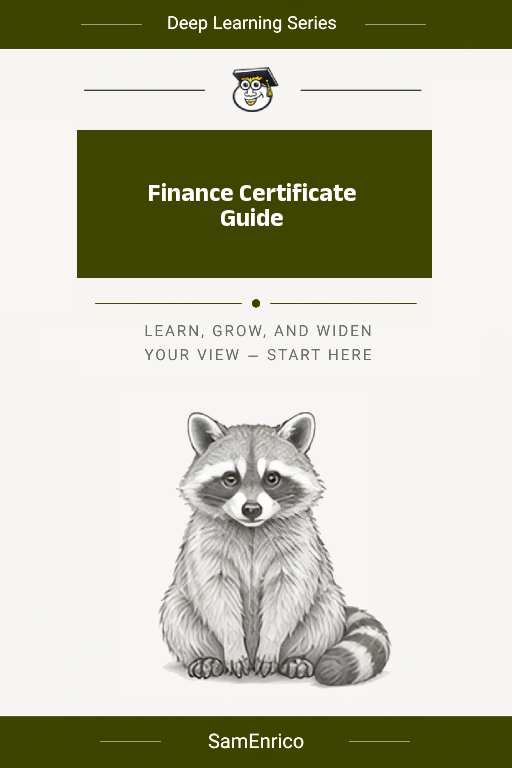
Non-FictionStudent's ShortcutFinance
Finance Certificate Guide eBook
Complete University of Michigan, Yale, or Wharton
by Engle Bailey
Complete University of Michigan, Yale, or Wharton Finance certificates for analyst roles.
Formats
Free sample
Chapter 1: The $200,000 Lie...--–- Every year, more than one hundred thousand students enroll in MBA programs across the United States. They borrow an average of 80,000to80,000 to 80,000to150,000 each. They sacrifice two years of income. They study cases, network frantically, and emerge with a degree that has historically been a ticket to Wall Street. But here is the truth that no business school wants you to hear: for the specific role of a junior financial analyst, three online certificates from Yale, Wharton, and the University of Michigan can replace approximately 80 percent of that MBA curriculum at less than 1 percent of the cost.Let that sink in.
You are about to read a book that will teach you everything those certificates require. But before a single formula or model appears, you need to understand why this path exists, why it works, and why the traditional finance establishment has a vested interest in pretending it does not.This chapter is not an introduction. It is a provocation. It is the strategic foundation for everything that follows. By the time you finish these pages, you will understand the precise economic logic of certificate-based career advancement, the hidden landscape of online proctoring that filters out unprepared candidates, and the three-phase strategy that turns credentialing into job offers.
You will also confront the single biggest objection to this approach—and see exactly why it fails.Let us begin with a simple question that changes everything.The Math That Breaks the MBA Argument Walk into any finance recruiting event and ask a simple question: "What do you actually learn in the first year of a top MBA program that qualifies you for an analyst role?" The answers cluster around a small set of topics. Financial accounting. Corporate finance. Valuation. Capital markets.
Portfolio management. A bit of economics. Some Excel modeling. Ethics and compliance.Now look at the syllabi for three online certificates. The Yale Financial Markets certificate, taught by Nobel laureate Robert Shiller, covers exactly those capital markets and behavioral finance topics.
The Wharton Business and Financial Modeling certificate covers corporate finance, valuation, and Excel modeling. The University of Michigan Financial Modeling specialization covers the quantitative rigor and accounting fundamentals. Together, they cover the same intellectual territory as the core curriculum of most MBA programs.The price difference is staggering. A two-year top MBA program costs 150,000to150,000 to 150,000to200,000 in tuition alone. Add foregone income of 120,000to120,000 to 120,000to200,000, and the all-in cost approaches 300,000to300,000 to 300,000to400,000.
The three certificates combined cost approximately 1,500.Evenaddingtheoptional CFALevel1exam(1,500. Even adding the optional CFA Level 1 exam (1,500.Evenaddingtheoptional CFALevel1exam(1,000 to 1,500)andthe SIEexam(1,500) and the SIE exam (1,500)andthe SIEexam(80), you remain under $3,000.That is a cost difference of two orders of magnitude. But cost alone does not make a strategy viable. The real question is whether employers accept the certificates as legitimate signals of competence.The Signaling Problem: Why Credentials Matter More Than Knowledge Economists have known for decades that education serves two functions. The first is human capital: you actually learn things that make you more productive.
The second is signaling: you demonstrate to employers that you have the intelligence, discipline, and conformity to complete a difficult program. The signaling function explains why employers pay for degrees even when the specific content is irrelevant to the job. A philosophy major can work in investment banking not because philosophy teaches discounted cash flow analysis, but because completing a rigorous philosophy degree signals that the candidate can think logically, write clearly, and persist through difficulty.Here is the insight that changes everything. Online certificates from elite universities now serve the same signaling function as traditional degrees, but at a fraction of the cost. When you complete the Yale Financial Markets certificate, your credential carries the Yale name.
When you complete Wharton's certificate, it carries the Wharton brand. The same professors who teach the on-campus versions often teach the online versions. The material is similar. The assessments, while adapted for online delivery, maintain rigor.Recruiters have noticed. A 2024 survey of financial services hiring managers found that 62 percent viewed elite university online certificates as positive signals for entry-level analyst candidates, with 18 percent considering them equivalent to a master's degree in finance for screening purposes.
The remaining 20 percent were either unfamiliar or skeptical—a gap this book aims to close by teaching you not just the material, but how to present it.The Gatekeeper You Did Not Know Existed: Online Proctoring Before you can signal anything to an employer, you must pass the certificate exams themselves. And here lies the first major filter. Yale, Wharton, and Michigan all use online proctoring services—Coursera's proctoring tool, Proctor U, or similar platforms. These systems are not casual. They record your screen, your webcam, and your environment.
They flag suspicious behavior. They can invalidate your exam if you look away too often, speak to yourself, or have an unrecognized person enter the room.Most candidates underestimate proctoring. They treat certificate quizzes like open-book, low-stakes homework. Then they fail the proctored final exam because they never practiced under real conditions. The statistics are sobering.
Across Coursera's professional certificate programs, approximately 40 percent of learners who enroll never complete the first course. Of those who reach the capstone or final exam, roughly 25 percent fail on their first attempt. Many never retake it.This book is designed to make you the exception. Every chapter includes exam strategy sections that teach you not just the material, but how to perform under proctored conditions. The appendix includes a proctoring checklist and troubleshooting guide.
And Chapter 12 contains a full mock exam designed to simulate the pressure of the real thing.But proctoring is only the mechanical gatekeeper. The real filter is psychological.The Three Enemies of Certificate Completion After analyzing thousands of learner journeys across the three programs, three predictable failure modes emerge. Understanding them is the first step to defeating them.The first enemy is scope creep. Most certificate programs are not single courses but specializations containing three to five courses, each with multiple modules, quizzes, and a final project. The Yale Financial Markets certificate is a single course but dense with material.
The Wharton certificate is a five-course specialization. The Michigan certificate is another multi-course sequence. Candidates who do not map the full scope upfront often run out of time or energy before the halfway point.The second enemy is quiz anxiety. The multiple-choice questions on these certificates are not trivial. They test subtle distinctions.
They use common distractors. They require precision. Candidates who study concepts but never practice under timed conditions freeze when the clock starts ticking. They second-guess correct answers. They run out of time.The third enemy is isolation fatigue.
Unlike a classroom with peers and professors, online learning is solitary. There is no one to ask when you get stuck. No one to keep you accountable. No social pressure to show up. Many candidates simply stop logging in.This book defeats each enemy systematically.
The chapter summaries provide scope maps. The practice problems build quiz endurance. And the study schedules in the appendix transform isolation into structure.The Three Certificate Strategy: Why All Three, Not One A reasonable question at this point: why complete all three certificates? Would…
This is the end of the free sample. Get the eBook to keep going. Buy now
About this book
Details
- Author
- Engle Bailey
- Publisher
- SamEnrico
- Language
- English
- Genre
- Non-Fiction, Student's Shortcut, Finance
- Released
- 2026-06-01
- Pages (approx.)
- 120
- Available as
- eBook, Audiobook

Read better in the ZLOADR app
Your eBooks on your phone or tablet. Sign in with your SamEnrico account and start reading.
More by Engle Bailey
 Chronic Illness and Self WorthEngle Bailey$11.99
 Domestic Worker Reunited With KidsEngle Bailey$11.99
 Career Pacing GuideEngle Bailey$11.99
 Meditation For Tinnitus AnxietyEngle Bailey$11.99
 The Journalist CapturedEngle Bailey$11.99
 Paul Farmer PartnersEngle Bailey$11.99
 Healing The Inner Child GuideEngle Bailey$11.99
 Whales and Leverage: The Liquidation MachineEngle Bailey$11.99
 The Dragon’s Hoard: A Knight’s Bargain with the Beast of the Black ForestEngle Bailey$11.99
 Freya’s Golden Tears: The Love That Shattered AsgardEngle Bailey$11.99
 The Mineral Guide to BertranditeEngle Bailey$11.99
 How to Start a Adventure Playground Business (Beginners Guide)Engle Bailey$11.99
You may also like
 Hong Kong Handover 1997Dunn Johnnie$11.99
 Zumba For Postnatal Recovery CourseNeal Christian$11.99
 Zumba for BeginnersLadner Nikia$11.99
 YouTube Comment Mining GuideHumes Pandora$12.99
 Worry Box MeditationCarlin Rudy$11.99
 Workplace Stress MeditationNguyen Lynn$11.99
 Workplace Stress and Sleep RepairHawley Ivory$11.99
 Workplace Perfectionism CureDelaney Jeffry$11.99
 Workplace Injustice Anger GuideWallen Isabelle$11.99
 Work Addiction and Burnout LinkGreenwood Ester$11.99
 Women in Yoga and WellnessBeattie Galina$11.99
 Women in Stand Up ComedyChun Evangeline$11.99