
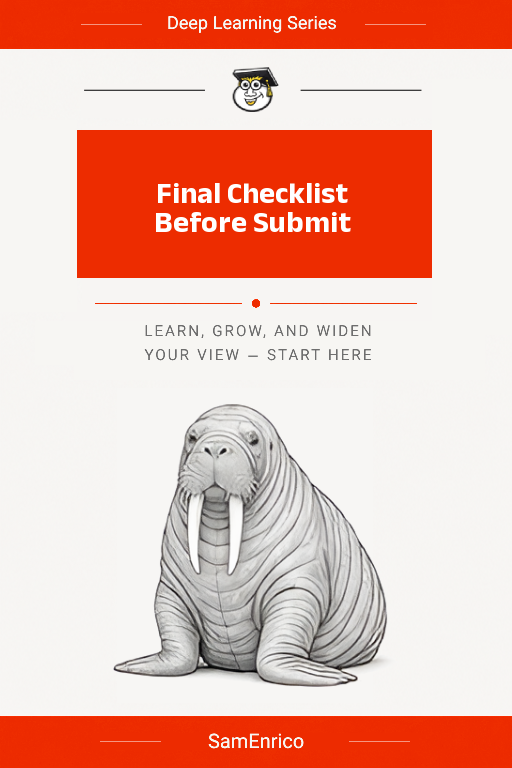
Final Checklist Before Submit eBook
Verify formatting, file uploads, and word counts a
Verify formatting, file uploads, and word counts across platforms, avoiding technical glitches that ruin your application.
Formats
Free sample
Chapter 1: The $50,000 Invisible Character--–- The rejection arrived at 9:47 AM on a Tuesday. I remember the exact time because I was sitting in a coffee shop, refreshing my email every thirty seconds like a gambler watching a slot machine. Three weeks of waiting, fifteen sleepless nights of revisions, and a manuscript I had poured my entire being into—all of it reduced to a single sentence that I had to read four times before it made sense."Thank you for your submission. However, due to technical issues with your file, we are unable to proceed with your application at this time."Technical issues. Not "your writing needs work." Not "your story isn't right for us." Technical issues.
The vagueness was almost cruel. It was like being told you failed a driving test because of "vehicle problems" without being told whether your tires were flat, your lights were broken, or you had simply forgotten to turn the key.I spent the next three days trying to figure out what had happened. I called the publisher's support line. I emailed their submissions department. I scoured their FAQ page.
Nothing. The rejection was final, and the reason was a black box.Six months later, at a writers' conference, I ran into an editor from that same publisher. Over drinks, I told her the story. She pulled out her phone, scrolled through some records, and said something that made my blood run cold."Your file had an invisible character in the metadata," she said. "Your name was still embedded in the document properties.
We were running an anonymous submission contest. The system automatically rejected any file with author metadata."An invisible character. A single piece of digital debris that I couldn't see, didn't know existed, and had no idea how to remove. That rejection cost me a $50,000 book advance and a two-book deal.I never made that mistake again. And I wrote this book so you never have to either.This is not a book about writing.
This is a book about not getting rejected by robots.The Most Expensive Button You Will Ever Click There is a moment, just before you hit "Submit," that feels like standing on the edge of a diving board. Your heart rate spikes. Your cursor hovers. You re-read your name, your email address, your file name, for the tenth time. And then you click.That click feels like the finish line.
You have done the work. You have revised, edited, polished, and perfected. You lean back in your chair, exhale, and wait for the confirmation email.Here is the truth that no one tells you: The moment you hit Submit is not the finish line. It is the starting line of a hidden gauntlet that you cannot see, cannot control, and probably do not know exists.Between your computer and the reviewer's eyes, there is a minefield of automated scanners, file renderers, format validators, virus checkers, metadata extractors, and platform-specific rendering engines. Any one of these can reject your submission without a single human ever seeing your work.
Your beautiful prose, your groundbreaking research, your compelling argument—none of it matters if a robot decides that your file is two megabytes too large or your font is not embedded or your metadata still contains your name.I have interviewed dozens of writers, academics, and professionals who have lost opportunities to technical rejections. The stories are heartbreaking not because the work was bad—it rarely was—but because the rejection felt so senseless. You can improve your writing. You cannot improve something you cannot see.One novelist I spoke with submitted her manuscript to a prestigious literary contest. She had spent two years on the book.
It had won a residency, received praise from beta readers, and been workshopped extensively. She hit Submit. Three days later, she received a one-line rejection: "File could not be processed."She resubmitted. Same error. She converted the file from DOCX to PDF.
Same error. She renamed the file, stripped the formatting, copied the text into a fresh document. Same error. By the time she figured out that the problem was a single corrupted image in her front matter—a tiny author photo that had been saved in the wrong color space—the submission deadline had passed.Her book found a home eventually, but she missed that specific opportunity. A small press picked it up for a 2,000advanceinsteadofthe2,000 advance instead of the 2,000advanceinsteadofthe30,000 the contest winner received.These stories are not rare.
They are the norm. And they are almost always avoidable.The Emotional Crash Nobody Talks About Let me be clear about something. Content rejection hurts. Of course it does. Being told that your writing isn't good enough, your argument isn't convincing, or your research isn't novel—that stings.
But there is a perverse silver lining to content rejection: it is about the work. You can improve. You can revise. You can try again.Technical rejection is different. Technical rejection says nothing about your work.
It says everything about your file. And that is precisely why it hurts more.When your submission is rejected for technical reasons, you experience a specific kind of emotional crash that psychologists might call "unjust frustration." You did everything right. You wrote the best work you could. You followed the guidelines. And then a robot found something you couldn't see and threw your application into the digital trash.I have seen this happen to brilliant people.
A grant applicant with a Ph D from MIT spent an entire weekend crying because her proposal was rejected for "file type mismatch." She had renamed a file instead of converting it. The system saw the discrepancy between the file extension and the file header and rejected her without processing a single page of her research.A poet with multiple Pushcart Prize nominations submitted to a journal that required anonymous submissions. He carefully removed his name from the document. He did not realize that Microsoft Word also stores the author name in the file properties. The journal's automated system flagged the metadata and rejected him instantly.
He never knew why until I told him two years later.A software developer submitted a hackathon project with his team. They had built something impressive—a working prototype, a clean interface, a compelling pitch. But they forgot to change their Git Hub repository from Private to Public. The judges clicked the link, saw a "404 Not Found" error, and moved on to the next submission. The team assumed their project wasn't good enough.
They almost disbanded before someone checked the link.These are not stories of incompetence. These are stories of invisibility. The problems were not in the work. The problems were in the margins, the metadata, the file headers, the permissions settings—places that no creative person thinks to check because no creative person should have to think to check them.But you do. And now you will.The 72-Hour Lie Every platform that accepts submissions—whether it is Amazon KDP, Submittable, Grants.gov, or a university journal system—makes the same promise.
"Instant upload." "Fast processing." "Quick review."These promises are technically true and practically false.Here is what actually happens. You upload your file. The…
This is the end of the free sample. Get the eBook to keep going. Buy now
About this book
Details
- Author
- Best Adelaida
- Publisher
- SamEnrico
- Language
- English
- Genre
- Non-Fiction, Student's Shortcut
- Released
- 2026-06-01
- Pages (approx.)
- 137
- Available as
- eBook, Audiobook

Read better in the ZLOADR app
Your eBooks on your phone or tablet. Sign in with your SamEnrico account and start reading.
More by Best Adelaida
 Shoe Polish Nitrobenzene RiskBest Adelaida$11.99
 Putin and the Russian MafiaBest Adelaida$11.99
 Cocaine Cravings and Compassionate SolutionsBest Adelaida$11.99
 The Foster Care CASA VolunteerBest Adelaida$11.99
 Recycling Center FounderBest Adelaida$11.99
 Remote Work Progress TrackingBest Adelaida$11.99
 Slave Trade North AmericaBest Adelaida$11.99
 Kettlebell Strength GuideBest Adelaida$11.99
 Silk and Shadows: The Spymasters of the Silk RoadBest Adelaida$11.99
 The Hammer and the Horse: Charlemagne’s Crusade Against the MagyarsBest Adelaida$11.99
 A Collector's Handbook to the Mg Tf 1250Best Adelaida$11.99
 Service Providers Guide to Petting ZoosBest Adelaida$11.99
You may also like
 LSE Online Program LengthAgee Letisha$11.99
 Harvard Extension School for Working AdultsRoush Yer$11.99
 LSE Online Reading ListAshford Ludivina$11.99
 LSE Online Language RequirementsWhitten Daphine$11.99
 LSE Online Class SizeHughey Garret$11.99
 LSE Online Alumni MentorshipWild Lyla$11.99
 London School of Economics Alumni NetworkDutton Chantal$11.99
 Harvard Extension School Student SupportCantrell Christene$11.99
 Harvard Extension School Library AccessSantana Adah$11.99
 Harvard Extension School Degree CompletionBray Wyatt$11.99
 Harvard Extension School Course AuditingAbbott Craig$11.99
 Harvard Extension School Extension DiplomaNew Joane$11.99