
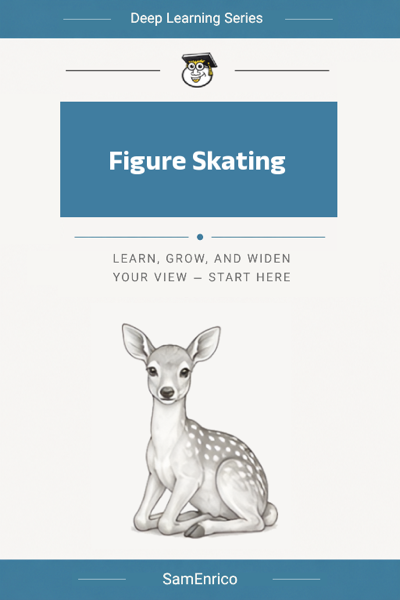
Non-FictionInformativeEducational
Figure Skating eBook
A Coursebook on Figure Skating
by Evans Hugo
A Coursebook on Figure Skating
Formats
Free sample
Chapter 1: First Ice, First Fear...--The first time you step onto ice that is not frozen pond solid but artificially smoothed and cold enough to burn through denim, something shifts in your chest. It is not quite courage, not quite terror—rather, the specific electric hum of standing at the edge of something you have watched from the other side of a screen for years. You have seen Olympians catch air, spin until they blur, land with their arms thrown wide in triumph. You have never, until this moment, understood that the ice itself has a voice. It cracks and whispers under the first tentative step.
It groans when a blade scrapes wrong. And when you finally push off, just a little, just enough to glide two feet instead of one—the ice sings.This chapter is not about jumps or spins or the difference between a Lutz and a flip. Those come later, and they will demand everything from you. This chapter is about the first thirty days—the period when most new skaters either fall in love or walk away forever. It is about why your ankles feel like wet cardboard, why the five-year-old at the other end of the rink is already doing backward crossovers while you cling to the boards like a shipwreck survivor, and why none of that actually matters.
Because here is the secret that no one puts on the Olympic broadcast: every single champion you have ever cheered for once stood exactly where you are standing now, gripping the boards with white knuckles, wondering if their legs had been replaced with stilts made of pudding.The Beginning Is Not What You Expect Let us dismantle a myth immediately. Most people imagine that learning to skate is a linear progression—that you will get a little better each week, that the graph of your ability will climb steadily upward like a gentle hill. This is not true. Learning to skate is a series of plateaus interrupted by sudden, inexplicable leaps. You will struggle for six weeks to master a forward swizzle, and then one Tuesday, for no reason you can name, your feet will simply figure it out.
You will land your first waltz jump exactly once, never again for a month, and then land ten in a row as if your body had been secretly practicing while you slept. The plateaus are not failure. They are the ice teaching your nervous system to rewire itself.The first session is the hardest, but not for the reasons beginners expect. It is not the falling that breaks people—though you will fall, probably more than once, probably in a way that leaves a spectacular bruise on your hip that you will show off at work like a war wound. What breaks people is the gap between what they imagine skating feels like and what it actually feels like.
Skating looks effortless on television because the broadcast edits out the fifteen seconds before each element where the skater is breathing, centering, fighting the flutter in their chest. What you see is the landing. What you do not see is the twenty thousand landings that ended in a sprawl on the ice.So let us be honest about the first day. Your rental skates will pinch somewhere strange, probably the inside of your arch or the knob of your ankle bone. The laces will be either too short or too long, and whichever they are, you will tie them wrong because no one ever taught you how to lace a skating boot.
(We will fix that in Chapter 2.) The ice will feel impossibly slippery, like walking on buttered glass. And the moment you let go of the boards—that first independent glide—your brain will panic. Your thighs will clench. Your toes will curl inside the boots. You will lean backward, which is exactly the wrong direction, and you will feel your feet slide out from under you.Then you will hit the ice, and here is the strange thing: it does not hurt as much as you feared.
The cold shocks you more than the impact. And when you look up from the ice, you will see the other beginners—the ones who started five minutes before you—already attempting something that looks like walking but is not quite walking, and you will feel a wild, unreasonable surge of hope.Why Adults Struggle (And Why That Is Not a Bad Thing)If you are an adult beginner, you need different advice than the eight-year-old practicing after school. This book takes that distinction seriously, and every chapter from this point forward includes specific guidance for skaters over the age of eighteen, thirty, fifty, and beyond. Because the truth is that adults and children learn to skate through completely different mechanisms, and pretending otherwise leads to frustration, injury, and quitting.Children learn through osmotic terrorlessness. They do not calculate the physics of a fall before they attempt a glide.
They simply try, fail, try again, and forget the failure by the time they stand up. Adults, by contrast, bring the full weight of their history to the ice. You have broken bones before. You have had back pain that lasted six months from something as simple as sleeping wrong. You have watched a colleague tear their ACL playing recreational soccer.
Your brain is not afraid of falling—it is afraid of the six weeks of physical therapy and the deductible and the explanation you will have to give your boss about why you are limping.This fear is not weakness. It is intelligence, misapplied. Your adult brain is doing exactly what evolution designed it to do: protecting you from unnecessary risk. The problem is that skating requires necessary risk. You cannot learn to glide without occasionally falling.
You cannot learn to stop without the terrifying sensation of scraping your blade sideways across the ice. And you cannot learn to trust your edges without leaning further than your ankle wants to lean.So here is the adult beginner's pact, which you should repeat to yourself before every session: "I will fall today. I will get up. I will fall again. And every time I stand up, I will be a slightly better skater than I was before I fell." This is not motivational fluff.
It is biomechanical fact. Each fall teaches your proprioceptive system—the internal sense of where your body is in space—where the edge of your balance actually lives. Until you cross that edge, you do not know where it is. Falling is data collection.The other reality that adult beginners face is time. A child who skates three hours a week will progress roughly twice as fast as an adult who skates three hours a week, all other things being equal.
This is not because children are smarter or more athletic. It is because children's brains are still building their fundamental motor pathways, and those pathways are more plastic—more willing to reorganize themselves in response to new input. An adult's motor pathways are already established, efficient, and stubborn. Teaching an adult to skate is not building a new road from scratch. It is rerouting a…
This is the end of the free sample. Get the eBook to keep going. Buy now
About this book
Details
- Author
- Evans Hugo
- Publisher
- SamEnrico
- Language
- English
- Genre
- Non-Fiction, Informative, Educational
- Released
- 2026-05-09
- Pages (approx.)
- 153
- Available as
- eBook, Audiobook

Read better in the ZLOADR app
Your eBooks on your phone or tablet. Sign in with your SamEnrico account and start reading.
More by Evans Hugo
 Meditation for Exam StressEvans Hugo$11.99
 The Parental Addiction and PerfectionismEvans Hugo$11.99
 Neuroplastic Pain RewiringEvans Hugo$11.99
 Dairy Sensitivity Gut GuideEvans Hugo$11.99
 The Great Wall of China: A Symphony in StoneEvans Hugo$11.99
 How to Produce Bulletin BoardsEvans Hugo$11.99
 How to Start a Archives BusinessEvans Hugo$11.99
 US IP Protection for Non Resident LLCsEvans Hugo$12.99
You may also like
 Hong Kong Handover 1997Dunn Johnnie$11.99
 Zumba For Postnatal Recovery CourseNeal Christian$11.99
 Zumba for BeginnersLadner Nikia$11.99
 YouTube Comment Mining GuideHumes Pandora$12.99
 Worry Box MeditationCarlin Rudy$11.99
 Workplace Stress MeditationNguyen Lynn$11.99
 Workplace Stress and Sleep RepairHawley Ivory$11.99
 Workplace Perfectionism CureDelaney Jeffry$11.99
 Workplace Injustice Anger GuideWallen Isabelle$11.99
 Work Addiction and Burnout LinkGreenwood Ester$11.99
 Women in Yoga and WellnessBeattie Galina$11.99
 Women in Stand Up ComedyChun Evangeline$11.99