
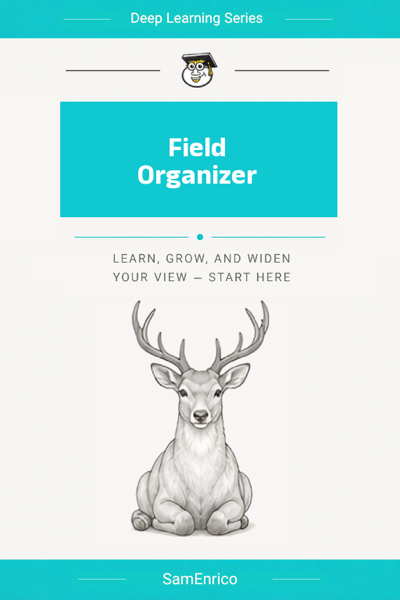
Non-FictionInformativeEducational
Field Organizer eBook
A Coursebook on Field Organizer
by Emerson Yong
A Coursebook on Field Organizer
Formats
Free sample
Chapter 1: The Organizer’s Trap--The first time I lost a campaign, I did everything right.I knocked on 2,000 doors myself. I made 1,500 phone calls from a creaky office chair that smelled like old coffee and desperation. I built the volunteer spreadsheet from scratch at 2 AM on a Tuesday, my eyes burning, because no one else knew how to use Excel. I wrote every script, planned every event, and personally followed up with every single person who said they might show up. When a volunteer canceled fifteen minutes before a canvassing shift, I grabbed the clipboard and went alone.
When someone needed a ride to the polls, I drove them. When a supporter had a question about the candidate’s position on zoning laws, I answered it from memory because I had written the policy brief myself.I worked eighty hours a week for four months. My relationship ended. My friends stopped inviting me to things. I ate gas station food for dinner more nights than I care to admit.
And on election night, standing in a fluorescent-lit community center with confetti still in its plastic packaging, I watched the numbers come in. We lost by twelve points. Twelve.I stood there holding a spreadsheet I had built myself, tracking numbers I had entered myself, and I realized something that cracked me open: I had done everything. And that was precisely the problem.The Organizer’s Trap is the single most common mistake that new field organizers make. It feels like dedication.
It feels like leadership. It feels like pulling your weight and then some. But what it actually is, is a failure of organizing. If you are the smartest person in your volunteer room, if you are the hardest worker, if every difficult task flows through you and only you, you have not built an organization. You have built a dependency.
And dependencies collapse when the person at the center burns out, moves on, or simply cannot carry the weight anymore.I wrote this book because I have seen a hundred organizers fall into the same trap, and I have pulled myself out of it more than once. This chapter is not about technique or data or scripts. It is about something more fundamental: the difference between doing the work and building the people who do the work. If you master nothing else from this book, master this distinction. It will save your campaigns, your volunteers, and your sanity.The False Hero Let me tell you about Maya.Maya was twenty-three years old, fresh out of a political science program, and burning with the kind of righteous anger that makes great organizers and terrible managers.
She had been hired to run a field program for a city council race in a mid-sized district with a lot of renters, a lot of students, and one very entrenched incumbent. Maya’s candidate was a long shot, but Maya didn’t care about odds. She cared about winning.From day one, Maya threw herself into the work. She built the voter file from scratch because the one she inherited was three years old and full of disconnected phone numbers. She recruited thirty volunteers in her first two weeks by standing outside grocery stores and coffee shops, clipboard in hand, talking to anyone who made eye contact.
She ran training sessions every Saturday morning, even when only three people showed up. She wrote and rewrote scripts until they felt like natural conversation. She memorized the names of every precinct captain, every frequent volunteer, every donor who had given more than fifty dollars.And when volunteers failed to show up for their shifts, Maya did not get angry. She did not call them to ask why. She simply grabbed their turfs and did the work herself.“It’s faster if I just do it,” she told me when I asked why she wasn’t delegating more.
“By the time I track down a volunteer, explain the task, and follow up to make sure they did it, I could have done it three times over.”She was right about the speed. She was wrong about everything else.By month three, Maya’s volunteers had become passive. They showed up when she reminded them, but they did not take initiative. They followed her instructions but never offered their own ideas. When a problem arose, they came to her instead of solving it themselves.
They had learned, through a thousand small interactions, that Maya would handle everything. She had trained them to be helpless.On election night, Maya’s candidate lost by eight points. Not as bad as my twelve-point loss, but a loss nonetheless. And here is the part that haunts me: Maya had thirty volunteers on her list. Thirty people who had signed up, attended training, and promised to help.
On the final weekend of the campaign, only seven of them showed up. The other twenty-three had drifted away, not because they didn’t care, but because they had never been asked to truly own anything. They had been treated as hands, not as leaders.Maya burned out six weeks after the election. She left organizing entirely. And her campaign’s field program died with her because she had built it around herself instead of around the people she was supposed to be developing.The Distinction That Changes Everything Here is the distinction that separates field organizing from advocacy, from mobilizing, from every other form of political action.Advocacy is speaking for people.
You identify a problem, you research a solution, you present it to decision-makers, and you ask them to act. Advocacy can be powerful, but it does not require volunteers. It does not require leadership development. It does not require you to build anything that outlasts a single legislative session.Mobilizing is activating people. You identify supporters, you send them a message (text, email, robocall), and you ask them to take a specific action: vote, attend a rally, sign a petition.
Mobilizing can move numbers, but it treats people as targets. It does not invest in relationships. It does not create leaders. When the election is over or the bill is voted on, the mobilized supporter goes back to their life and does not think about you until the next text arrives.Field organizing is building people who build people. You start with a conversation, not a demand.
You invest in relationships before you ask for work. You develop volunteers into captains, captains into coordinators, coordinators into leaders who can train the next generation. Field organizing is slow. It is inefficient in the short term. It requires you to do less work yourself so that others can learn to do it.
But it is the only method that creates durable power.Maya did advocacy (she spoke for her candidate) and mobilizing (she activated her thirty volunteers to knock doors and make calls). She did not do field organizing. She never asked herself the question that separates the two: Am I building a machine that runs without me?The Five Competencies of a Field Organizer If field organizing is different from advocacy and mobilizing, then what specific skills does it require? Through studying winning campaigns and interviewing…
This is the end of the free sample. Get the eBook to keep going. Buy now
About this book
Details
- Author
- Emerson Yong
- Publisher
- SamEnrico
- Language
- English
- Genre
- Non-Fiction, Informative, Educational
- Released
- 2026-05-04
- Pages (approx.)
- 117
- Available as
- eBook, Audiobook

Read better in the ZLOADR app
Your eBooks on your phone or tablet. Sign in with your SamEnrico account and start reading.
More by Emerson Yong
 Talent Acquisition for Family OfficesEmerson Yong$11.99
 Drownings At Nantes Mass Murder CourseEmerson Yong$11.99
 The Aggressive Sarcasm DropEmerson Yong$11.99
 Jackie Stewart Flying ScotEmerson Yong$11.99
 The Post Divorce Identity WorkbookEmerson Yong$11.99
 The Resurrectionists of Lima: Grave Robbers and the Dark Trade of Human RemainsEmerson Yong$11.99
 Understanding Symphalangism, Distal, With Microdontia, Dental Pulp Stones, and Narrowed Zygomatic ArchEmerson Yong$17.99
 How to Start a Abrasive Materials Mining and Quarrying Business (Beginners Guide)Emerson Yong$11.99
 Open Source IP ValuationEmerson Yong$12.99
 Alibaba Negotiation GuideEmerson Yong$12.99
You may also like
 Hong Kong Handover 1997Dunn Johnnie$11.99
 Zumba For Postnatal Recovery CourseNeal Christian$11.99
 Zumba for BeginnersLadner Nikia$11.99
 YouTube Comment Mining GuideHumes Pandora$12.99
 Worry Box MeditationCarlin Rudy$11.99
 Workplace Stress MeditationNguyen Lynn$11.99
 Workplace Stress and Sleep RepairHawley Ivory$11.99
 Workplace Perfectionism CureDelaney Jeffry$11.99
 Workplace Injustice Anger GuideWallen Isabelle$11.99
 Work Addiction and Burnout LinkGreenwood Ester$11.99
 Women in Yoga and WellnessBeattie Galina$11.99
 Women in Stand Up ComedyChun Evangeline$11.99