
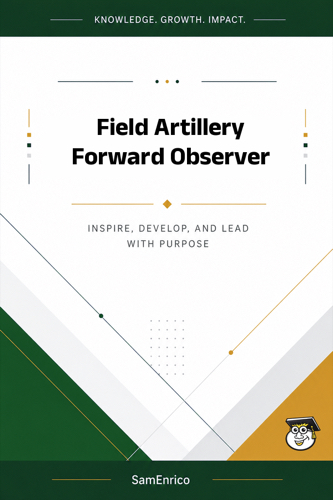
Field Artillery Forward Observer eBook
Recalls calling in shells from behind enemy lines
by Tong Myrl
Recalls calling in shells from behind enemy lines under direct fire.
Formats
Free sample
Chapter 1: The Weight of Numbers...–- The summer heat of Fort Sill, Oklahoma, in 1943 did not merely sit on the skin—it pressed down like a damp wool blanket, seeping through the open windows of the classroom in thick, visible waves. Private William “Bill” Hansen sat in the third row of a wooden folding chair, his spine rigid, his hands folded on the green metal desk in front of him. Sweat traced a slow path from his temple down his jaw, and he did not wipe it away. Nineteen years old, five feet nine inches tall, 148 pounds, with the pale complexion of a boy who had spent his life indoors adding columns of numbers for his father’s accounting firm in Des Moines, Iowa. He looked like what he was: a clerk who had volunteered for the wrong war.The classroom was a converted barracks building on the Fort Sill artillery post, its walls lined with blackboards covered in chalk diagrams—parabolas, angles of fall, deflection corrections, and something called “Mils,” which the instructor had introduced as if it were a holy sacrament.
Fluorescent lights buzzed overhead, casting a sickly green glow on the faces of fifty recruits. Most were eighteen or nineteen. Some were farmers from Kansas who had never seen a compass. A few were high school teachers drafted into a war that needed bodies. All of them were about to learn that artillery was not brute force.It was mathematics.The instructor was a gunnery sergeant named Kowalski—first name unknown, never offered, never requested.
He was a thick-necked Pole from Chicago with a glass left eye that did not track with the right, giving him the unsettling appearance of watching two different conversations simultaneously. His uniform was starched to the point of fragility, his boots shined to a mirror gloss that seemed obscene in the dust of Oklahoma. He had served in North Africa and Sicily, and he carried himself with the quiet authority of a man who had watched other men die by the hundreds and had learned to sleep anyway.“Listen to me,” Kowalski said, not raising his voice. He never raised his voice. The classroom, which had been murmuring with the low static of nervous conversation, fell silent immediately.
“You are not infantry. You are not tankers. You are not pilots. You are something worse. You are the men who tell the guns where to point.”He turned to the blackboard and drew a circle.
Then a dot in the center. Then a series of arcs radiating outward.“This is a howitzer,” he said, tapping the dot. “This is the enemy.” He tapped the circle. “And this”—he tapped the arcs—“is physics. You do not defeat the enemy with courage.
You do not defeat him with hatred. You defeat him with vectors, azimuths, and the brutal, unforgiving mathematics of a high-explosive shell in flight.”Kowalski picked up a piece of chalk and wrote a number on the board: 6,400.“Anyone know what this is?”A hand went up in the back. A skinny kid with wire-rim glasses. “Mils in a circle, Sergeant.”“Correct. Six thousand four hundred mils.
Not three hundred sixty degrees like you learned in high school geometry. Six thousand four hundred. Why?”Silence.“Because,” Kowalski said, “degrees are for surveying corn fields. Mils are for killing. One mil at one thousand meters is one meter.
Simple math. Easy math. Math you will do with shrapnel in your thigh and a concussion rattling your teeth loose. If you transpose a number, you kill Americans. If you hesitate, you kill Americans.
If you do it right, you save hundreds. No pressure, gentlemen.”He let that sink in. Then he smiled, which was somehow worse than his silence.The Accounting of Violence Bill Hansen had not intended to become a Forward Observer. He had intended to become a pilot—a B-17 bombardier, specifically, dropping bombs on German factories from twenty thousand feet, where war was abstract and clean. But the Army Air Corps had rejected him for “insufficient depth perception,” a polite way of saying his eyes did not work quite right together.
A clerk in the recruitment office had stamped his papers and rerouted him to the Artillery Replacement Training Center at Fort Sill.“Forward Observer,” the clerk had said, not looking up from his typewriter. “You do math. You said you were good at math.”“I added columns,” Bill had said. “Accounts receivable.”The clerk had shrugged. “Same thing.
Numbers.”It was not the same thing. Bill was learning that quickly.The first week of training was classroom instruction, twelve hours a day, six days a week. They learned the M2 compass—a liquid-filled dial that measured azimuths in mils with an accuracy of plus or minus ten mils. They learned the M1910A1 rangefinder, a cumbersome optical device that looked like a brass telescope mounted on a tripod, used to estimate distance by aligning two images into one. They learned the M49 observation telescope, twenty-power magnification, capable of identifying a man’s face at two thousand meters.But mostly, they learned the Call for Fire.Kowalski had written the six elements on the blackboard on the first day, and he had not erased them since:Observer Identification – Who you are.Warning Order – What you want (“Adjust Fire,” “Fire for Effect,” or “Suppress”).Target Location – Where the enemy is (grid coordinates, polar plot, or shift from a known point).Target Description – What you see (infantry, armor, mortar, dug-in positions).Method of Engagement – How you want to kill them (ammunition type, fuze setting, trajectory).Method of Fire and Control – When to stop (“Fire for Effect,” “Cease Loading,” “Check Firing”).Bill repeated them like a prayer, under his breath, at meals, while lying in his bunk at night, while marching to the mess hall.
He wrote them on his forearm in pen so he could glance down during drills. He dreamed in mils and azimuths, his sleeping mind converting the geometry of the barracks into firing solutions.He was not the best in the class. That was Raymond “Ray” Jenkins, a twenty-two-year-old corporal from Texas who had been a mathematics major at Texas A&M before enlisting. Ray was tall, lanky, with a drawl that stretched vowels into multiple syllables and a mind that processed numbers like a mechanical calculator. He sat two rows behind Bill and never seemed to struggle.“You’re overthinking it,” Ray said one evening, finding Bill alone in the classroom after hours.
Bill had been staring at a practice problem: a hypothetical target at grid coordinate 4587 2190, elevation 340 meters, wind from the northwest at fifteen knots, air temperature 22 degrees Celsius. He was supposed to calculate the firing solution—the azimuth and quadrant elevation needed to put a 105mm shell on that grid.“I don’t understand how the Coriolis effect matters at this range,” Bill said, frustrated. “We’re talking about five kilometers. The Earth doesn’t spin that much.”Ray laughed, a soft, easy sound. “It matters if you want to hit within fifty meters.
And you do. Because fifty meters is the difference between killing the machine gun and killing the tree next to the machine gun.”…
This is the end of the free sample. Get the eBook to keep going. Buy now
About this book
Details
- Author
- Tong Myrl
- Publisher
- SamEnrico
- Language
- English
- Genre
- Non-Fiction, Biography, Artillery History
- Released
- 2026-06-06
- Pages (approx.)
- 105
- Available as
- eBook, Audiobook

Read better in the ZLOADR app
Your eBooks on your phone or tablet. Sign in with your SamEnrico account and start reading.
More by Tong Myrl
 Meal Prep for Meal SwapsTong Myrl$11.99
 Musk Social Media UseTong Myrl$11.99
 LinkedIn Content StrategyTong Myrl$11.99
 Delayed Sleep Phase DisorderTong Myrl$11.99
 Social Skills EQ GuideTong Myrl$11.99
 Memory Span Improvement CourseTong Myrl$11.99
 General Liability EssentialsTong Myrl$11.99
 The Siege of Chittorgarh: Rajput Valor Against the SultanateTong Myrl$11.99
 Beneath the Glass: The Last Song of the Siren’s CallTong Myrl$11.99
 How to Produce Rug PadsTong Myrl$11.99
 How to Produce Financial, Tax and Accounting SoftwareTong Myrl$11.99
 JEE Mathematics Formula HandbookTong Myrl$12.99