
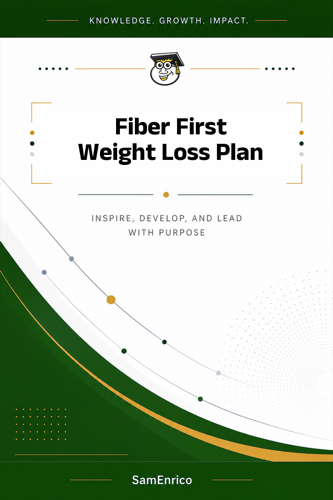
Non-FictionHealth & WellnessFiber
Fiber First Weight Loss Plan eBook
Load up on vegetables and legumes to fill your sto
Load up on vegetables and legumes to fill your stomach with low calorie volume.
Formats
Free sample
Chapter 1: The Starvation Lie--–- Every diet you have ever tried has lied to you. Not accidentally. Not carelessly. By design. The lie is simple, seductive, and devastatingly effective: If you just had more willpower, you would be thin.
This chapter dismantles that lie and replaces it with something far more useful—the truth about why hunger always wins and what to do about it.The $78 Billion Bet Against You Let us begin with a number that should make you angry: $78 billion. That is how much Americans spent on weight loss products and services last year. Not on groceries. Not on medicine. On weight loss.
And what did that $78 billion buy? For the vast majority of people, it bought failure. Study after study confirms what you already know from experience: 95 percent of dieters regain their lost weight within three years. Most regain more than they lost.The diet industry does not view this as a problem. It views this as a business model.Consider what happens when a diet actually works permanently.
That customer stops buying the meal replacements, the coaching sessions, the detox teas, the specialized cookbooks. A permanently thin customer is a lost customer. The industry requires churn—people who lose, regain, and return. This is not a conspiracy theory. This is publicly traded companies reporting quarterly earnings to shareholders.
Weight Watchers (now WW) has built its entire valuation on a 10 to 15 percent annual member churn rate. No churn, no profit.But here is what the industry does not want you to know: the failure is not your fault. The failure is baked into the premise of every diet that tells you to eat less and move more. That premise ignores the fundamental biology of hunger. And biology always wins.The Hunger Hormone You Cannot Outsmart Meet ghrelin.
It is a hormone produced primarily in your stomach lining, and its only job is to make you hungry. When your stomach is empty, ghrelin levels rise. When you eat, ghrelin levels fall. Simple, elegant, unstoppable.Now meet leptin. It is a hormone produced by your fat cells, and its only job is to signal satiety—to tell your brain that you have enough energy stored and do not need to eat.
When you have plenty of body fat, leptin levels rise. When you have less body fat, leptin levels fall.These two hormones worked perfectly for 99 percent of human evolutionary history. They kept our ancestors alive through feast and famine, ensuring they ate enough when food was available and conserved energy when it was scarce. They are still working perfectly today. The problem is not with the hormones.
The problem is with the environment they are operating in and the diets you are forcing them to ignore.When you go on a calorie-restricted diet—let us say, cutting from 2,500 calories per day to 1,500 calories per day—several things happen immediately. Ghrelin spikes. Your stomach senses that it is receiving less food than expected, so it produces more hunger hormones to motivate you to eat. Leptin drops. Your fat cells detect that you are losing stored energy, so they reduce satiety signaling to encourage you to replenish your reserves.
Your metabolic rate drops by 10 to 25 percent within days, as your body tries to conserve energy in response to perceived starvation. And your brain—specifically the hypothalamus, the region that regulates appetite—increases the hedonic value of food. Food tastes better when you are hungry. That is not a psychological quirk. That is a neurobiological adaptation designed to prevent starvation.You are not fighting a craving.
You are fighting 200,000 years of evolutionary programming with nothing but willpower. Willpower is a limited resource. Evolution is not.The False Promise of "Eat Less, Move More""Eat less, move more" is the most destructive piece of conventional wisdom in the history of public health. It is not wrong in the narrow sense—yes, weight loss requires a calorie deficit. It is wrong in the practical sense because it ignores everything we know about human behavior and biology.Consider what "eat less" actually means on a typical 1,500-calorie diet.
You are supposed to consume approximately 1.5 to 2 pounds of food per day. Your stomach can hold 2 to 4 pounds comfortably. On a standard diet, you are eating at the very bottom of your stomach's capacity. You are walking around slightly hungry all the time. Ghrelin is constantly elevated.
Leptin is suppressed. Your metabolism is slowing. And you are being told that the solution is more willpower.Now consider what "move more" actually means. Exercise is excellent for cardiovascular health, mental health, and longevity. It is terrible for weight loss as a primary strategy.
A 30-minute jog burns approximately 300 calories—roughly the equivalent of a bagel. You can eat that bagel in 90 seconds. You cannot outrun a bad diet, not because you are lazy but because the math does not work. The calorie cost of exercise is trivial compared to the calorie density of modern processed food.The Minnesota Starvation Experiment, conducted by Dr. Ancel Keys during World War II, provides a chilling illustration of what happens when humans are placed in a prolonged calorie deficit.
Thirty-six healthy men were fed 1,560 calories per day for six months—roughly the same intake as a standard weight loss diet. The results were devastating. The men became obsessed with food, thinking about it constantly. They lost sexual function. They became depressed, anxious, and withdrawn.
Their metabolic rates dropped by 40 percent. And when the experiment ended and they were allowed to eat freely, they binged—consuming up to 5,000 calories per day for months. Every single one regained all the weight they had lost, plus additional fat.This is not a failure of will. This is a predictable biological response to starvation. And yet the diet industry continues to sell you the same starvation model, repackaged with new branding, new supplements, and new celebrity spokespeople.Satiation Versus Satiety: The Critical Distinction To understand why fiber-first eating works, you need to understand two words that sound similar but mean very different things.
Most diets confuse them. That confusion is why you have been hungry for years.Satiation is the feeling of fullness that tells you to stop eating during a meal. It is the signal that says, "Put down the fork. You have had enough." Satiation is driven primarily by stomach stretch. When your stomach expands to a certain volume, stretch receptors send signals through the vagus nerve to your brain, triggering the release of cholecystokinin (CCK), a hormone that suppresses further eating.Satiety is the feeling of fullness that lasts between meals.
It is the signal that says, "You are not hungry yet. Wait a few hours before eating again." Satiety is driven primarily by nutrient density, particularly protein and fiber, which slow gastric emptying and trigger the release of peptide YY (PYY) and glucagon-like peptide-1 (GLP-1), hormones that keep hunger suppressed for hours after a meal.Traditional calorie-restricted diets fail at both. They reduce portion sizes, which means less stomach stretch, which means weaker satiation signals. You finish the meal feeling like you could eat more, because you physically could. And they reduce total food intake, which means faster gastric emptying, which means…
This is the end of the free sample. Get the eBook to keep going. Buy now
About this book
Details
- Author
- Lassiter Jackqueline
- Publisher
- SamEnrico
- Language
- English
- Genre
- Non-Fiction, Health & Wellness, Fiber
- Released
- 2026-06-07
- Pages (approx.)
- 146
- Available as
- eBook, Audiobook

Read better in the ZLOADR app
Your eBooks on your phone or tablet. Sign in with your SamEnrico account and start reading.
More by Lassiter Jackqueline
 The Preschooler Sleep HandbookLassiter Jackqueline$11.99
 Innocence Project Washington CasesLassiter Jackqueline$11.99
 Spain Energy Rehabilitation ProgramLassiter Jackqueline$11.99
 Chilean Green Incentives HandbookLassiter Jackqueline$11.99
 Bread or Blood: The 1919 Winnipeg General StrikeLassiter Jackqueline$11.99
 The Lost Climbers of the Seychelles: A 1920s Mountain Rescue MiracleLassiter Jackqueline$11.99
 Central Line InsertionLassiter Jackqueline$11.99
 PDP For Individual ContributorsLassiter Jackqueline$12.99
 EE After Study Permit ExpiryLassiter Jackqueline$12.99
 Understanding Chromosome 2Lassiter Jackqueline$17.99
 How to Start a Motor Starting and Controlling Gear Business (Beginners Guide)Lassiter Jackqueline$11.99
You may also like
 Hong Kong Handover 1997Dunn Johnnie$11.99
 Zumba For Postnatal Recovery CourseNeal Christian$11.99
 Zumba for BeginnersLadner Nikia$11.99
 YouTube Comment Mining GuideHumes Pandora$12.99
 Worry Box MeditationCarlin Rudy$11.99
 Workplace Stress MeditationNguyen Lynn$11.99
 Workplace Stress and Sleep RepairHawley Ivory$11.99
 Workplace Perfectionism CureDelaney Jeffry$11.99
 Workplace Injustice Anger GuideWallen Isabelle$11.99
 Work Addiction and Burnout LinkGreenwood Ester$11.99
 Women in Yoga and WellnessBeattie Galina$11.99
 Women in Stand Up ComedyChun Evangeline$11.99