
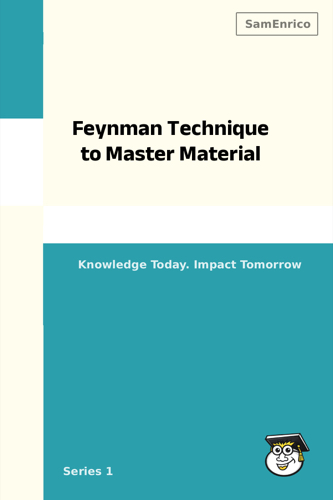
Non-FictionSelf-HelpTeaching Method
Feynman Technique to Master Material eBook
Teaches explaining concepts in simple language to
Teaches explaining concepts in simple language to identify knowledge gaps.
Formats
Free sample
Chapter 1: The Elegant Bomb--The Nobel Prize-winning physicist Richard Feynman was once asked by a Princeton graduate student to explain why magnets repel. The student, well-versed in quantum field theory, expected a lecture on virtual photons, exchange particles, and the electromagnetic force. Instead, Feynman paused, looked at the student with genuine curiosity, and said something that has become legendary among physicists: "When you push two magnets together, you feel a force. I can't explain that force in terms of anything you're more familiar with, because you're not familiar with that kind of force. That's the problem."The student was confused.
He wanted the complex answer, the one filled with equations and technical precision. Feynman refused to give it to him—not because he didn't know it, but because he understood something deeper about learning. Feynman knew that pretending to explain something by using complex language is not explanation at all. It is performance. And performance, no matter how technically accurate, does not produce understanding.This moment captures the central paradox of expertise: the more you know about a subject, the harder it often becomes to explain it simply.
This is not a failure of intelligence. It is a feature of how the brain organizes knowledge. Experts chunk information into dense, interconnected networks. A single word like "entropy" or "mitochondria" or "liability" carries the weight of years of study. But to a beginner, that word is just a sound.
The expert cannot un-know what they know, and so they vastly overestimate how clear they are being. This is the Curse of Knowledge, and it is the single greatest barrier to genuine mastery.This book is built on a radical proposition: simplicity is not the opposite of intelligence. Simplicity is the ultimate form of intelligence. The ability to take a complex idea—quantum mechanics, macroeconomics, constitutional law, or any other daunting subject—and strip it down to its essential moving parts, then explain those parts in language a curious child could understand, is not "dumbing down." It is the mark of someone who has truly mastered the material.The Feynman Technique, named after the man who embodied this principle, is a four-step method for identifying and closing the gaps in your understanding. But most people who have heard of the Feynman Technique know only a shallow version of it: "Pick a topic, explain it to a child, identify gaps, review." That is like saying "To build a house, get some wood, hammer some nails, and paint it." The statement is technically correct but practically useless.
This book is not that shallow summary. This book is the architectural blueprint.Over the next twelve chapters, you will learn not just the steps of the Feynman Technique, but the cognitive science that makes it work, the emotional discipline required to face your own ignorance, and the practical systems for turning temporary understanding into permanent expertise. You will learn how to select the right-sized concept to tackle, how to translate technical jargon into plain language without losing precision, how to identify the specific type of gap you are facing (because not all gaps are the same), and how to review your knowledge so that it sticks for years, not days.Before we dive into the mechanics, however, we must first understand why complexity has become a crutch—and why letting go of that crutch is the most liberating intellectual move you can make.The Curse of Knowledge: Why Experts Make Terrible Teachers In 1990, a Stanford graduate student named Elizabeth Newton conducted a simple but devastating experiment. She divided participants into two roles: "tappers" and "listeners." Tappers were given a list of well-known songs—"Happy Birthday," "The Star-Spangled Banner," and other melodies any American adult would recognize. The tapper's job was to tap out the rhythm of the song on a table.
The listener's job was to guess the song.Before the experiment began, Newton asked the tappers to predict how often listeners would guess correctly. The tappers estimated 50 percent. After all, the songs were obvious, weren't they? The rhythms were distinctive. Anyone should be able to recognize "Happy Birthday" from its rhythm.The actual result?
Listeners guessed correctly only 2.5 percent of the time.When a tapper taps a rhythm, they cannot help but hear the song in their own head. The melody, the lyrics, the emotional associations—all of it plays like a soundtrack. The listener hears only a series of disconnected thumps. The tapper is suffering from the Curse of Knowledge: once you know something, you cannot imagine what it is like not to know it.This is why Ph Ds often make terrible explainers. This is why textbooks are frequently unreadable.
This is why a brilliant physicist can leave a room full of students feeling lost and defeated. The expert is tapping the rhythm of quantum mechanics, hearing the full symphony in their head. The student hears only thumps.The Curse of Knowledge does not make you a bad person or a bad teacher. It makes you a normal human being. The brain is designed to automate expertise.
When you learn to drive a car, you initially think about every action: check the mirror, signal, turn the wheel, ease off the brake. After a few years, you arrive at your destination with no memory of the journey. The driving has become unconscious. That automation is efficient for performance but disastrous for explanation.To explain something, you must reverse the automation. You must break the chunk back down into its component parts.
You must remember what it was like to not know. And that is profoundly difficult. It requires a kind of intellectual empathy that does not come naturally to most people.This book is designed to train that empathy. The Feynman Technique is, at its core, a systematic method for breaking your own expertise back down into beginner-sized pieces. It is the deliberate practice of remembering what it feels like to be confused.Feynman's Notebooks: The Method Behind the Legend Richard Feynman was not born a genius explainer.
He worked at it. His famous Lectures on Physics, published after his death, are considered masterpieces of pedagogical clarity. But what most people do not see is the process behind those lectures. Feynman's notebooks—the actual working documents he used to prepare his teaching—reveal a systematic, almost obsessive process of translation.Every equation in his notebooks is preceded by a plain-English story. Before he wrote F=ma F = ma F=ma, he wrote: "When you push something, it speeds up.
The harder you push, the more it speeds up. If it is heavy, it speeds up less. If it is light, it speeds up more." Only after the story was clear did he add the symbols as shorthand.This ordering is crucial. Most students learn science backward. They memorize the equation first, then try to attach a story to it.
But the story is the understanding. The equation is just a compression algorithm. If you learn the equation first, you are learning to manipulate symbols without meaning. If you learn the story first, the equation becomes a convenient label for something you already grasp.Feynman applied this method even to quantum electrodynamics—a subject so counterintuitive that even…
This is the end of the free sample. Get the eBook to keep going. Buy now
About this book
Details
- Author
- Merriman Daysi
- Publisher
- SamEnrico
- Language
- English
- Genre
- Non-Fiction, Self-Help, Teaching Method
- Released
- 2026-06-07
- Pages (approx.)
- 148
- Available as
- eBook, Audiobook

Read better in the ZLOADR app
Your eBooks on your phone or tablet. Sign in with your SamEnrico account and start reading.
More by Merriman Daysi
 Name Recall Practice AppMerriman Daysi$11.99
 Stimulant Overdose RecognitionMerriman Daysi$11.99
 Self Esteem During AuditsMerriman Daysi$11.99
 Golden Child and ScapegoatMerriman Daysi$11.99
 OKRs for FreelancersMerriman Daysi$11.99
 Menopause Nap GuideMerriman Daysi$11.99
 Compulsive Spending And ManiaMerriman Daysi$11.99
 The Imperial Falcons of Constantinople: Guardians of the Byzantine SkiesMerriman Daysi$11.99
 The Angel of Death: The Chilling Case of Darya Nikolayevna KupinaMerriman Daysi$11.99
 How to Produce USB GadgetsMerriman Daysi$11.99
 Service Providers Guide to Equipment RentalsMerriman Daysi$11.99
 A Collector's Handbook to the Lamborghini Lp400sMerriman Daysi$11.99
You may also like
 Hong Kong Handover 1997Dunn Johnnie$11.99
 Zumba For Postnatal Recovery CourseNeal Christian$11.99
 Zumba for BeginnersLadner Nikia$11.99
 YouTube Comment Mining GuideHumes Pandora$12.99
 Worry Box MeditationCarlin Rudy$11.99
 Workplace Stress MeditationNguyen Lynn$11.99
 Workplace Stress and Sleep RepairHawley Ivory$11.99
 Workplace Perfectionism CureDelaney Jeffry$11.99
 Workplace Injustice Anger GuideWallen Isabelle$11.99
 Work Addiction and Burnout LinkGreenwood Ester$11.99
 Women in Yoga and WellnessBeattie Galina$11.99
 Women in Stand Up ComedyChun Evangeline$11.99