
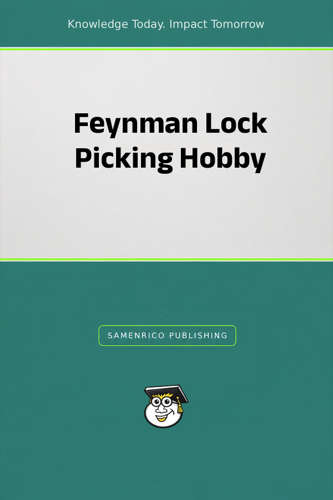
Feynman Lock Picking Hobby eBook
Learn how Feynman's safecracking skills became a l
Learn how Feynman's safecracking skills became a legendary part of his persona.
Formats
Free sample
Chapter 1: The Paperclip Epiphany...--–- The combination lock on the filing cabinet had no business being open. It was a sturdy Mosler, the kind the military trusted with classified documents, and by every official measure, it was secure. The dial had been spun to random numbers. The bolt was engaged. The documents inside—calculations for the implosion lens of the first atomic bomb—were supposed to be inaccessible to anyone without the three-number code.And yet, there Richard Feynman stood, the cabinet drawer sliding open on its metal runners, a bent paperclip still pinched between his fingers.It was 1943.
He was twenty-four years old. And in that moment, a bored physicist working on the most secret project in human history had just discovered something that the lock manufacturers didn't want you to know: A lock is not a wall. It is a conversation.The paperclip was not a key. It was not a skeleton key or a master key or any kind of key at all. It was a office supply, the kind that came in boxes of a hundred and held expense reports together.
But Feynman had discovered that if you bent it into a specific shape, inserted it into the keyway, and applied the right amount of pressure while jiggling it in a particular way, the lock would open as if you had the original key.He didn't understand why, at first. He only understood that it worked.That night, he didn't sleep. He lay on his cot in the hastily-built barracks of Los Alamos, staring at the ceiling, running his fingers through the air as if tracing the contours of an invisible lock. The question burned in his mind: What did my fingers feel that my eyes couldn't see?The Physics of "Stuck"To understand what Feynman discovered, you need to understand something about the nature of mechanical things. Every manufactured object is imperfect.
This is not a failure of manufacturing; it is a fundamental law of physics. No matter how precise the machine, there will always be tolerances—tiny gaps between moving parts, microscopic variations in shape, minuscule differences in spring tension.A lock is a collection of these imperfections stacked together. The pins are slightly undersized for their chambers. The springs have slightly different tensions. The plug (the part that turns) is slightly smaller than the housing that contains it.
These tolerances are not bugs; they are features. They allow the lock to function at all, because without gaps, the parts would bind and nothing would move.But here is the secret that Feynman understood: Those same gaps that allow the lock to work also allow it to be picked.When you insert a key into a lock, it lifts each pin to a specific height—the shear line—allowing the plug to turn. The key does this all at once, perfectly, because it was cut to the exact specifications of the lock. When you insert a paperclip, you are doing the same thing, but one pin at a time. You lift the first pin until it reaches the shear line.
The slight imperfections in the lock—the microscopic gap between the plug and the housing—hold that pin in place while you move to the next one. By the time you've lifted all the pins, the plug can turn freely.This is called "single pin picking," and it is the most fundamental skill in locksport. Every other technique—raking, zipping, bumping—is a variation on this basic principle: manipulate the pins individually until they all rest at the shear line.Feynman didn't learn this from a manual. He learned it by feel, by trial and error, by the sheer stubborn insistence that a lock is a physical system and physical systems can be understood. He pressed his paperclip against a pin and felt it move.
He applied tension and felt the pin set. He listened—not with his ears, but with his fingertips—and heard the lock telling him its secrets.The Map of the Unseen Let me ask you to imagine something. Close your eyes and hold a coin in your hand. Feel its edges, its weight, the temperature of the metal. Now imagine that you have to describe the coin to someone who has never seen one—not its appearance, but its feel.
The way the ridges on the edge catch your thumbnail. The way the faces are slightly recessed. The way the metal conducts heat away from your skin.You can do this because your fingers are exquisitely sensitive instruments. They can detect differences in texture smaller than a human hair. They can feel vibrations so subtle that your ears would miss them.
They can sense pressure changes measured in grams.A lock pick is an extension of your fingers. It transmits these sensations—the click of a pin reaching the shear line, the drag of a binding pin, the sudden release of tension when the plug turns—directly to your nervous system. With practice, you will be able to "see" the inside of a lock as clearly as if it were made of glass.Feynman developed this sensitivity to a supernatural degree. Colleagues at Los Alamos would watch him approach a safe, place his fingers on the dial, and close his eyes. He wasn't meditating.
He was listening. The slight resistance of the dial as it turned, the faint click of the fence dropping into a gate, the almost imperceptible change in spring tension when a wheel aligned—all of this was data, and his brain had been trained to interpret it.This is not magic. It is neuroplasticity—the ability of your brain to rewire itself in response to practice. Every time you pick a lock, your brain strengthens the neural pathways that process tactile feedback. Over time, sensations that once seemed impossibly subtle become obvious.
What Feynman could do after months of practice, you can learn as well.The First Principle of Manipulation Feynman was a physicist, and physicists think in first principles. A first principle is a basic truth that cannot be deduced from anything else. For locksport, the first principle is this: A lock is a system that wants to be open.Think about it. A lock is not designed to frustrate you. It is designed to be opened by a key—a specific shape of metal that lifts pins to specific heights.
The lock has no opinion about whether that shape arrives via a key or a paperclip. It only knows that when the pins are at the shear line, the plug turns.This is a liberating realization. The lock is not your enemy. It is a neutral mechanism, governed by physics, waiting for the correct input. Your job is not to defeat the lock; your job is to become the correct input.This mindset shift is critical.
Many people approach lock picking as a battle—a contest of wills between the picker and the lock. This is counterproductive. When you fight a lock, you apply too much tension. You force picks into keyways. You break tools and damage locks.
When you cooperate with a lock—when you listen to what it needs and provide exactly that—the lock opens almost effortlessly.Feynman…
This is the end of the free sample. Get the eBook to keep going. Buy now
About this book
Details
- Author
- Mccrary Chere
- Publisher
- SamEnrico
- Language
- English
- Genre
- Non-Fiction, Biography, Hobbies
- Released
- 2026-06-09
- Pages (approx.)
- 136
- Available as
- eBook, Audiobook

Read better in the ZLOADR app
Your eBooks on your phone or tablet. Sign in with your SamEnrico account and start reading.
More by Mccrary Chere
 Middle Child Syndrome RecoveryMccrary Chere$11.99
 Twelve Step for Self Harm RecoveryMccrary Chere$11.99
 DoorDash Time Blocking GuideMccrary Chere$11.99
 The Technical Difficulties ExamMccrary Chere$11.99
 Remote Therapy CommunicationMccrary Chere$11.99
 Anticipatory Grief and FinancesMccrary Chere$11.99
 Ankle Mobility and Foot Stretching GuideMccrary Chere$11.99
 Hearst Marion DaviesMccrary Chere$11.99
 The Midnight Tunneler: The Audacious Escape from Alcatraz’s ShadowMccrary Chere$11.99
 Ra’s Shadow: The Serpent’s Rebellion in the DuatMccrary Chere$11.99
 The Bone Thief of Yunnan: Unmasking the Lost Warriors of ChinaMccrary Chere$11.99
 Customer Service Participant ServicesMccrary Chere$11.99
You may also like
 Hong Kong Handover 1997Dunn Johnnie$11.99
 Zumba For Postnatal Recovery CourseNeal Christian$11.99
 Zumba for BeginnersLadner Nikia$11.99
 YouTube Comment Mining GuideHumes Pandora$12.99
 Worry Box MeditationCarlin Rudy$11.99
 Workplace Stress MeditationNguyen Lynn$11.99
 Workplace Stress and Sleep RepairHawley Ivory$11.99
 Workplace Perfectionism CureDelaney Jeffry$11.99
 Workplace Injustice Anger GuideWallen Isabelle$11.99
 Work Addiction and Burnout LinkGreenwood Ester$11.99
 Women in Yoga and WellnessBeattie Galina$11.99
 Women in Stand Up ComedyChun Evangeline$11.99