
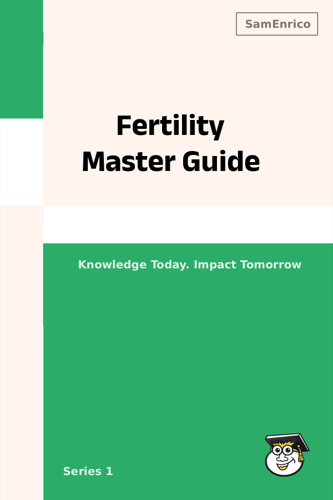
Non-FictionHealth & WellnessComplete
Fertility Master Guide eBook
Complete reference for trying to conceive.
Complete reference for trying to conceive.
Formats
Free sample
Chapter 1: The Hidden Blueprint...--–- Most couples trying to conceive operate under a dangerous assumption: that pregnancy is simple, that the body runs like clockwork, and that if it doesn't happen quickly, something must be terribly wrong. The truth is far more nuanced—and far more empowering. Conception is not a single event but a complex cascade of hormonal signals, anatomical alignments, and biological timing. Understanding this hidden blueprint transforms anxiety into action, self-blame into strategy, and guesswork into precision.This chapter is not a biology textbook. It is a field guide to your own body.
You will learn the rhythm of your cycle, the secret language of your cervical mucus, the surprising lifespan of sperm, and the red flags that warrant medical attention. By the final page, you will move from passive participant to active investigator in your fertility journey.The Menstrual Cycle: Your Body's Monthly Symphony The menstrual cycle is not a countdown to your period. It is a carefully orchestrated hormonal symphony with four distinct movements. Most women learn only two phases—"fertile" and "not fertile"—but the truth is richer and more useful.The Follicular Phase: The Recruiting Period Day one of your menstrual cycle is the first day of full flow bleeding. From this day until ovulation, you are in the follicular phase.
The length of this phase varies dramatically from woman to woman and even from cycle to cycle. It can last anywhere from 10 to 22 days, which is why calendar-based predictions of ovulation are so unreliable.During this phase, your pituitary gland releases follicle-stimulating hormone (FSH). Despite its name, FSH does not stimulate follicles directly—it signals a group of eggs to begin their final 90-day maturation sprint. Each egg resides inside a fluid-filled sac called a follicle. Typically, five to twenty follicles begin growing each cycle, but only one (occasionally two) becomes dominant and completes the journey to ovulation.
The others naturally degenerate.As the dominant follicle grows, it produces rising levels of estrogen. This estrogen thickens your uterine lining (the endometrium) to create a welcoming bed for a potential embryo. It also changes your cervical mucus from thick and impenetrable to thin and sperm-friendly. By the end of the follicular phase, a surge of luteinizing hormone (LH) triggers the final release of the egg.Ovulation: The 24-Hour Window Ovulation is the moment the egg is released from the dominant follicle. It is not a gradual process.
The follicle ruptures, and the egg is swept into the fallopian tube by finger-like projections called fimbriae. This entire event takes seconds, but the egg's fertile lifespan is only 12 to 24 hours after release.If conception does not occur during this window, the egg dissolves and is absorbed by the body. No amount of well-timed intercourse after ovulation can result in pregnancy—the egg is already gone.The Luteal Phase: The Waiting Period After ovulation, the ruptured follicle transforms into the corpus luteum, a temporary endocrine gland that produces progesterone. Progesterone is the "pregnancy support hormone." It stabilizes the uterine lining, prevents premature shedding, and raises your basal body temperature.The luteal phase is remarkably consistent from cycle to cycle for most women, lasting 12 to 16 days. If pregnancy occurs, the embryo produces human chorionic gonadotropin (h CG), which signals the corpus luteum to keep producing progesterone.
If pregnancy does not occur, the corpus luteum degenerates, progesterone levels plummet, and the uterine lining sheds as your period.The Fertile Window: Why Timing Is Everything Here is the single most important fact in this entire chapter: the fertile window is approximately six days per cycle. This is not because the egg lives for six days—it does not. It is because sperm can survive for up to five days inside the female reproductive tract when fertile cervical mucus is present. The egg then lives for 12 to 24 hours. Add the five days before ovulation to the day of ovulation, and you get a six-day window.Sperm survival is not automatic.
In the absence of fertile cervical mucus, sperm die within a few hours. But when estrogen peaks just before ovulation, your cervix produces abundant, clear, stretchy mucus—often called "egg white cervical mucus" because of its resemblance to raw egg white. This mucus has three critical properties: it is alkaline (sperm prefer alkaline environments), it is nutrient-rich (providing energy for the long journey), and it creates channels that guide sperm toward the cervix.Understanding the fertile window transforms your approach to trying to conceive. Instead of having intercourse every day of your cycle (which is exhausting and often unsustainable), you can focus your energy on the five days before and the day of ovulation. You do not need to hit every single day.
Every other day within the fertile window provides excellent coverage.Sperm 101: The Unseen Partner For decades, fertility has been framed as a woman's issue. This is a profound and harmful misconception. Male factor infertility contributes to approximately 40 to 50 percent of all couples experiencing difficulty conceiving. In many cases, both partners contribute to the challenge.The 90-Day Rule Sperm are not produced on demand. The journey from germ cell to mature, motile sperm takes a full 90 days.
This means that the sperm you ejaculate today began their development three months ago. Any lifestyle change—dietary improvement, supplement addition, toxin reduction—takes approximately three months to affect sperm quality.This timeline is both sobering and liberating. It means that if you have been exposed to a fertility-damaging factor (fever, medication, alcohol binge, hot tub use), you do not need to panic about immediate effects. It also means that patience is required when implementing positive changes.Key Parameters of Semen Analysis When you eventually undergo fertility testing (see Chapter 6 for timing guidelines), the semen analysis will report three main parameters:Count (concentration): Normal is 15 million or more sperm per milliliter. Low count is called oligospermia.
Very low count (less than 5 million) may require advanced reproductive assistance.Motility (movement): Normal is 40 percent or more total motile sperm. Progressive motility (swimming forward in a straight line) is most important for natural conception. Poor motility is called asthenospermia.Morphology (shape): Normal forms are typically 4 percent or higher using strict Kruger criteria. Low morphology is called teratozoospermia. Isolated low morphology (normal count and motility) is rarely a barrier to natural conception.What Damages Sperm Sperm are exquisitely sensitive to environmental factors.
The most common disruptors include:Heat: The testicles are located outside the body for a reason—they require a temperature two to four degrees Celsius below core body temperature. Frequent hot tub use, saunas, heated car seats, laptops on the lap, and even tight underwear can temporarily lower sperm production. The effect is fully reversible within three months of removing the heat source.Infection and Fever: A fever over 101 degrees Fahrenheit can temporarily halt sperm production. The effect appears approximately two weeks after the fever and lasts for up to three months. This is not a cause for alarm—it is a predictable, reversible phenomenon.Medications and Substances: Testosterone therapy (including gels, injections, and pellets) shuts down natural sperm production.
Many bodybuilding supplements contain testosterone-like compounds that do the same. Finasteride (for hair loss) and some antidepressants can also impair sperm quality.Lifestyle…
This is the end of the free sample. Get the eBook to keep going. Buy now
About this book
Details
- Author
- Koontz Ferdinand
- Publisher
- SamEnrico
- Language
- English
- Genre
- Non-Fiction, Health & Wellness, Complete
- Released
- 2026-06-06
- Pages (approx.)
- 125
- Available as
- eBook, Audiobook

Read better in the ZLOADR app
Your eBooks on your phone or tablet. Sign in with your SamEnrico account and start reading.
More by Koontz Ferdinand
 DoorDash Dasher Equipment ChecklistKoontz Ferdinand$11.99
 Maintaining Gains Long TermKoontz Ferdinand$11.99
 Processing Rejection NightmaresKoontz Ferdinand$11.99
 The Isochronic Tones MethodKoontz Ferdinand$11.99
 Public Speaking for Non NativeKoontz Ferdinand$11.99
 Doe Network Mental Health AdvocacyKoontz Ferdinand$11.99
 Adversity Growth Mindset GuideKoontz Ferdinand$11.99
 The Emperor's Secret Affair: A Love That Shook an EmpireKoontz Ferdinand$11.99
 The Storm at Tsushima: Japan's Naval MiracleKoontz Ferdinand$11.99
 A Collector's Handbook to the Singer SmxKoontz Ferdinand$11.99
 How to Produce Apricot KernelsKoontz Ferdinand$11.99
 Franchise International Awards GuideKoontz Ferdinand$12.99
You may also like
 Hong Kong Handover 1997Dunn Johnnie$11.99
 Zumba For Postnatal Recovery CourseNeal Christian$11.99
 Zumba for BeginnersLadner Nikia$11.99
 YouTube Comment Mining GuideHumes Pandora$12.99
 Worry Box MeditationCarlin Rudy$11.99
 Workplace Stress MeditationNguyen Lynn$11.99
 Workplace Stress and Sleep RepairHawley Ivory$11.99
 Workplace Perfectionism CureDelaney Jeffry$11.99
 Workplace Injustice Anger GuideWallen Isabelle$11.99
 Work Addiction and Burnout LinkGreenwood Ester$11.99
 Women in Yoga and WellnessBeattie Galina$11.99
 Women in Stand Up ComedyChun Evangeline$11.99