
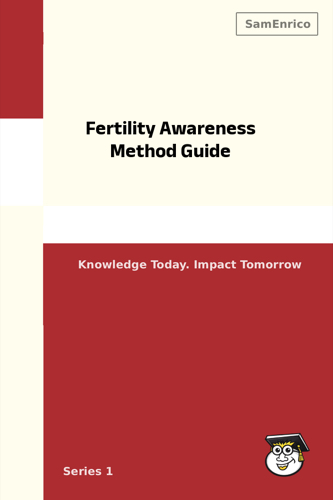
Non-FictionHealth & WellnessFAM
Fertility Awareness Method Guide eBook
Track cervical mucus and basal temperature to avoi
by Adcock Misha
Track cervical mucus and basal temperature to avoid pregnancy without hormones.
Formats
Free sample
Chapter 1: The 28-Day Lie...--–- The first lie you were told about your body came wrapped in a pink cardboard box with a smiling woman on the front. It arrived sometime in your teenage years, probably in a health class or a pediatrician’s office, delivered with the casual authority of someone explaining that the sky is blue. “The average menstrual cycle is 28 days,” they said. “Ovulation occurs on day 14.” You wrote it down. You memorized it.
You believed it. And for years—maybe decades—you organized your life, your expectations, and your anxieties around a calendar that was never actually true for most women. This chapter is not an introduction to the menstrual cycle. It is an intervention. Before you can learn to track cervical mucus or interpret basal body temperature, you must first unlearn the single most damaging myth in reproductive health: that your body is supposed to operate on a neat, predictable, 28-day schedule.
The truth is messier, more variable, and far more fascinating. And once you understand the real architecture of your cycle, the entire Fertility Awareness Method will make sense—not as a set of arbitrary rules, but as a logical response to the biology you actually have.The invention of the 28-day “norm” is not a biological fact. It is a statistical convenience, born from a 1930s study of just a few hundred women, averaged together, and then taught as universal truth for nearly a century. In reality, fewer than 15% of women have a 28-day cycle. Most healthy, ovulatory cycles range from 21 to 35 days, with some falling outside even that range.
More importantly, cycle length is not fixed. Your own cycles can vary by several days from month to month without indicating anything abnormal. A woman who has a 26-day cycle one month, a 31-day cycle the next, and a 29-day cycle the month after has not “irregular” cycles. She has normal cycles. The calendar-based rhythm method—which tells you to abstain from intercourse on certain numbered days based on past cycles—fails precisely because it assumes your body will repeat itself.
Your body does not repeat itself. It responds to stress, sleep, travel, illness, diet, exercise, and a thousand other variables. And that is not a flaw. It is a feature. Your cycle is a living conversation between your brain and your ovaries, not a train schedule.To understand why the 28-day myth is so dangerous for anyone using Fertility Awareness for contraception, you need to understand the two distinct halves of your cycle.
They are not symmetrical. They do not behave the same way. And confusing them is the fastest path to an unintended pregnancy.The first half of your cycle is called the follicular phase. It begins on the first day of full menstrual flow—what you call day one of your period—and ends the day you ovulate. This phase is variable.
Wildly variable. It can last seven days. It can last seven weeks. In some circumstances (postpartum, perimenopause, or after stopping hormonal birth control), it can last months. The length of your follicular phase depends on how long it takes your ovaries to recruit, mature, and release a dominant follicle.
Estrogen rises slowly, then rapidly. Cervical mucus changes from absent to sticky to creamy to watery to egg white. Your body is preparing for a possible pregnancy, and it takes as much time as it needs. The follicular phase does not consult your calendar. It does not care that you have a vacation planned or that your partner is only in town for three days.
It follows its own biological logic, influenced by hormones that respond to your environment.The second half of your cycle is called the luteal phase. It begins the day after ovulation and ends the day before your next period. This phase is relatively fixed. For almost all women with ovulatory cycles, the luteal phase lasts between 12 and 16 days. In 95% of cycles, it is 14 days plus or minus two.
The reason the luteal phase is stable is that it is governed by the lifespan of the corpus luteum—the temporary endocrine structure that forms on your ovary after you release an egg. The corpus luteum produces progesterone, which raises your temperature and stabilizes your uterine lining. After approximately 14 days, if pregnancy has not occurred, the corpus luteum dies, progesterone drops, and you get your period. Your body has no control over this timeline. It is biologically fixed.Here is the key insight that changes everything: when women say they have “irregular cycles,” they almost always mean that their follicular phase varies in length.
The luteal phase remains constant. This means that ovulation can shift earlier or later, but once ovulation occurs, your period will arrive roughly 12 to 16 days later. This predictability of the luteal phase is what makes the Symptothermal Method of FAM possible. You do not need to predict ovulation in advance. You only need to identify that it has happened—using temperature—and then count forward to confirm the end of the fertile window.Now consider the biological window for conception.
This is where the calendar myth becomes actively dangerous. Sperm deposited into the reproductive tract during the fertile window can survive for an astonishing length of time: five to seven days in the presence of fertile-quality cervical mucus. The egg, by contrast, survives for only 12 to 24 hours after ovulation. This asymmetry means that the fertile window opens long before ovulation occurs. In fact, the most fertile days are the three days leading up to ovulation and the day of ovulation itself.
A couple who has unprotected intercourse five days before ovulation can still conceive. A couple who waits until the day after ovulation—thinking they missed the window—is safe, because the egg is already gone. But most people get this backwards. They worry about the day of ovulation and ignore the week before. This is why the rhythm method fails.
It tells you to avoid intercourse on days 10 through 17 of a 28-day cycle, assuming that ovulation occurs on day 14. But if your follicular phase is short and you ovulate on day 10, you have already been fertile since day 5. If your follicular phase is long and you ovulate on day 21, you might have avoided intercourse unnecessarily for a week before your fertile window even opened. Either way, you are guessing. And guessing is not a contraceptive method.The hormonal orchestra that conducts this entire process involves three main players: estrogen, luteinizing hormone (LH), and progesterone.
Understanding their roles will make every subsequent chapter—on mucus, temperature, and charting—feel intuitive rather than memorized.Estrogen is the architect of fertility. During the follicular phase, rising estrogen from developing ovarian follicles triggers two critical changes. First, it stimulates the cervical crypts—gland-like structures in the cervix—to produce increasingly fertile mucus. This mucus is not just a sign of fertility; it is the biological medium that allows sperm to survive and swim. Without fertile mucus, sperm die within hours.
With it, they can live for nearly a week. Second, estrogen thickens and nourishes the uterine lining, preparing a welcoming environment for a potential embryo. As estrogen approaches its peak, it triggers a dramatic…
This is the end of the free sample. Get the eBook to keep going. Buy now
About this book
Details
- Author
- Adcock Misha
- Publisher
- SamEnrico
- Language
- English
- Genre
- Non-Fiction, Health & Wellness, FAM
- Released
- 2026-06-08
- Pages (approx.)
- 148
- Available as
- eBook, Audiobook

Read better in the ZLOADR app
Your eBooks on your phone or tablet. Sign in with your SamEnrico account and start reading.
More by Adcock Misha
 Boomer Auto PreferenceAdcock Misha$11.99
 Creative Habits for Project ManagersAdcock Misha$11.99
 Niacin Cholesterol Reduction GuideAdcock Misha$11.99
 Disney Villain Voice StoriesAdcock Misha$11.99
 Assertive Tone of VoiceAdcock Misha$11.99
 Senior Hearing Loss EsteemAdcock Misha$11.99
 Pelvic Nerve PainAdcock Misha$11.99
 The Opium Wars of the Golden Triangle: The Warlord's GambitAdcock Misha$11.99
 Hypatia of Alexandria: The Last Oracle of the Classical WorldAdcock Misha$11.99
 How to Produce Cove BASEAdcock Misha$11.99
 Harriers: Scent Hound BreedAdcock Misha$11.99
 Ramadan B2B Selling EtiquetteAdcock Misha$12.99
You may also like
 Hong Kong Handover 1997Dunn Johnnie$11.99
 Zumba For Postnatal Recovery CourseNeal Christian$11.99
 Zumba for BeginnersLadner Nikia$11.99
 YouTube Comment Mining GuideHumes Pandora$12.99
 Worry Box MeditationCarlin Rudy$11.99
 Workplace Stress MeditationNguyen Lynn$11.99
 Workplace Stress and Sleep RepairHawley Ivory$11.99
 Workplace Perfectionism CureDelaney Jeffry$11.99
 Workplace Injustice Anger GuideWallen Isabelle$11.99
 Work Addiction and Burnout LinkGreenwood Ester$11.99
 Women in Yoga and WellnessBeattie Galina$11.99
 Women in Stand Up ComedyChun Evangeline$11.99