
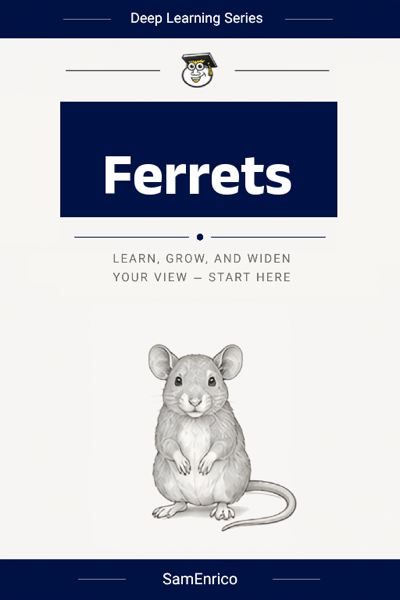
Ferrets eBook
A Coursebook on Ferrets
A Coursebook on Ferrets
Formats
Free sample
Chapter 1: The Shadow of the Polecat...--–- On a cool evening in the English countryside, a domesticated ferret escaped its hutch. Within forty-eight hours, it was found alive, healthy, and hunting voles in a hedgerow. It had not starved. It had not panicked. It had simply returned to a blueprint written ten thousand generations before its birth.
That seemingly insignificant escape reveals the first and most important truth about owning a ferret: you are not bringing a tame hamster into your home. You are inviting a semi-domesticated predator whose instincts remain sharp enough to survive without you. Most first-time owners learn this lesson the hard way—usually when their new pet bites their ankle, hoards their car keys under the sofa, or sleeps for twenty hours and then explodes into what appears to be a seizure but is actually a invitation to play. Understanding the ferret means abandoning everything you think you know about traditional pets. A dog wants to please you.
A cat wants to use you. A ferret wants to hunt with you, and if you are not available, it will hunt alone.This chapter establishes the biological, evolutionary, and historical foundation for every subsequent decision you will make as a ferret owner. By the time you finish reading, you will understand why ferrets sleep eighteen to twenty hours per day, why they stash your belongings, why they nip at your heels, and why their digestive systems cannot process a single green bean. You will also learn why the domestic ferret is neither a rodent nor a member of the weasel family you might encounter in your backyard. More importantly, you will gain the perspective necessary to distinguish between normal ferret behavior and signs of genuine distress—a distinction that separates successful owners from those who rehome their pets within six months.
The shadow of the polecat falls across every ferret alive today, and learning to see that shadow is the first step toward becoming not just an owner, but a guardian.The Taxonomy of Confusion: What a Ferret Is Not Before discussing what a ferret is, we must clear away the misconceptions that plague pet stores and internet forums. The domestic ferret (Mustela putorius furo) belongs to the family Mustelidae, which includes weasels, minks, otters, badgers, and wolverines. Notice that rodents—mice, rats, hamsters, guinea pigs—are entirely absent from this list. Yet countless ferret owners have been asked, "Do you have to worry about rabies from your giant rat?" The answer is no, because ferrets are not rodents. They are carnivorous mustelids, and their closest wild relative is the European polecat (Mustela putorius), not the North American black-footed ferret (which is a different species entirely, Mustela nigripes).
This distinction matters because rodent biology and ferret biology share almost nothing in common. Rodents have continuously growing incisors and can survive on plant matter. Ferrets have fixed canine teeth designed to puncture flesh and require a diet almost entirely composed of animal protein.The second misconception: ferrets are wild animals. They are not. Domestication began at least 2,500 years ago, likely in the Mediterranean region, where humans discovered that polecat kittens could be raised to chase rabbits out of burrows.
Unlike dogs, which were domesticated for companionship and work simultaneously, ferrets were domesticated for a single purpose: hunting. This narrow selection pressure means ferrets remain closer to their wild ancestors than dogs do to wolves. A ferret will not form the same pack-bond with a human that a dog will. Instead, a ferret forms a hunting partnership. It sees you as a large, clumsy, but useful companion who can open doors, move furniture, and provide high-value food.
That is not a limitation; it is a different kind of relationship, one that rewards observation and respect rather than blind obedience.The third misconception: ferrets are essentially the same as the wild mustelids found in North America, such as fishers or martens. This is dangerously incorrect. Wild mustelids have territories measured in square miles and metabolisms tuned to constant hunting. Domestic ferrets have been selected for tractability, smaller size, and a reduced flight response. A wild mink will fight to the death when cornered.
A ferret will hiss, nip, and then—almost always—retreat or accept handling. That said, the domestic ferret retains enough wild instinct to escape a poorly secured cage, kill a pet bird left within reach, and survive outdoors for weeks. Respecting the wild shadow does not mean fearing the animal; it means acknowledging that your living room contains a creature that, given enough motivation, will revert to behaviors perfected over millions of years of evolution.The 2,500-Year Partnership: From Rabbiting to Recliners Archaeological evidence places ferret domestication around 500 BCE in the Mediterranean basin, with clear references appearing in Greek and Roman texts describing the use of "viverrae" (likely polecats or early ferrets) for rabbit hunting. The Romans spread ferrets across Europe as they expanded their empire, using them to control rabbit populations that would otherwise devastate crops. By the Middle Ages, ferrets were firmly established in European agriculture, and the practice of "rabbiting"—sending a ferret into burrows to flush rabbits into nets—became a specialized craft.
Medieval ferrets were valuable enough to appear in manorial records as property, and laws regulated their ownership and trade.The English language preserves this history in unexpected places. The word "ferret" comes from the Latin furittus, meaning "little thief," a reference to the animal's habit of stealing eggs and small prey. The collective noun for ferrets—a "business" of ferrets—dates to the 15th century, when a group of working ferrets was indeed serious business for a household dependent on rabbit meat and fur. Even the phrase "ferret out," meaning to search determinedly, derives directly from the animal's hunting style: relentless, thorough, and willing to go where humans cannot follow.The Industrial Revolution marked the beginning of ferrets' transition from working animal to pet. As rural populations moved to cities, rabbit hunting became less practical, but ferrets' small size, playful nature, and adaptability made them appealing companions.
By the Victorian era, ferrets appeared in pet manuals alongside dogs and cats, though always with the caveat that they required specialized handling. The 20th century saw ferrets become common laboratory animals, particularly in influenza research (ferrets are one of the few animals that contract human flu strains), which paradoxically advanced veterinary knowledge while cementing their reputation as "odd" pets.Today, ferrets occupy an ambiguous position. In the United States, they are the third most common pet mammal after dogs and cats, yet they remain illegal in California and Hawaii. In the United Kingdom, ferrets are widely accepted as pets, though working ferrets are still bred for rabbiting. In Japan, ferret cafes have become tourist attractions, while in Australia, ferrets are banned entirely due to concerns about their impact on native wildlife.
This patchwork of acceptance reflects a deeper tension: ferrets are domesticated enough to thrive in human homes but wild enough to threaten ecosystems if released. Understanding this history explains why ferret ownership comes with legal restrictions, why rescues are full of surrendered animals, and why your first responsibility as an owner is to prevent escape at all costs.The Biology of…
This is the end of the free sample. Get the eBook to keep going. Buy now
About this book
Details
- Author
- Mcinnis Josefine
- Publisher
- SamEnrico
- Language
- English
- Genre
- Non-Fiction, Informative, Educational
- Released
- 2026-06-02
- Pages (approx.)
- 160
- Available as
- eBook, Audiobook

Read better in the ZLOADR app
Your eBooks on your phone or tablet. Sign in with your SamEnrico account and start reading.
More by Mcinnis Josefine
 Parenting Conversation GuideMcinnis Josefine$11.99
 Dust Ingestion Prevention GuideMcinnis Josefine$11.99
 Body Scan During Fertility TreatmentMcinnis Josefine$11.99
 Collector Edition Buyer ProfileMcinnis Josefine$11.99
 MBSR for Cancer PatientsMcinnis Josefine$11.99
 Baba Yaga's Lament: The Witch's Forbidden BalladMcinnis Josefine$11.99
 Understanding Pulmonary Artery Familial DilatationMcinnis Josefine$17.99
 Wholesale Marketing One Page PlanMcinnis Josefine$12.99
 Rippling GuideMcinnis Josefine$12.99
 How to Become a Oil-burner-servicer-and-installer HelperMcinnis Josefine$11.99