
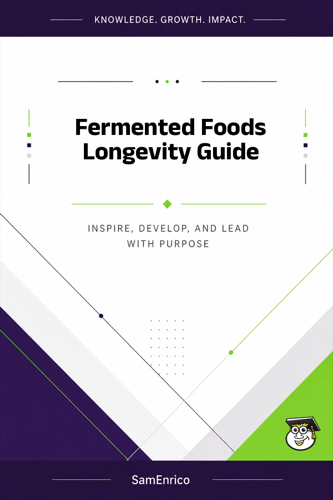
Non-FictionHealth & WellnessMicrobiome
Fermented Foods Longevity Guide eBook
Eat naturally fermented foods like sourdough, miso
Eat naturally fermented foods like sourdough, miso, and kimchi for gut health.
Formats
Free sample
Chapter 1: The Longevity Paradox--–- The woman sitting across from me in my consultation room was only 48, but her body moved like someone two decades older. She eased herself into the chair slowly, wincing as her right knee bent. Her name was Maria—a pseudonym she asked me to use because she was embarrassed. Embarrassed that a former college athlete now struggled to button her jeans. Embarrassed that she needed a nap by 2 PM every day.
Embarrassed that her doctor had just told her, gently but firmly, that her blood work was "completely normal" and that she should "expect these changes" as she approached her fifties.Maria had done everything right. She ate salads for lunch. She avoided fast food. She exercised three times a week. She took a probiotic supplement recommended by a popular wellness influencer.
And yet, here she was—bloated, exhausted, and secretly terrified that the next twenty years would feel like a slow, steady decline into frailty.I asked her to describe a typical day of eating. She pulled out her phone and showed me her food log. Breakfast: Greek yogurt with berries and a gluten-free granola. Lunch: a large salad with grilled chicken, quinoa, and a store-bought vinaigrette. Dinner: salmon with roasted vegetables and a small sweet potato.
Snacks: rice cakes with almond butter, a kombucha from the grocery store, the occasional piece of dark chocolate.From a conventional nutrition standpoint, Maria's diet was impeccable. It was the kind of diet that gets featured in wellness magazines. It was low in processed sugar, rich in vegetables, and contained a variety of protein sources. By every standard metric, Maria should have been thriving.But she wasn't.And that is the paradox at the heart of this book. The most well-intentioned "healthy" eaters in the modern world are often the ones suffering the most—not because they're doing something wrong, but because they're missing something essential.
Something invisible. Something that our ancestors understood intuitively but that modern nutrition science has only recently begun to measure.Maria needed to rewild her gut. And the key to that rewilding sat, unassumingly, in jars of naturally fermented foods that cost pennies to make and had been nourishing human beings for ten thousand years.The Moment Everything Changed I first became interested in the connection between fermented foods and longevity not through a textbook, but through a grandmother. My own grandmother, to be precise. She was born in 1928 in a small village in southern Italy, a place where refrigeration was a luxury that didn't arrive until the 1960s.
Every autumn, she and her mother would spend an entire weekend transforming the last harvest of cabbages, peppers, and eggplants into jars of fermented vegetables that would sustain the family through the winter.She didn't know the word "probiotic." She had never heard of the gut microbiome. But she knew, with the unshakable certainty of lived experience, that eating something fermented every day kept her healthy. When I was a child, she would spoon a small amount of brine from her fermenting crock into a cup and make me drink it before breakfast. "This is your medicine," she would say. I thought she was being superstitious.She lived to be 94.
She gardened until she was 90. She never took a statin, never had a hip replacement, and never once complained about "brain fog." Her final years were not a slow decline but a sharp, mercifully short fade. And when she died, the only thing in her refrigerator—literally the only thing—was a half-empty jar of fermented peppers.That jar sat in my refrigerator for three months after she passed. I couldn't bring myself to throw it away. It smelled like her kitchen.
It smelled like my childhood. And eventually, it became the catalyst for a question that would change the course of my career: what did my grandmother know that modern medicine has forgotten?What the Blue Zones Actually Eat In 2004, National Geographic fellow Dan Buettner assembled a team of demographers, anthropologists, and epidemiologists to identify the world's longest-lived populations. They called these regions "Blue Zones," and the original five were Okinawa (Japan), Sardinia (Italy), Nicoya (Costa Rica), Ikaria (Greece), and the Seventh-day Adventist community in Loma Linda, California.The media coverage of the Blue Zones has tended to focus on surface-level observations: eat mostly plants, move naturally, have a sense of purpose, drink red wine in moderation. All of these are valid. But the research teams noticed something else, something that rarely makes the headlines: every single Blue Zone population consumes naturally fermented foods daily.Let me say that again.
Not some of them. Not most of them. Every single one.In Okinawa, they eat fermented soy in the form of miso soup with most meals, plus a fermented soybean paste called tofuyo.In Sardinia, sourdough bread is a staple, made using a starter culture (called "sa madia") that has often been passed down for generations.In Nicoya, a fermented corn beverage called chicha is traditional, along with naturally fermented cabbage curtido (similar to kimchi).In Ikaria, homemade sourdough, wild fermented goat milk yogurt, and fermented wild greens are daily foods.In Loma Linda, many Adventists consume fermented plant milks, sourdough, and naturally fermented pickles.The Blue Zone populations didn't set out to optimize their microbiomes. They didn't spend money on probiotic supplements or read articles about gut health. They simply ate the way their ancestors ate—and that way included live, fermented foods with every meal.Maria, by contrast, was eating a "healthy" diet that was almost entirely sterile.
Her Greek yogurt was pasteurized after fermentation (killing most of the live bacteria). Her kombucha was store-bought and likely diluted. Her probiotic supplement contained perhaps three or four isolated strains of bacteria—a tiny fraction of the hundreds of species present in a single jar of homemade kimchi. Her salads, however nutritious in terms of vitamins and minerals, contained no live microbes whatsoever.She was feeding her body. But she was starving her gut.The Hygiene Hypothesis: When Clean Becomes Dangerous To understand why Maria was suffering, we need to travel back to 1989.
That year, a British epidemiologist named David Strachan published a paper that would fundamentally change how scientists think about allergies, autoimmune disease, and—eventually—aging itself. Strachan noticed that children in larger families had lower rates of hay fever and eczema than children in smaller families. His explanation became known as the Hygiene Hypothesis: exposure to microbes early in life trains the immune system to distinguish between threats and non-threats. When that exposure is absent, the immune system becomes hyperactive, attacking harmless things like pollen, dust mites, and even the body's own tissues.In the three decades since Strachan's paper, the Hygiene Hypothesis has been expanded and refined. We now know that it's not just about childhood allergies.
It's about the entire relationship between the human immune system and the microbial world. And it's about something even more fundamental: inflammaging.Inflammaging is a term coined by immunologist Claudio Franceschi in 2000. It describes the chronic, low-grade inflammation that accumulates as we age. Unlike acute inflammation (the redness and swelling you get from a cut), inflammaging is silent. It doesn't hurt.
It doesn't show up on standard blood tests. But it is the single most powerful driver of age-related decline.Here's what…
This is the end of the free sample. Get the eBook to keep going. Buy now
About this book
Details
- Author
- Lawrence Gretchen
- Publisher
- SamEnrico
- Language
- English
- Genre
- Non-Fiction, Health & Wellness, Microbiome
- Released
- 2026-06-06
- Pages (approx.)
- 144
- Available as
- eBook, Audiobook

Read better in the ZLOADR app
Your eBooks on your phone or tablet. Sign in with your SamEnrico account and start reading.
More by Lawrence Gretchen
 The Autonomy Motivation GuideLawrence Gretchen$11.99
 Resume Gap Cover LetterLawrence Gretchen$11.99
 Diaphragmatic Breathing PelvicLawrence Gretchen$11.99
 Stress Mitochondrial HealthLawrence Gretchen$11.99
 The Poisoner's Garden: A Victorian Venomologist's Dark LegacyLawrence Gretchen$11.99
 Nairobi vs Kigali StartupsLawrence Gretchen$12.99
 Facebook Ads Manager Mobile AppLawrence Gretchen$12.99Facebook Ads Manager Mobile AppLawrence Gretchen$12.99Facebook Ads Manager Mobile AppLawrence Gretchen$12.99Facebook Ads Manager Mobile AppLawrence Gretchen$12.99
 The Breeder's Guide to Brahma ChickensLawrence Gretchen$11.99
 Clinical Exercise PhysiologistLawrence Gretchen$11.99
You may also like
 Hong Kong Handover 1997Dunn Johnnie$11.99
 Zumba For Postnatal Recovery CourseNeal Christian$11.99
 Zumba for BeginnersLadner Nikia$11.99
 YouTube Comment Mining GuideHumes Pandora$12.99
 Worry Box MeditationCarlin Rudy$11.99
 Workplace Stress MeditationNguyen Lynn$11.99
 Workplace Stress and Sleep RepairHawley Ivory$11.99
 Workplace Perfectionism CureDelaney Jeffry$11.99
 Workplace Injustice Anger GuideWallen Isabelle$11.99
 Work Addiction and Burnout LinkGreenwood Ester$11.99
 Women in Yoga and WellnessBeattie Galina$11.99
 Women in Stand Up ComedyChun Evangeline$11.99