
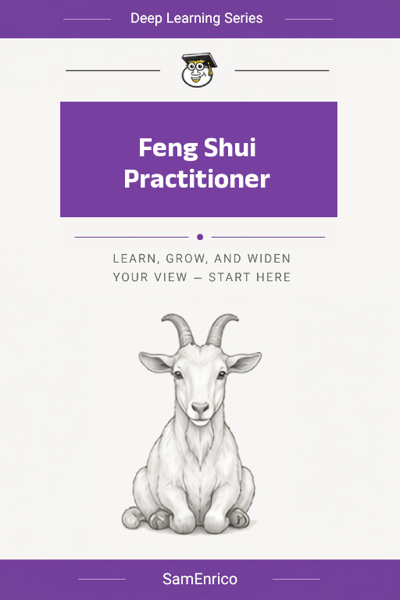
Feng Shui Practitioner eBook
A Coursebook on Feng Shui Practitioner
A Coursebook on Feng Shui Practitioner
Formats
Free sample
Chapter 1: The Wake-Up Call...--–- You have been lied to about Feng Shui. Not by malice, but by simplification. The version of Feng Shui you have seen on lifestyle blogs, in home decor magazines, and on social media reels is not the ancient science of environmental harmony. It is a ghost. A watered-down, commercialized approximation that has been stripped of its analytical rigor, its mathematical precision, and its profound philosophical depth.
The truth is both simpler and more complex than you have been told. Feng Shui is not about lucky bamboo. It is not about painting your front door red. It is not about hanging a bagua mirror to deflect vague "bad energy." These are the equivalent of taking a single aspirin and calling yourself a surgeon.The real Feng Shui, the system that has survived and evolved for over four thousand years, is an environmental intelligence framework. It is a method for reading the subtle and not-so-subtle relationships between human beings and the spaces they inhabit.
It is a diagnostic tool that predates modern architecture, environmental psychology, and sustainable design by millennia. And it works not because of magic, but because of pattern recognition, observation, and a deep understanding of how energy moves through matter.This book is not for the curious browser. It is for the aspiring practitioner. The person who wants to walk into a room and know, within minutes, why that room is making its occupants anxious, or tired, or argumentative. The person who wants to move beyond generic cures to personalized, precise, and powerful interventions.
The person who understands that where you live and work is not separate from who you become. Your environment is not a backdrop to your life. It is an active participant. And for too long, you have been letting it participate against you.Before we go any further, a warning is necessary. This chapter will dismantle things you thought you knew.
It will ask you to unlearn. It will challenge the comfortable, low-effort version of Feng Shui that requires nothing more than a trip to a home goods store. If you are looking for twenty quick tips to arrange your living room, put this book down. This is not that book. If you are ready to become a serious student of an ancient and powerful discipline, turn the page.
The work begins now.The Great Misconception: Feng Shui Is Not Decoration The first and most damaging misconception is that Feng Shui belongs in the same category as interior design. It does not. Interior design is concerned with aesthetics, functionality, and comfort. These are worthy goals, but they are surface-level concerns. Feng Shui operates beneath the surface.
It asks different questions entirely. Instead of "Does this sofa match this wall color?" Feng Shui asks "Where is the energy coming from before it reaches this sofa?" Instead of "Is this room beautiful?" it asks "Is this room alive or dead?" Instead of "Does this layout feel good?" it asks "What invisible forces are at play here that the occupants cannot name but can certainly feel?"Consider a simple example. Two identical rooms, identical furniture, identical paint colors. One feels peaceful. The other feels unsettling.
An interior designer cannot explain the difference because on paper, there is no difference. A Feng Shui practitioner can. The practitioner notices that one room has a clear line of sight to the door, a solid wall behind the main seating area, and no sharp corners pointing at the places where people rest. The other room has the door behind the main seat, a sharp bookshelf corner aimed at the sofa, and a window directly behind the chair. These are not aesthetic differences.
They are energetic differences. And they manifest as felt experiences: anxiety, fatigue, irritability, or conversely, calm, focus, and restoration.This is the first lesson of this chapter and of this entire book. Feng Shui is a science of perception. It trains you to see what others overlook. It teaches you that every object, every surface, every opening in a space is either supporting life or diminishing it.
There is no neutral. There is no "just decoration." Every choice you make about your environment is a choice about your energy, your relationships, your health, and your prosperity. Most people make these choices randomly, based on whatever looks nice at the furniture store. A practitioner makes them deliberately, based on a coherent system of principles that has been tested across cultures and centuries.The Two Schools: Landform and Compass To understand Feng Shui as a practitioner, you must understand its two foundational branches. Every technique, every cure, every analysis in this book descends from one of these two schools.
They are not contradictory. They are complementary. A well-rounded practitioner uses both.The Landform School (Xingshi Pai) is the older of the two. It emerged from observing the natural landscape. Ancient practitioners noticed that settlements located in certain geographical configurations thrived, while others suffered from disease, conflict, or poverty.
They noticed that a hill behind a village provided protection from cold winds and invaders. They noticed that a river curving gently in front of a village brought fertile soil and transportation, while a river rushing straight at a village brought flooding and destruction. They noticed that open land in front of a village allowed for agriculture, trade, and expansion. These observations became the basis of the Four Celestial Animals, which you will study in depth later in this book.The Landform School is intuitive. It is visual.
It is about the relationship between a space and its surrounding environment. In ancient times, that environment was mountains, rivers, and forests. In modern times, it is buildings, streets, and parking garages. The principles remain the same. A tall building behind your home provides support.
A busy street rushing toward your front door creates Sha Chi. A park or open space in front of your home invites opportunity. The Landform School teaches you to read the landscape of your city as easily as an ancient master read the landscape of a valley.The Compass School (Liqi Pai) emerged later, as practitioners began to refine their observations with mathematical precision. The Compass School is not intuitive. It is calculated.
It requires tools: specifically, the Luopan, a geomantic compass with up to thirty-six concentric rings. The Compass School asks: what is the exact directional orientation of this building? What is the facing direction? The sitting direction? How do these directions interact with the passage of time?
The Compass School gave rise to the Flying Star system, the Eight Mansions formula, and the complex calculations that separate a casual enthusiast from a master practitioner.The Landform School tells you that a building with a tall support behind it and open space in front of it is generally good. The Compass School tells you that a building facing exactly 185 degrees south in the year 2026 has a specific configuration of stars that requires specific cures. One without the other is incomplete. A Landform-only practitioner misses the temporal dimension. A Compass-only practitioner misses the physical reality of the site.
This book will train you in both. You will learn to see the landscape and calculate the directions. You will…
This is the end of the free sample. Get the eBook to keep going. Buy now
About this book
Details
- Author
- Santos Margarita
- Publisher
- SamEnrico
- Language
- English
- Genre
- Non-Fiction, Informative, Educational
- Released
- 2026-06-03
- Pages (approx.)
- 160
- Available as
- eBook, Audiobook

Read better in the ZLOADR app
Your eBooks on your phone or tablet. Sign in with your SamEnrico account and start reading.
More by Santos Margarita
 Metta Morning Ritual GuideSantos Margarita$11.99
 Power Nap Protocol GuideSantos Margarita$11.99
 Low FODMAP Gut GuideSantos Margarita$11.99
 Loving Kindness For SufferingSantos Margarita$11.99
 Ironclads and Iron Will: The Naval Revolution of the Pacific (1866)Santos Margarita$11.99
 US Sales Tax for Non Resident LLCsSantos Margarita$12.99
 How to Produce Bulletproof VestsSantos Margarita$11.99
 Ultimate Handbook Guide to Harare : (Zimbabwe) Travel GuideSantos Margarita$11.99