
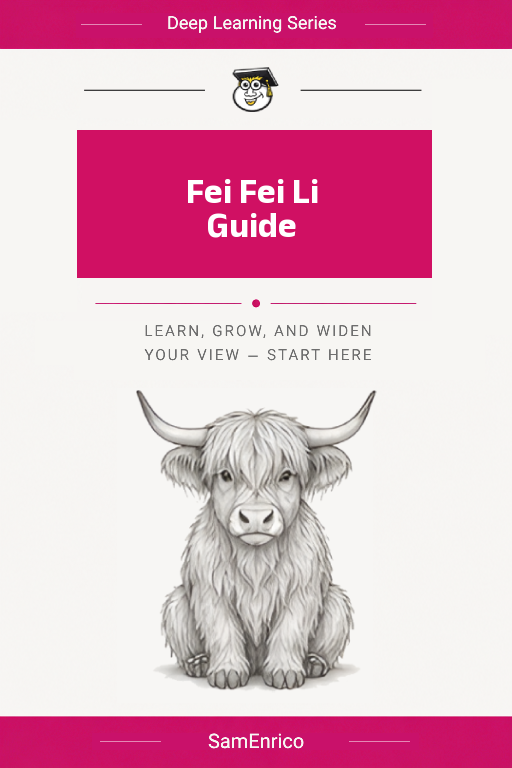
Non-FictionStrategic AtlasAI Academia
Fei Fei Li Guide eBook
Explore Stanford AI leader focus: human-centered A
by Meade Carisa
Explore Stanford AI leader focus: human-centered AI, spatial intelligence, ethics in vision, and academic-industry bridge.
Formats
Free sample
Chapter 1: The Data Rebellion...--In 2006, a thirty-year-old assistant professor named Fei-Fei Li sat in a cramped, windowless office at the University of Illinois at Urbana-Champaign and decided to commit professional suicide.She didn't know that was what she was doing, of course. No one sets out to end their career. But every senior colleague who heard her idea warned her, in tones ranging from concerned to contemptuous, that she was throwing away her chance at tenure. One distinguished professor pulled her aside after a seminar and said, with genuine kindness, "You're brilliant. That's why this is so painful to watch.
Do you want to get tenure? Then don't do this."The idea, stripped to its essence, was embarrassingly simple: what if the entire field of computer vision had been looking at the wrong thing?The Tower of Babel Problem To understand why Li's idea seemed so radical—and so foolish—you have to understand the state of computer vision in the mid-2000s. It was a field in crisis, though few researchers admitted it publicly.Computer vision, the branch of artificial intelligence dedicated to teaching machines to "see" and interpret images, had been stuck for decades. Researchers could build algorithms that recognized specific objects under specific conditions—a chair detector that worked beautifully on a plain white background, a car detector that performed well in bright daylight—but these systems fell apart the moment they encountered the messy, unpredictable, gloriously chaotic real world.Move the chair detector to a cluttered living room. Fail.
Change the lighting on the car detector to dusk. Fail. Show either system an object it hadn't been explicitly trained on. Catastrophic fail.The problem, as Li diagnosed it, was what she called the "Tower of Babel" of computer vision. Every research lab was building its own tiny, private dataset.
One lab had two hundred images of chairs. Another had five hundred images of cars. A third had a hundred images of pedestrians. These datasets were incompatible, incomparable, and impossibly small. Algorithms were being trained and tested on data that bore almost no relationship to the visual complexity of an actual human life.A toddler, Li liked to point out, sees thousands of distinct objects and scenes before breakfast.
A state-of-the-art computer vision algorithm in 2006 might have seen a few thousand images in its entire "lifetime.""We were teaching machines to memorize answers to tests we wrote ourselves," Li later recalled. "And then we were surprised when they failed in the real world."The prevailing wisdom was that the solution lay in better algorithms. Smarter mathematics. More elegant models. If only we could write the perfect equation, the reasoning went, the problem of vision would yield.
Li thought this was exactly backward.The Radical Hypothesis Her hypothesis, first scribbled on a whiteboard in that cramped office, was almost insulting in its simplicity: the algorithm wasn't the bottleneck. The data was."We had been asking the wrong question for thirty years," she explained. "We kept asking, 'What is the best algorithm?' The real question was, 'What is the best training set?'"The analogy she used, in conversations with skeptical colleagues, was language learning. If you wanted to teach a child English, would you give her a hundred sentences and demand she deduce grammar from that tiny sample? Of course not.
You would immerse her in millions of sentences, thousands of conversations, a lifetime of linguistic input. The same principle, Li argued, should apply to teaching a machine to see.What computer vision needed, she concluded, was not a better equation. It was a bigger library. Not a smarter algorithm. A larger dataset.
Not a more elegant theory. A more massive, more comprehensive, more exhausting collection of labeled images than anyone had ever attempted.The scale she proposed was almost obscene. She wanted to collect and label over fourteen million images across twenty-two thousand distinct categories. Not just cars and chairs and pedestrians, but obscure breeds of dogs, rare species of birds, types of furniture from cultures most researchers had never heard of. She wanted an atlas of the visual world, comprehensive enough to capture its full diversity, granular enough to distinguish a Siberian husky from an Alaskan malamute.Most researchers thought she was insane.
Some thought she was naïve. A few thought she was simply stupid.None of them understood what she understood: that the path to general intelligence—the kind of flexible, adaptable, world-grounded intelligence that humans possess—ran through massive, varied, painstakingly curated data.The Education of an Outsider To understand why Fei-Fei Li could see what others couldn't, you have to understand where she came from.She was born in Beijing in 1976, the only child of two intellectuals who were deeply unhappy under the constraints of China's cultural and political system. Her father, an engineer with a restless, curious mind, chafed at the conformity demanded of him. Her mother, a teacher who should have been a scholar, poured her frustrated ambitions into her daughter.When Li was twelve, her father left for the United States, hoping to build a life that would allow his family to follow. Four years later, in 1992, Li and her mother joined him in Parsippany, New Jersey.
She was sixteen years old. She spoke almost no English.The family's finances were catastrophic. Her father found work as a repairman; her mother, despite her education, ended up in a dry-cleaning shop. They lived in a tiny one-bedroom apartment. Li worked behind the counter of the dry-cleaning shop whenever she wasn't in school, handing customers their pressed shirts, handling transactions, doing homework between rushes."I didn't know a single word of English when I arrived," she later said.
"I learned by watching television with a dictionary in my lap. I learned by making mistakes and being humiliated and refusing to stop."She also learned mathematics. Math, she discovered, was a language that transcended the one she was struggling to acquire. Numbers didn't require translation. Equations didn't have accents.
In math, she was not an outsider.At Parsippany High School, her teachers quickly recognized that the quiet Chinese girl behind the counter of the dry-cleaning shop was something extraordinary. Her math scores were perfect. Her physics aptitude was startling. Within two years, she had not only caught up to her peers but surpassed nearly all of them.Princeton accepted her. She arrived on campus with nothing but determination and a deep, almost painful sense of impostor syndrome.
Everyone around her seemed to have been born into privilege, born into English, born into confidence. She had been born into struggle."Every day at Princeton, I felt like I was faking it," she admitted. "Like someone would tap me on the shoulder and say, 'We made a mistake. You don't belong here.'"She studied physics, drawn to the elegance of its laws and the universality of its principles. But she found herself increasingly fascinated by a more slippery question: how does intelligence emerge from mere matter?
How does the wet, three-pound organ inside your skull give rise to thoughts, memories, dreams, vision?That question led her to neuroscience, and neuroscience led her to computer science, and computer science led her, eventually, to the…
This is the end of the free sample. Get the eBook to keep going. Buy now
About this book
Details
- Author
- Meade Carisa
- Publisher
- SamEnrico
- Language
- English
- Genre
- Non-Fiction, Strategic Atlas, AI Academia
- Released
- 2026-05-30
- Pages (approx.)
- 143
- Available as
- eBook, Audiobook

Read better in the ZLOADR app
Your eBooks on your phone or tablet. Sign in with your SamEnrico account and start reading.
More by Meade Carisa
 Affirmations For Parenting GuideMeade Carisa$11.99
 Async Performance Review TemplatesMeade Carisa$11.99
 Batrachophobia Frog FearMeade Carisa$11.99
 The FAST DBT Self Respect SkillMeade Carisa$11.99
 Betrayal Trauma TriggersMeade Carisa$11.99
 The Banquet of the Great Kings: Culinary Splendor of the Mali EmpireMeade Carisa$11.99
 Understanding Pancreatic Islet Cell TumorsMeade Carisa$17.99
 Customer Supply Chain AnalystMeade Carisa$11.99
 Story Ad First Campaign GuideMeade Carisa$12.99
 How to Start a Vegetable Markets BusinessMeade Carisa$11.99
You may also like
 Hong Kong Handover 1997Dunn Johnnie$11.99
 Zumba For Postnatal Recovery CourseNeal Christian$11.99
 Zumba for BeginnersLadner Nikia$11.99
 YouTube Comment Mining GuideHumes Pandora$12.99
 Worry Box MeditationCarlin Rudy$11.99
 Workplace Stress MeditationNguyen Lynn$11.99
 Workplace Stress and Sleep RepairHawley Ivory$11.99
 Workplace Perfectionism CureDelaney Jeffry$11.99
 Workplace Injustice Anger GuideWallen Isabelle$11.99
 Work Addiction and Burnout LinkGreenwood Ester$11.99
 Women in Yoga and WellnessBeattie Galina$11.99
 Women in Stand Up ComedyChun Evangeline$11.99