
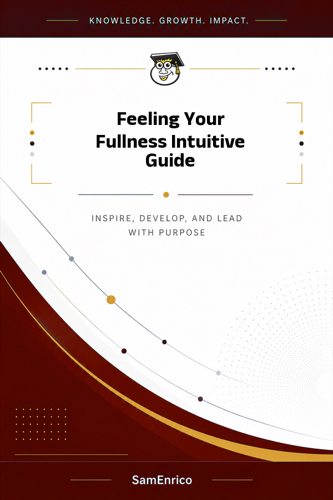
Non-FictionHealth & WellnessMindful Eating
Feeling Your Fullness Intuitive Guide eBook
Teaches mindful awareness of fullness cues to guid
Teaches mindful awareness of fullness cues to guide stopping points during meals.
Formats
Free sample
Chapter 1: The Clean Plate Lie--–- The first time you ignored your body’s stop signal, you were probably rewarded for it. Maybe you were three years old, sitting in a high chair, pushing mashed potatoes around a plastic plate. Your stomach had sent the signal—a gentle, rising pressure that whispered, “Enough.” You stopped. Then an adult leaned in with a spoon and a smile and said, “Just three more bites. Think of the starving children.” So you ate.
Not because you were hungry. Because you were good. Because you obeyed. Because you learned, right there in that high chair, that your body’s wisdom was less important than the rule of the empty plate.This chapter is about unlearning that lesson. It is about naming the invisible rules that have been running your eating habits for decades—often without your knowledge or consent.
It is about understanding why finishing your plate feels like a moral obligation and why leaving food behind feels like a sin. Most of all, it is about reclaiming the one thing diet culture and good intentions stole from you: the ability to trust your own body to tell you when enough is enough.Welcome to the first step of feeling your fullness. It is not a step about food. It is a step about freedom.The Moment Your Off Switch Broke Let us be clear about something from the start: you were born knowing how to stop eating. Every infant does.
Watch a baby being fed. When they are hungry, they open their mouths, lean forward, and suck eagerly. When they are full, they turn their heads away, clamp their lips shut, or simply stop swallowing. No one teaches them this. It is as instinctive as breathing.Somewhere along the way, that instinct got overwritten.For most people, the overwriting happened so gradually and so lovingly that they never noticed it happening.
It came in the form of grandparents who beamed with pride when you cleaned your plate. It came from parents who measured love in second helpings. It came from school lunchrooms where food waste was publicly shamed. It came from a culture that equates leaving food on your plate with ingratitude, wastefulness, or weakness.The result is what I call the Clean Plate Lie: the false belief that finishing everything in front of you is a virtue, while stopping when you are full is a failure.This lie is so pervasive that most people do not even recognize it as a lie. They have internalized it so completely that they experience physical discomfort—anxiety, guilt, even shame—at the thought of leaving food uneaten.
They will eat past the point of pleasure, past the point of comfort, all the way to the point of pain, just to avoid the feeling of a plate that is not perfectly empty.Let me say that again. You will make yourself physically uncomfortable—bloated, sluggish, sometimes nauseated—rather than violate a rule that someone taught you before you could tie your shoes.That is not a sign of willpower. That is a sign of programming. And programming can be rewritten.The Three Override Switches To understand how the Clean Plate Lie operates, we need to look at the three ways external rules override your body’s natural fullness signal. I call these the Three Override Switches.
Every time you eat past fullness, at least one of these switches has been flipped.Override Switch #1: Visual Cues You have been trained to look at a plate, not your stomach, to decide when to stop eating. This is the most obvious and most dangerous override. Your great-grandmother ate from plates that were nine inches in diameter. The standard dinner plate today is twelve inches—a forty percent increase in surface area. A “small” soda in 1950 was seven ounces.
Today’s “small” is often twelve ounces, and a “large” can be forty-four ounces. Portion sizes have ballooned across every food category, and your brain still thinks it should finish what is in front of it.This is not a moral failing. It is a cognitive bias called unit bias. Humans tend to want to complete a unit of something, whether it is a chapter, a task, or a plate of food. When the unit gets larger, you eat more without even noticing.
Research consistently shows that people served larger portions eat significantly more calories than those served smaller portions—regardless of hunger level. Double the portion, and people eat roughly thirty to forty percent more. Not because they are greedier or more out of control, but because the visual cue of “one plate equals one meal” overrides the biological cue of “my stomach is full.”You have probably experienced this without realizing it. Think back to the last buffet you visited. Did you eat more than usual?
Almost certainly. Not because you were hungrier, but because the visual abundance told your brain that more was available, so more should be consumed. The same principle applies to bags of chips, boxes of cookies, and family-style platters. When you cannot see the bottom, you do not feel the stop.Override Switch #2: Social Cues Food is never just food. It is love, celebration, community, obligation, and sometimes weapon.
The second override switch is social pressure: the often-unspoken expectation that you will eat what is offered, finish what is served, and accept second helpings as a compliment to the cook.This pressure takes many forms. There is the direct pressure: “You barely ate anything. Are you sick?” “Come on, just one more slice. I made it special for you.” “You’re not leaving the table until your plate is clean.” There is the indirect pressure: the host who keeps refilling your glass, the family member who serves you before you can say no, the cultural expectation that refusing food is an insult. And there is the internalized pressure: the voice in your head that says, “They worked so hard on this meal.
It would be rude not to finish it.”Most people find social eating situations the hardest place to honor their fullness. It is one thing to stop at a 7 when you are alone. It is quite another when your mother-in-law is watching you push food around your plate. The fear of seeming ungrateful, picky, or disordered overrides the physical signal of “enough.” You eat past fullness to keep the peace, to show appreciation, to belong.This is not weakness. This is a deep-seated human need for social connection.
Evolutionarily, refusing food from a tribe member could be a death sentence. Your brain still treats social eating with ancient seriousness. The good news is that you can learn new social scripts—new ways of saying “enough” without saying “your food is bad.” We will cover those scripts in detail in Chapter 10. For now, simply notice how often you eat past fullness because someone else is watching.Override Switch #3: Temporal Cues The third override switch is the clock. You have been trained to eat at specific times regardless of hunger.
Breakfast at 8 AM. Lunch at noon. Dinner at 6 PM. Snack at 3 PM. These schedules are useful for schools, workplaces, and families…
This is the end of the free sample. Get the eBook to keep going. Buy now
About this book
Details
- Author
- Olivares Deana
- Publisher
- SamEnrico
- Language
- English
- Genre
- Non-Fiction, Health & Wellness, Mindful Eating
- Released
- 2026-06-11
- Pages (approx.)
- 141
- Available as
- eBook, Audiobook

Read better in the ZLOADR app
Your eBooks on your phone or tablet. Sign in with your SamEnrico account and start reading.
More by Olivares Deana
 The Space Economy Talent FlowOlivares Deana$11.99
 Fenugreek Gut GuideOlivares Deana$11.99
 Weekly Review for Coaches GuideOlivares Deana$11.99
 Elizabeth I West African Trade InitiationOlivares Deana$11.99
 The Last Witness of the PyramidsOlivares Deana$11.99
 The Billionaire’s Floating Fortress: Inside the Secret World of Superyacht EspionageOlivares Deana$11.99
 Single Member vs Multi Member LLCOlivares Deana$12.99
 Purchase Order Matching SystemOlivares Deana$12.99
 Understanding Berger DiseaseOlivares Deana$17.99
 Orthodontic Treatment CoordinatorOlivares Deana$11.99
 How to Start a Power-driven Lifting Hoists Business (Beginners Guide)Olivares Deana$11.99
You may also like
 Hong Kong Handover 1997Dunn Johnnie$11.99
 Zumba For Postnatal Recovery CourseNeal Christian$11.99
 Zumba for BeginnersLadner Nikia$11.99
 YouTube Comment Mining GuideHumes Pandora$12.99
 Worry Box MeditationCarlin Rudy$11.99
 Workplace Stress MeditationNguyen Lynn$11.99
 Workplace Stress and Sleep RepairHawley Ivory$11.99
 Workplace Perfectionism CureDelaney Jeffry$11.99
 Workplace Injustice Anger GuideWallen Isabelle$11.99
 Work Addiction and Burnout LinkGreenwood Ester$11.99
 Women in Yoga and WellnessBeattie Galina$11.99
 Women in Stand Up ComedyChun Evangeline$11.99