
Non-FictionSelf-HelpFeedbackGrowth Mindset
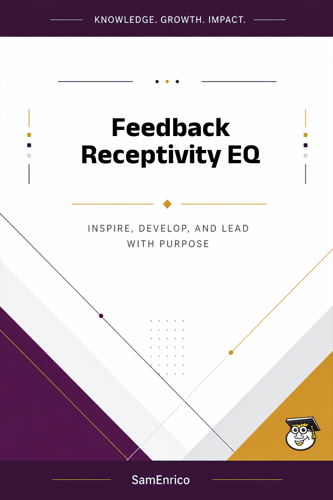
Feedback Receptivity EQ eBook
Receive criticism without becoming defensive or co
Receive criticism without becoming defensive or collapsing.
Formats
Free sample
Chapter 1: The Ambush of Kindness--You are about to receive a compliment. It will feel like an attack. And that is not your fault.Let me tell you about a Tuesday afternoon that changed how I think about feedback forever. I was thirty-two years old, six months into a job I desperately wanted to keep, and my manager—a soft-spoken woman named Diane who had never raised her voice in four years—asked if we could chat after the team meeting. Nothing in her tone suggested danger.
No ominous subject line. No “we need to talk.” Just a gentle, “Got a minute?”I followed her into a small glass-walled conference room. She closed the door, which she never did. And then she said, with genuine warmth, “I want to give you some feedback that I think will help you grow.”My throat closed. My face went hot.
My heartbeat became audible in my own ears. I had not yet heard a single piece of feedback, and already my body had decided that I was under attack.Diane continued, gently: “In the last few client meetings, I’ve noticed that you sometimes interrupt before people finish their thoughts. I think it comes from enthusiasm—you’re so eager to solve problems. But I wanted to flag it because I think it’s holding you back from being seen as the leader you’re capable of becoming.”She was right. She was kind.
She was trying to help me. And I spent the next forty-five minutes in a spiral of shame, defensiveness, and silent self-destruction that she never even saw. I said “thank you” and walked back to my desk. But inside, I was gone. For the rest of the day, I mentally composed counterarguments, replayed every meeting looking for evidence that she was wrong, and ultimately concluded that I was a fraud who had somehow tricked everyone into thinking I was competent.That night, I told my partner, “My manager thinks I’m terrible at my job.”She asked, “Did she say that?”“She said I interrupt people.”“Do you?”“Sometimes.
But that’s not the point.”That is the point. That is exactly the point. And it took me years to understand why a kind, accurate, well-intentioned piece of feedback could produce such catastrophic internal chaos. The answer is not that I was weak or fragile or too sensitive. The answer is that I—like every human being who has ever lived—was caught in a neurological trap that evolution set for me millions of years before I was born.This book exists because that Tuesday afternoon happened to you too.
Maybe not with a manager named Diane. Maybe with a spouse over dinner. Maybe with a parent who “just wants what’s best for you.” Maybe with a friend who said, “Can I tell you something honestly?” and your stomach dropped through the floor. The specific details change. The physics are identical.Here is the truth that will either liberate you or terrify you, depending on how ready you are to hear it: You cannot stop the initial defensiveness.
It is not a character flaw. It is not a failure of your mindfulness practice. It is not evidence that you are “bad at receiving feedback.” It is biology. And once you stop trying to eliminate it—once you stop believing that good, mature, emotionally intelligent people should simply smile and say “thank you” while their nervous system screams—you can finally start learning how to work with it.The War Inside Your Skull To understand why feedback feels like an ambush, you need to understand a fundamental conflict that lives inside every human being. Psychologists and neuroscientists have given it many names over the years, but the most useful framing comes from the work of Stone and Heen, whose book Thanks for the Feedback remains the gold standard on this topic.
They describe two competing drives that operate within us at all times, often without our conscious awareness.The first drive is the Learning Goal. This is the part of you that wants to grow, improve, master new skills, and become better tomorrow than you are today. The Learning Goal is why you read books, take classes, ask for advice, and practice difficult things. It is ambitious. It is forward-looking.
It is the engine of human progress, both personal and collective.The second drive is the Acceptance Goal. This is the part of you that wants to be liked, respected, valued, and seen as good by the people around you. The Acceptance Goal is why you care about your reputation, why you feel hurt when someone criticizes you, and why you have ever edited a text message seven times before sending it. It is social. It is protective.
It is the reason human beings have survived as a species, because being rejected by the tribe used to mean death.Here is the problem. These two drives are not friends. They are not even uneasy allies. They are enemies locked in a constant, low-grade war for control of your attention and your emotional state. And feedback is the weapon that forces them into direct combat.When someone gives you feedback—even gentle, accurate, well-intentioned feedback—the Learning Goal says, “This is useful data.
Let me process it. Let me see what I can learn.” At the exact same moment, the Acceptance Goal screams, “This person just said something is wrong with you. The tribe is rejecting you. DEFEND YOURSELF.”Which voice wins? Almost always, the Acceptance Goal.
Because the Acceptance Goal is older. It comes from a part of your brain that evolved long before you had language, long before you had a prefrontal cortex capable of abstract reasoning, long before you could tell yourself “it’s just feedback, it’s not a threat.” Your amygdala—the ancient alarm system buried deep in your limbic system—cannot tell the difference between “my manager says I interrupt people” and “a saber-toothed tiger is charging at me.” Same alarm. Same adrenaline. Same stupid urge to fight, flee, or freeze.This is not a metaphor. Neuroscientists have actually measured this.
When people receive criticism in a laboratory setting, their brains show activation patterns that are nearly identical to those observed when they experience physical pain. The same neural circuitry that processes a broken bone also processes a broken ego. Social rejection literally hurts.Let me say that again because it matters: Your brain processes social criticism the same way it processes physical injury. You are not being dramatic when feedback stings. You are not being weak when your eyes well up.
You are having a normal neurological response to a perceived threat. The problem is not that you feel defensive. The problem is that you have been taught that feeling defensive is a moral failure, which makes you feel defensive about feeling defensive, which creates a shame spiral that helps absolutely no one.The Train Tracks Problem Here is where most feedback conversations go off the rails. Diane said, “You interrupt people.” That was her track. Her track was about behavior, impact, and a specific pattern she had observed.
My track, after she delivered that feedback, was “You just told me I am bad at my job and everyone…
This is the end of the free sample. Get the eBook to keep going. Buy now
About this book
Details
- Author
- Gerard Tatiana
- Publisher
- SamEnrico
- Language
- English
- Genre
- Non-Fiction, Self-Help, Feedback, Growth Mindset
- Released
- 2026-06-07
- Pages (approx.)
- 113
- Available as
- eBook, Audiobook

Read better in the ZLOADR app
Your eBooks on your phone or tablet. Sign in with your SamEnrico account and start reading.
More by Gerard Tatiana
 Young People AA GuideGerard Tatiana$11.99
 Japanese American Internee VetGerard Tatiana$11.99
 Fear of Abandonment WorkbookGerard Tatiana$11.99
 The Clockwork Conspiracy: How the 1969 Moon Landing Almost FailedGerard Tatiana$11.99
 How to Become a LinkerGerard Tatiana$11.99
 Learn to Play the Cello (Violoncello)Gerard Tatiana$11.99
 Housing CoordinatorGerard Tatiana$11.99
 AI for Open Ended Question CodingGerard Tatiana$12.99
You may also like
 Hong Kong Handover 1997Dunn Johnnie$11.99
 Zumba For Postnatal Recovery CourseNeal Christian$11.99
 Zumba for BeginnersLadner Nikia$11.99
 YouTube Comment Mining GuideHumes Pandora$12.99
 Worry Box MeditationCarlin Rudy$11.99
 Workplace Stress MeditationNguyen Lynn$11.99
 Workplace Stress and Sleep RepairHawley Ivory$11.99
 Workplace Perfectionism CureDelaney Jeffry$11.99
 Workplace Injustice Anger GuideWallen Isabelle$11.99
 Work Addiction and Burnout LinkGreenwood Ester$11.99
 Women in Yoga and WellnessBeattie Galina$11.99
 Women in Stand Up ComedyChun Evangeline$11.99