
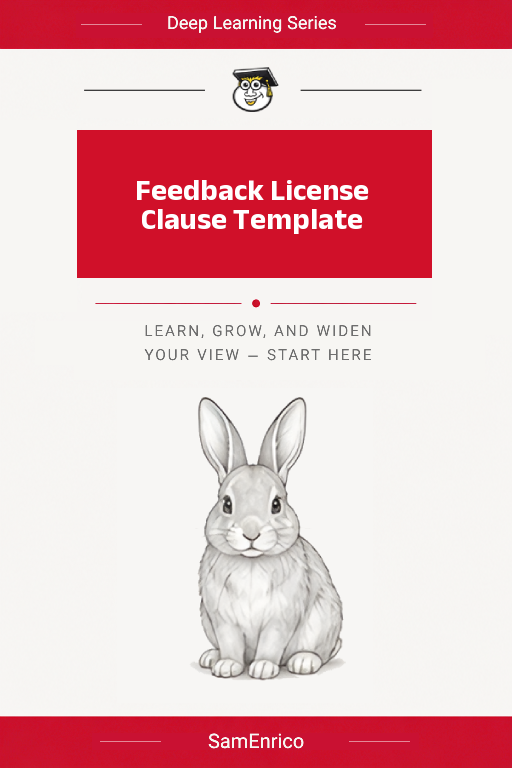
Feedback License Clause Template eBook
Get ownership of user suggestions to implement ide
by Crum Ashli
Get ownership of user suggestions to implement ideas without compensation or legal risk.
Formats
Free sample
Chapter 1: The $47 Million Email...--–- It arrived on a Tuesday afternoon. The subject line read: "Quick idea – you're welcome." The body contained three sentences describing a dark mode toggle for a B2B Saa S dashboard. The founder, sleep-deprived and desperate for product-market fit, forwarded it to her engineering team with two words: "Build this."Eighteen months later, that dark mode toggle was cited in seven enterprise procurement contracts as a "key accessibility feature." The startup had raised a Series B at a 200millionvaluation.Andthenthelawsuitlanded.Theuserwhosentthatthree−sentenceemailclaimedhewasentitledto5200 million valuation. And then the lawsuit landed. The user who sent that three-sentence email claimed he was entitled to 5% of the company's increased valuation – roughly 200millionvaluation.Andthenthelawsuitlanded.Theuserwhosentthatthree−sentenceemailclaimedhewasentitledto547 million – because his "idea" had been used without compensation or credit.The startup's lawyers filed a motion to dismiss.
They pointed to the terms of service, which contained a standard "perpetual, irrevocable, worldwide license" clause covering user feedback. The court denied the motion. The judge's reasoning was brief and devastating: "Plaintiff never owned a copyright in the idea of a dark mode toggle. Therefore, he could not grant a license. Defendant's license clause is void.
The case proceeds on a theory of implied contract."The startup settled for $8 million and a confidentiality agreement. They had a perfect license clause – or so they thought. But they had made the same mistake that 90% of Saa S companies make: they confused licensing with waiving, expressions with ideas, and protection with illusion.This book exists because that startup's legal team called me six months after the settlement, desperate for a solution that actually works. The solution is not a better license. The solution is no license at all.The Suggestion Box That Can Destroy Your Company Every Saa S company has an invisible suggestion box.
It lives in support tickets, feature request portals, sales calls, and the dreaded "just following up" email from a customer who has "a quick thought." These suggestions are the lifeblood of product development – they tell you what features to build, what bugs to fix, and what your users actually need.But that invisible suggestion box is also a loaded weapon. And most companies are pointing it directly at their own chest.The problem is not that users sue. The problem is that when they do sue, they win – or settle – because companies use the wrong legal framework. They treat feedback like user-generated content. They ask for a license.
They assume that "perpetual" and "irrevocable" are magic words that make any problem go away. They are wrong.This chapter establishes the foundational problem that the rest of the book solves: unsolicited user feedback is simultaneously the most valuable asset for product development and the most dangerous legal liability for Saa S companies. Understanding why requires a deep dive into three areas: the legal distinction between categories of user submissions, the common law claims that fuel idea theft lawsuits, and the catastrophic failure of the "license" approach that most companies currently use.The Three Categories of User Submissions (And Why You've Been Confusing Them)Before we can fix your feedback clause, you need to understand what "feedback" actually is – and what it is not. Most terms of service lump everything together under a single "submissions" heading. This is a catastrophic error because different categories of user submissions are governed by completely different bodies of law.Category One: User Content User content is anything a user creates and uploads to your platform.
Photos on Instagram. Posts on Reddit. Comments on a blog. Documents saved to Dropbox. Messages sent via Slack.
These are original works of authorship fixed in a tangible medium – the legal definition of copyrightable material.When a user uploads a photo to your platform, they own the copyright to that photo. You need a license to display, reproduce, and distribute that photo. That is why your terms of service contain a "license to user content" clause. That clause is legally sound because the user actually owns something – a copyright – that they can license to you.Category Two: User Data User data is information about how a user interacts with your service. IP addresses.
Browser fingerprints. Click paths. Session durations. Feature usage patterns. This data is not creative; it is observational.
It is governed not by copyright law but by privacy regulations – GDPR in Europe, CCPA in California, LGPD in Brazil, and a growing patchwork of state and national laws worldwide.User data belongs to the user in a regulatory sense – you cannot collect, process, or sell it without consent. But you do not need a copyright license for user data because there is no copyright to license. You need a privacy policy and a data processing agreement.Category Three: Feedback Feedback is the dangerous middle child. It includes suggestions, feature requests, bug reports, enhancement recommendations, corrections, and any other input that describes how to improve your product. Feedback is not a creative work (usually) and it is not observational data (usually).
It is an idea.And under US copyright law – and the laws of most other countries – ideas are not property. You cannot own an idea. You cannot copyright an idea. You cannot patent an idea unless it is reduced to a specific, novel, non-obvious invention. The idea for dark mode on a dashboard is not patentable.
The idea for a new button placement is not copyrightable. The idea for a reporting feature is not ownable property.This creates a paradox. If the user does not own their feedback, they cannot grant you a license to it. But they can still sue you for using it – under theories that have nothing to do with copyright. Breach of implied contract.
Unjust enrichment. Conversion. Misappropriation. These are common law claims that predate copyright law, and they are the weapons that plaintiffs use to extract settlements from unsuspecting companies.The Case Study: How a Single Email Cost $8 Million Let me tell you the full story of the startup from this chapter's opening – anonymized but real in its essential details.The Company: A B2B Saa S platform for project management, call it "Dash Corp." 50 employees. $5 million annual recurring revenue.
Growing fast.The User: A product manager at a mid-sized marketing agency, call him "Alex." Alex used Dash Corp daily and had strong opinions about its flaws. Alex was not an engineer; he had never written a line of code. But he had ideas.The Email (Tuesday, 2:47 PM): "Hey team – quick idea. Your dashboard is killing my eyes at night. Add a dark mode toggle.
Just invert the colors on the left nav and main content area. Easy win. You're welcome."The Implementation: The head of product loved the idea. An engineer implemented dark mode in three days. It shipped in the next release.
Users celebrated. Dash Corp added dark mode to their enterprise sales deck as an accessibility feature.The Lawsuit (18 months later): Alex had been laid off from his agency job. He was looking for income. A lawyer friend mentioned the "idea theft" lawsuit trend. Alex reviewed Dash Corp's terms of service, found the feedback license clause, and his lawyer argued exactly what the judge would later accept: "The license clause is void because Alex…
This is the end of the free sample. Get the eBook to keep going. Buy now
About this book
Details
- Author
- Crum Ashli
- Publisher
- SamEnrico
- Language
- English
- Genre
- Non-Fiction, First 30 Days
- Released
- 2026-05-29
- Pages (approx.)
- 151
- Available as
- eBook, Audiobook

Read better in the ZLOADR app
Your eBooks on your phone or tablet. Sign in with your SamEnrico account and start reading.
More by Crum Ashli
 Mobile Game Spending AddictionCrum Ashli$11.99
 Step Seven Humility PracticeCrum Ashli$11.99
 Grief and Loss in CaregivingCrum Ashli$11.99
 Controlling Parent Escape PlanCrum Ashli$11.99
 Non 24 Hour Sleep Wake DisorderCrum Ashli$11.99
 Anki Flashcard Mastery GuideCrum Ashli$11.99
 Yak-3 Soviet Lightweight DogfighterCrum Ashli$11.99
 The Rookie Year ODCrum Ashli$11.99
 Resentment After FireCrum Ashli$11.99
 The Habsburgs and the Vienna Waltz: A Dynasty of Art and PowerCrum Ashli$11.99
 The Great Barrier Reef's Last Stand: A Coral RebellionCrum Ashli$11.99
 Operation Midnight Sun: The Untold Spy War That Saved NATOCrum Ashli$11.99
You may also like
 Hong Kong Handover 1997Dunn Johnnie$11.99
 Zumba For Postnatal Recovery CourseNeal Christian$11.99
 Zumba for BeginnersLadner Nikia$11.99
 YouTube Comment Mining GuideHumes Pandora$12.99
 Worry Box MeditationCarlin Rudy$11.99
 Workplace Stress MeditationNguyen Lynn$11.99
 Workplace Stress and Sleep RepairHawley Ivory$11.99
 Workplace Perfectionism CureDelaney Jeffry$11.99
 Workplace Injustice Anger GuideWallen Isabelle$11.99
 Work Addiction and Burnout LinkGreenwood Ester$11.99
 Women in Yoga and WellnessBeattie Galina$11.99
 Women in Stand Up ComedyChun Evangeline$11.99