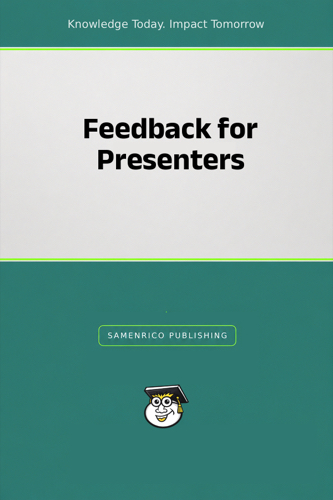
Free sample
Chapter 1: The Mirror Lies...--–- Immediately after you finish speaking, your brain becomes a liar.Not a malicious one. Not a deceptive one. A well-intentioned, exhausted, chemically flooded liar that has just survived a perceived threat and is now rewriting history to protect you from the horror of what just happened. The problem is, the more it protects you, the worse you become. Because if you cannot accurately judge your own performance, you cannot improve it.
And if you cannot improve it, you will keep making the same mistakes, feeling the same anxiety, and wondering why the gap between how you felt and how the audience reacted never seems to close.This chapter is about that gap. It is about the three specific ways your brain distorts reality when you present. And it is about the first, most essential tool you will need to begin seeing yourself as others actually see you: a recording device and a 48-hour waiting period. But before we get to the solution, we have to fully understand the problem. Because the problem is not your slides.
The problem is not your nerves. The problem is that you are trapped inside your own head, and the walls are made of cognitive biases that feel like truth.The Experiment That Will Ruin Your Next Presentation (In a Good Way)Here is a simple experiment that has been conducted in various forms by communication researchers, corporate training departments, and at least one very frustrated Harvard Business School professor. Take any group of presenters. Have them deliver a five-minute talk to an audience of peers. Immediately after they finish, ask them to rate their own performance on a scale of one to ten.
Then, collect anonymous ratings from the audience. Compare the two numbers.What do you find? In study after study, the correlation between self-assessment and audience assessment hovers somewhere between weak and nonexistent. The average presenter rates themselves a full 1.7 points higher or lower than the audience does. But here is the more interesting finding: presenters who felt nervous rate themselves harshly, often giving themselves a four or five when the audience gave them a seven or eight.
Presenters who felt confident often rate themselves generously, giving themselves an eight or nine when the audience gave them a six or seven.In other words, your internal feelings are not just an imperfect signal of your performance. They are frequently an inverse signal. The more nervous you felt, the better you probably did. The more confident you felt, the more likely you missed something obvious.Why does this happen? Because you are not watching the presentation.
You are living it. And those are two radically different experiences.The Spectator vs. The Actor: Why You Can't Trust Your Own Eyes Imagine two people watching the same movie. One is sitting in the theater, popcorn in hand, watching the story unfold on screen. The other is inside the movie, playing the lead role, sweating under the lights, trying to remember their lines, and hoping the director doesn't yell "cut." After the movie ends, you ask both of them to describe what happened.
Do you think they will give the same account?Of course not. The spectator saw the final product: the pacing, the emotional beats, the overall arc. The actor felt the chaos: the missed cue on page 17, the dry mouth during the love scene, the terrifying silence between lines that felt like an eternity but lasted exactly one second.As a presenter, you are the actor. Your audience is the spectator. And the single most important insight in this entire book is that you will never experience your own presentation the way your audience does.
Not because you are bad at self-reflection. Not because you lack emotional intelligence. Because you are human, and human perception is fundamentally limited by where you are standing.This is what psychologists call the actor-observer asymmetry. When you are the actor, your attention is drawn inward. You feel your heartbeat.
You notice every stumble. You are acutely aware of what you meant to say versus what actually came out. When you are the observer, your attention is drawn outward. You see the speaker's energy. You absorb the main ideas.
You barely register the stumbles because you were not anticipating them.The result is that you and your audience are watching two different presentations. Yours is a horror movie full of close calls and near-disasters. Theirs is a drama, maybe a comedy, hopefully a compelling story. And until you learn to see what they see, you will be trapped in a feedback loop of inaccurate self-assessment and unnecessary anxiety.The Three Blind Spots: Spotlight, Knowledge, and Time The actor-observer asymmetry manifests in three specific cognitive biases that every presenter must learn to recognize. These are not personality flaws or signs of low confidence.
They are hardwired features of how the human brain processes information under stress. And once you know they exist, you can start to correct for them.Blind Spot #1: The Spotlight Effect You are standing at the front of the room. You have just finished a sentence that came out slightly garbled. You stumbled over the word "strategic" and had to repeat it. In the milliseconds that follow, your brain sounds an alarm.
Everyone heard that. Everyone noticed. You look incompetent. Your face flushes. Your palms sweat.
You rush through the next two sentences to "get past" the embarrassing moment.Here is what actually happened in the audience: three people were checking their email. Two were thinking about what to order for lunch. One was wondering if they locked their car. The remaining seven people heard the stumble, registered it subconsciously, and forgot about it by the time you finished the next word. Not one person concluded that you were incompetent.
Not one person marked you down for it. Most of them could not tell you five minutes later that the stumble even occurred.This is the Spotlight Effect, first identified by social psychologists Thomas Gilovich and Kenneth Savitsky. The phenomenon is simple: we systematically overestimate the extent to which others notice our mistakes, our appearance, and our performance. When you are wearing a shirt with an embarrassing stain, you think everyone sees it. When you stumble over a word, you think the room is judging you.
In reality, people are far too absorbed in their own experience to pay as much attention to you as you think they are.The Spotlight Effect is amplified during presentations because of the physical setup. You are standing alone. The lights are on you. The audience is looking in your direction. But looking is not scrutinizing.
And noticing is not judging. The vast majority of the time, the audience wants you to succeed. They are not waiting for you to fail so they can pounce. They are hoping you do well because a good presentation makes their time worthwhile.The practical implication is enormous: most of what you fear going wrong goes completely unnoticed. And the small fraction that is noticed is almost immediately forgotten.
You are not performing for a panel of judges. You are performing for a room full of people who are…
This is the end of the free sample. Get the eBook to keep going. Buy now
About this book
Details
- Author
- Abernathy Modesta
- Publisher
- SamEnrico
- Language
- English
- Genre
- Non-Fiction, Self-Help / Feedback
- Released
- 2026-06-06
- Pages (approx.)
- 153
- Available as
- eBook, Audiobook

Read better in the ZLOADR app
Your eBooks on your phone or tablet. Sign in with your SamEnrico account and start reading.
More by Abernathy Modesta
 Garage Startup Immigrant StoryAbernathy Modesta$11.99
 Upwork Payment Protection ClaimsAbernathy Modesta$11.99
 Self Compassion ResilienceAbernathy Modesta$11.99
 The Hand Stick InductionAbernathy Modesta$11.99
 Vaginal Birth RecoveryAbernathy Modesta$11.99
 Processing Nightmares From SurgeryAbernathy Modesta$11.99
 Doe Network NamUs API IntegrationAbernathy Modesta$11.99
 The Visionaries of Stone and Light: How Western Architects Defied GravityAbernathy Modesta$11.99
 Rana Pratap: The Last Rajput Stand at HaldighatiAbernathy Modesta$11.99
 How to Produce Nut ButtersAbernathy Modesta$11.99
 How to Produce ArchesAbernathy Modesta$11.99
 Growing Cassia (Shower Tree)Abernathy Modesta$11.99