
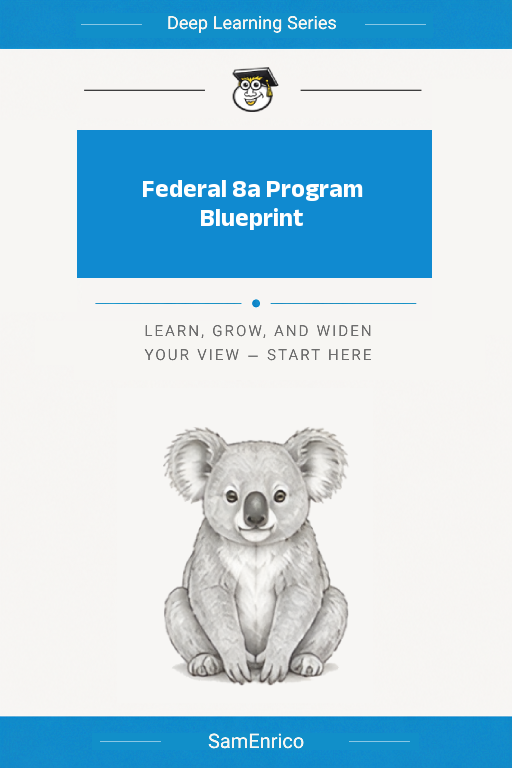
Federal 8a Program Blueprint eBook
Navigate SBA's 8(a) Business Development program f
Navigate SBA's 8(a) Business Development program for minority-owned firms with nine-year term, sole-source awards, and mentor-protégé benefits.
Formats
Free sample
Chapter 1: The Nine-Year Clock--–- Every federal contracting program comes with rules, but only one comes with an expiration date. The SBA’s 8(a) Business Development program is not a certification you renew like a license. It is not a set-aside you can rely on indefinitely. It is a nine-year window of preferential access that opens once in a business owner’s lifetime and then closes forever. Most applicants discover this too late.
They spend their first three years figuring out the paperwork, their next three years chasing contracts, and their final three years realizing they never built a business that could survive without 8(a) training wheels. By then, the clock has run out.This book exists because that tragedy is avoidable. The 8(a) program, when understood as a strategic launchpad rather than a permanent crutch, has transformed thousands of minority-owned firms into competitive, standalone enterprises. But the difference between those who succeed and those who fade away after graduation comes down to one fundamental shift in mindset: the nine-year clock is not a countdown to the end of your opportunities. It is a countdown to the moment when you no longer need preferences because you have built something better.This chapter establishes the foundational framework for everything that follows.
You will learn what the 8(a) program actually is (and what it is not), how its two-stage structure dictates your strategic decisions year by year, and why the nine-year clock must become the central organizing principle of your business planning. By the end of this chapter, you will understand why firms that treat the program as a finish line almost always fail, while those who treat it as a launchpad build generational wealth.The Great Misunderstanding: What 8(a) Is Not Let us clear the air immediately. Ask a hundred small business owners what the 8(a) program does, and ninety will say some version of “it helps minority-owned firms win government contracts.” That is technically true but strategically useless. It is like saying a scalpel helps surgeons perform operations. The statement is correct, but it misses everything that matters about how, when, and why to use the tool.The 8(a) program is not a minority set-aside in the same way that the HUBZone or SDVOSB programs are set-asides.
Those programs give you a preference in competitive bidding. The 8(a) program gives you something far more powerful: the ability to win contracts without any competition at all through sole-source awards. But that power comes with a strict time limit and a set of developmental obligations that other certification programs do not impose.Here is what the 8(a) program is not:It is not a loan program. The SBA does not give you money.It is not a preference for all federal contracts. You must still be the best qualified firm for the work.It is not a guarantee of success.
Thousands of 8(a) firms graduate with no sustainable revenue.It is not a permanent status. After nine years, you are out regardless of whether you are ready.Here is what the 8(a) program actually is: a federally funded nine-year business development accelerator for socially and economically disadvantaged owners. The word “development” is the key. The program’s statutory purpose, codified in 15 U.S.C. § 637(a), is to “assist small business concerns owned and controlled by socially and economically disadvantaged individuals to compete in the American economy.” Not to give them contracts forever.
To help them compete. To build them up so they no longer need help.The Congressional Research Service, in its 2023 report on the 8(a) program, emphasized that the original legislative intent was graduation. Lawmakers in 1978, when the modern 8(a) program was created, explicitly rejected a permanent set-aside model. They wanted a program with an entrance and an exit. The nine-year term was not arbitrary.
It was calculated based on studies showing that small businesses typically need seven to ten years of preferential access to build the past performance, infrastructure, and reputation necessary to compete in full-and-open markets.Yet today, more than four decades later, the majority of 8(a) firms still treat the program as an endpoint rather than a beginning. They enter, they win some sole-source contracts, they grow comfortable, and then they hit year seven or eight in a panic because they have no non-8(a) revenue and no plan for life after certification. According to SBA data cited in multiple Government Accountability Office reports, fewer than one-third of 8(a) graduates are able to win unrestricted federal contracts within two years of leaving the program. The rest either shrink, pivot to commercial work, or close their doors.This book is for the one-third who want to succeed—and for the two-thirds who want to become part of that successful minority.The $24 Billion Reality: Scale and Opportunity Before we dive into strategy, let us understand the scale of what is at stake. In fiscal year 2023, the federal government awarded over 24billionto8(a)firms.Thatisnotatypo.Twenty−fourbilliondollarsinasingleyear,representingapproximately8percentofallsmallbusinessfederalcontractingdollars.Sole−sourceawardsmadeuproughly30to40percentofthattotal,meaningthatbetween24 billion to 8(a) firms.
That is not a typo. Twenty-four billion dollars in a single year, representing approximately 8 percent of all small business federal contracting dollars. Sole-source awards made up roughly 30 to 40 percent of that total, meaning that between 24billionto8(a)firms.Thatisnotatypo.Twenty−fourbilliondollarsinasingleyear,representingapproximately8percentofallsmallbusinessfederalcontractingdollars.Sole−sourceawardsmadeuproughly30to40percentofthattotal,meaningthatbetween7 billion and $10 billion flowed to 8(a) firms without any competitive bidding.Which agencies spend the most on 8(a) contracts? The Department of Defense leads by a wide margin, accounting for nearly 40 percent of all 8(a) dollars. The Department of Health and Human Services follows, driven by IT and research contracts.
The General Services Administration, Department of Homeland Security, and Department of Veterans Affairs round out the top five. Within these agencies, the NAICS codes with the highest 8(a) spend include computer systems design services (541512), commercial and institutional building construction (236220), facilities support services (561210), and logistics (541614).What does this mean for you? It means that if you are in IT services, construction, logistics, or professional services, the 8(a) program offers a massive and proven pathway to federal revenue. But it also means that competition for competitive 8(a) set-asides has intensified. In 2010, an 8(a) firm might be one of five bidders on a competitive set-aside.
Today, it is common to see thirty or forty 8(a) firms bidding on the same opportunity. The days of easy wins are over. You need a strategy.That strategy begins with understanding the two-stage structure of the program itself.The Two-Stage Framework: Developmental versus Transitional The SBA divides the nine-year 8(a) term into two distinct stages, and most business owners never notice the difference until it is too late. The first stage is the Developmental Stage, covering years one through four. The second stage is the Transitional Stage, covering years five through nine.
Each stage comes with different expectations, different levels of SBA oversight, and different strategic imperatives.The Developmental Stage (Years 1–4)During the first four years of your 8(a) participation, the SBA treats you as a developing business in need of active support and supervision. You are required to submit annual business plan updates, attend SBA-sponsored training sessions, and work closely with your assigned Business Opportunity Specialist (BOS). The SBA expects you to…
This is the end of the free sample. Get the eBook to keep going. Buy now
About this book
Details
- Author
- Raymond Joseph
- Publisher
- SamEnrico
- Language
- English
- Genre
- Non-Fiction, Business Brief
- Released
- 2026-06-01
- Pages (approx.)
- 154
- Available as
- eBook, Audiobook

Read better in the ZLOADR app
Your eBooks on your phone or tablet. Sign in with your SamEnrico account and start reading.
More by Raymond Joseph
 HIIT For New Moms GuideRaymond Joseph$11.99
 Validation Journal WorkbookRaymond Joseph$11.99
 The ADHD Parent Anger GuideRaymond Joseph$11.99
 Twelve Step for IncarceratedRaymond Joseph$11.99
 The Cost Plus Pricing GuideRaymond Joseph$11.99
 The Phoenix Protocol: When Fire Wrote HistoryRaymond Joseph$11.99
 Lava Flow MonitoringRaymond Joseph$11.99
 How to Start a Blood Pudding Business (Beginners Guide)Raymond Joseph$11.99
 LinkedIn PR for StartupsRaymond Joseph$12.99
You may also like
 Franchising Your Local Brand Across Borders Child Labor LawsWilson Ida$11.99
 Franchising Your Local Brand Across Borders Beneficial OwnershipGordon Debbie$11.99
 Franchising Your Local Brand Across Borders Trade SecretsKeener Tatum$11.99
 Franchising Your Local Brand Across Borders Performance DashboardsCota Lisette$11.99
 Franchising Your Local Brand Across Borders Parallel ImportsBailey Wallace$11.99
 Franchising Your Local Brand Across Borders Packaging RegulationsRandle Adaline$11.99
 Franchising Your Local Brand Across Borders Know Your CustomerMyers Adam$11.99
 Franchising Your Local Brand Across Borders Human TraffickingFranklin Lee$11.99
 Franchising Your Local Brand Across Borders Government IncentivesLogsdon Beckie$11.99
 Franchising Your Local Brand Across Borders Carbon FootprintMcfarlane Margot$11.99
 Franchising Your Local Brand Across Borders Bribery LawsStarr Cortney$11.99
 Franchising Your Local Brand Across Borders Best Practice SharingBryson Vernia$11.99