
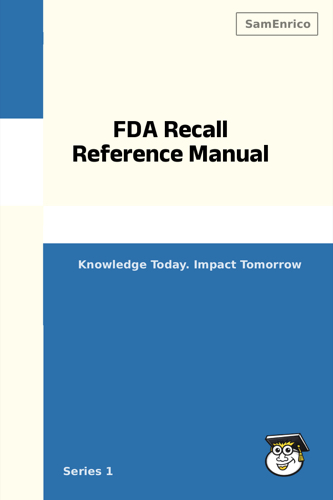
Non-FictionCompliance & Risk ArchiveFood Law
FDA Recall Reference Manual eBook
Navigate the FDA recall classification system from
by Windham Loni
Navigate the FDA recall classification system from Class I to III with enforcement trend analysis.
Formats
Free sample
Chapter 1: The 21% Spike...-- The call comes on a Tuesday. Not from your quality team, not from your legal department, but from a reporter. "We have documents showing your product may have caused three patient deaths. The FDA isn't commenting. What do you know?" Your stock is down 11% before you finish the sentence.
Your largest distributor puts you on hold. Your CEO wants an answer in the next twenty minutes. And somewhere in your supply chain, a single component that cost seventeen cents is about to cost you everything.This is not a hypothetical. Between 2021 and 2025, recall events in FDA-regulated industries rose by 21 percent. Not because products suddenly became more dangerous, but because the system that detects, classifies, and communicates product failures became faster, more aggressive, and less forgiving.
The FDA of 2026 is not the FDA of 2016. The enforcement landscape has shifted, and the ground beneath quality professionals, regulatory affairs executives, and supply chain directors has moved with it.This chapter establishes the contemporary context for why recalls have become a critical business continuity issue rather than a mere regulatory nuisance. It is not a history lesson. It is a diagnosis of the present moment—and a warning about what happens to companies that treat recalls as paperwork instead of existential threats. We will examine the three converging forces driving the 21 percent increase, the tangible costs of non-compliance that extend far beyond fines, and the persistent myth that continues to trap well-intentioned executives into catastrophic decision-making.The Shifting Enforcement Landscape To understand where recalls are going, we must first understand where the FDA has been.
For decades, the agency operated largely as a reactive enforcement body. Inspections occurred on predictable schedules. Warning letters followed a rhythm that allowed companies time to respond. Recalls, when they happened, were often collaborative affairs between regulators and regulated.That era is over.The shift began quietly in the late 2010s but accelerated dramatically following the pandemic, when supply chain disruptions, remote manufacturing oversight, and a series of high-profile public health failures forced the agency to reconsider its posture. The FDA of 2026 is proactive, data-driven, and increasingly willing to escalate enforcement actions when it perceives delay or obfuscation.
Consider the following markers of this transformation:First, the agency has invested heavily in predictive analytics. Using adverse event reports, inspection histories, and social media monitoring, the FDA now identifies potential recall situations before companies themselves may be aware of emerging patterns. This means the clock on your response begins earlier than you think.Second, the agency has streamlined its recall request process. What once required weeks of back-and-forth correspondence can now be initiated with a single phone call from a district office. The "gentleman's agreement" of a requested recall carries the same weight as a mandatory order, because everyone involved knows what comes next if the request is refused.Third, and most significantly for the purposes of this book, the agency has become transparent about its enforcement metrics.
The 21 percent increase in recall events is not buried in annual reports. It is published, analyzed, and cited in congressional hearings. The FDA wants you to know that recalls are increasing, because that knowledge itself is a deterrent.The 21 Percent: Anatomy of a Statistic Let us examine this 21 percent figure more closely, because it contains within it the story of the modern recall landscape. Between 2021 and 2025, the FDA recorded recalls across all product categories—food, medical devices, pharmaceuticals, biologics, and cosmetics—totaling more than eight thousand individual events in the peak year of that period. Of these, approximately 12 to 15 percent were classified as Class I, the most serious category, indicating a reasonable probability of death or serious injury.The 21 percent increase was not evenly distributed.
Medical devices led the trend, with a 28 percent increase in recall events over the period, followed by food at 19 percent, and pharmaceuticals at 14 percent. These variations are not random. They reflect underlying structural factors that we will explore throughout this book, including the "malfunction versus harm" distinction for devices (Chapter 4), the traceability challenges in food supply chains (Chapter 11), and the longer development and testing cycles for pharmaceuticals that catch problems earlier.More troubling than the raw increase is the composition of the increase. Class I recalls grew at 36 percent over the same period—more than one and a half times the rate of recalls overall. This means it is not simply that more recalls are happening; it is that more recalls are being classified at the highest level of severity.
For quality professionals, this is the statistic that should keep you awake at night. A Class I recall is not a paperwork exercise. It is a business extinction event.Three Converging Forces What is driving this increase? The answer lies not in any single factor but in the convergence of three distinct forces, each of which would be significant on its own and which together create a perfect storm of recall risk.Force One: Supply Chain Fragmentation Twenty years ago, a typical medical device manufacturer might source components from a dozen suppliers, most of them domestic. Today, that same manufacturer might source from two hundred suppliers across thirty countries.
Each new supplier introduces a new point of failure: a different quality system, a different inspection regime, a different language for describing defects, a different legal framework for liability.The problem is compounded by the fact that most manufacturers do not audit their suppliers with sufficient rigor. A survey of quality professionals conducted in 2024 found that only 38 percent of companies audited their Tier 2 suppliers (suppliers to their direct suppliers) at all, and only 12 percent audited Tier 3 suppliers. Yet a defect originating at Tier 3—say, a contaminated raw material or a mis-calibrated production machine—will manifest at the final product exactly as if the manufacturer had caused it themselves. The FDA does not care where the defect originated. They care only that the product is dangerous.Supply chain fragmentation also creates what regulators call "traceability debt"—the accumulated difficulty of tracing a finished product back to its component origins.
When a recall is initiated, the FDA expects to know, within hours, which suppliers provided which components for which lots. Companies that cannot answer this question quickly face extended audit checks, public warnings, and in some cases, mandatory orders. Chapter 11 provides a framework for building traceability systems that can survive this scrutiny, but the foundational reality is this: every supplier you add increases your recall risk, and most companies have added far more suppliers than they have added quality controls.Force Two: Remote Manufacturing Oversight The pandemic normalized remote work across virtually every industry, including quality assurance. For eighteen months, FDA inspections were largely suspended. Manufacturers conducted internal audits remotely.
Suppliers certified their own compliance without on-site verification. When in-person inspections resumed, the backlog was immense—and so was the pent-up enforcement energy.What regulators found when they returned to factory floors was sobering. In a 2023 analysis of inspection findings following the resumption of normal operations, the FDA reported a 34 percent increase in observations related to process controls, a 41 percent increase in documentation deficiencies, and a 27 percent increase in labeling errors compared to pre-pandemic baselines. The remote period had created what one investigator called…
This is the end of the free sample. Get the eBook to keep going. Buy now
About this book
Details
- Author
- Windham Loni
- Publisher
- SamEnrico
- Language
- English
- Genre
- Non-Fiction, Compliance & Risk Archive, Food Law
- Released
- 2026-06-07
- Pages (approx.)
- 155
- Available as
- eBook, Audiobook

Read better in the ZLOADR app
Your eBooks on your phone or tablet. Sign in with your SamEnrico account and start reading.
More by Windham Loni
 Branded AI DecksWindham Loni$11.99
 The Homeless Shelter SchoolWindham Loni$11.99
 The Beginner's Self CompassionWindham Loni$11.99
 Strength Training For BJJWindham Loni$11.99
 Just for Today Card GuideWindham Loni$11.99
 Postpartum Self Esteem CoupleWindham Loni$11.99
 Toddler Dream DevelopmentWindham Loni$11.99
 Local Grief Group FinderWindham Loni$11.99
 The Ghost in the Machine: How a Cold War Spy Ring Outsmarted the CIAWindham Loni$11.99
 The Desert Codebreakers: How Iraq's Scientists Deciphered Ancient CuneiformWindham Loni$11.99
 Blood, Sweat, and Silk: The Untold Story of Ancient Chinese Wrestling ChampionsWindham Loni$11.99
 X Twitter Audience Growth and MonetizationWindham Loni$11.99
You may also like
 Hong Kong Handover 1997Dunn Johnnie$11.99
 Zumba For Postnatal Recovery CourseNeal Christian$11.99
 Zumba for BeginnersLadner Nikia$11.99
 YouTube Comment Mining GuideHumes Pandora$12.99
 Worry Box MeditationCarlin Rudy$11.99
 Workplace Stress MeditationNguyen Lynn$11.99
 Workplace Stress and Sleep RepairHawley Ivory$11.99
 Workplace Perfectionism CureDelaney Jeffry$11.99
 Workplace Injustice Anger GuideWallen Isabelle$11.99
 Work Addiction and Burnout LinkGreenwood Ester$11.99
 Women in Yoga and WellnessBeattie Galina$11.99
 Women in Stand Up ComedyChun Evangeline$11.99