
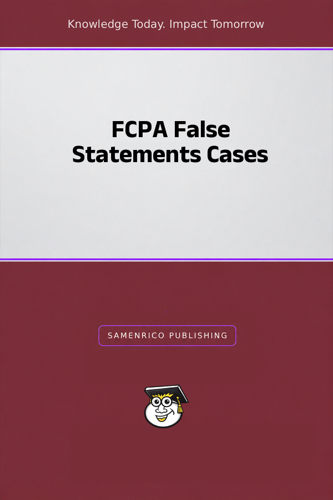
Non-FictionCompliance & Risk ArchiveFalse Statements
FCPA False Statements Cases eBook
Examines enforcement for lying to federal investig
by Coates Cher
Examines enforcement for lying to federal investigators.
Formats
Free sample
Chapter 1: The Cover-Up Calculus...--–- On a humid Tuesday morning in Northern Virginia, a senior vice president of business development for a publicly traded technology firm walked into a nondescript federal building. He had flown in from Singapore the night before. His general counsel had assured him this was a "routine inquiry" about a contract in Indonesia. The two FBI agents across the table were polite, even disarming. They offered him coffee.
They asked about his flight. Then, almost casually, they asked about a dinner meeting in Jakarta three years prior—specifically, whether he recalled approving a $15,000 payment to a consultant named Mr. A., who happened to be the nephew of a procurement minister.The executive answered nine questions truthfully. He was confident, articulate, and cooperative. On the tenth question—"Do you recall any discussion about whether Mr.
A. was actually a government official?"—he paused. He did not remember any such discussion. He had reviewed hundreds of emails the night before and saw nothing. So he said three words: "I don't recall."Eighteen months later, he was sentenced to federal prison.
Not for bribery. The government never proved he knew the $15,000 was a bribe. He was convicted under 18 U.S.C. § 1001 for making a false statement—because a single email, which he had missed in his late-night review, showed he had been copied on a message where a subordinate wrote, "Just to confirm, Mr. A.
is the minister's nephew and expects the usual arrangement." The executive's "I don't recall" was not a memory lapse. In the government's telling, it was a deliberate false statement designed to obstruct an investigation.This book is about that executive. And the dozens like him. And the thousands more who will sit across from federal agents in the coming years, unaware that the greatest legal danger they face is not the bribe they may or may not have paid, but the words that come out of their own mouths.The Central Argument: Why This Book Exists Most books about the Foreign Corrupt Practices Act focus on the bribery itself. They devote hundreds of pages to defining "foreign official," parsing the "business purpose" test, and analyzing the nuances of the "knowing" standard.
These are important topics. But they miss the forest for the trees.The forest is this: between 2020 and 2026, the Department of Justice secured convictions in FCPA-related matters at a rate of over 90 percent when they charged false statements. By contrast, standalone FCPA bribery convictions at trial succeeded barely half the time. The reason is simple. Proving a bribery case requires the government to establish a specific corrupt agreement—a meeting of the minds between the payer and the recipient to trade money for an improper benefit.
That is hard. It requires documentary evidence, cooperating witnesses, and often a whistleblower. Proving a false statement, on the other hand, requires only three things: a statement, knowledge of falsity, and materiality. The corrupt agreement is irrelevant. The government does not need to prove the underlying bribe existed.
They only need to prove that you said something untrue while speaking to a federal agent.This is what we call the Cover-Up Calculus. It is a simple equation that every executive, board member, and in-house counsel must memorize:Cost of Bribery Conviction = Prison time (often 2-5 years) + Corporate fine + Reputational damage + Debarment risk.Cost of False Statement Conviction = Prison time (often 1-3 years, but stacking enhancements can push to 10+) + Loss of cooperation credit + Obstruction enhancement + Virtually guaranteed conviction (90%+ rate).The key insight is not that false statements are punished more severely than bribery—although they often are, particularly when obstruction enhancements apply. The key insight is that false statements are easier to prove. The government pursues them not because they are more serious, but because they are more winnable. A prosecutor staring at a weak bribery case will almost always pivot to a false statement charge if the defendant opened their mouth.
And in the vast majority of FCPA investigations, the defendant did.The Spoiler: Silence Is the Only Safe Answer Before we go any further, let me give away the ending. Because this is not a mystery novel, and the stakes are too high for suspense.The only consistently safe response to a federal investigator's question—from an FBI agent, a DOJ prosecutor, an SEC enforcement attorney, or any other federal official—is some version of the following: "I respectfully decline to answer on the advice of counsel and in exercise of my Fifth Amendment right against self-incrimination." Or, in less formal settings: "I need to speak with my lawyer before I answer any questions."That is it. There is no magical phrasing that allows you to tell your side of the story without risk. There is no "cooperative witness" exception to § 1001. There is no "I was just clarifying" defense.
There is no "I didn't know that was false" escape hatch when the falsehood is obvious. The statute is ruthlessly simple, and the courts have interpreted it with ruthless consistency.The remaining eleven chapters of this book exist to answer one question: What happens when executives ignore this advice? They are not a manual for how to lie safely—there is no such thing. They are a forensic autopsy of the false statement prosecution, designed to show, in excruciating detail, why the safe answer is the only answer.If you are reading this book as an executive hoping to find a loophole, a clever workaround, or a strategic way to "manage" an interview with federal agents, you will be disappointed. Put the book down now and remember only this: say nothing, ask for your lawyer, and wait.
If you are reading this book as a defense attorney, compliance officer, or board member who wants to understand the mechanics of false statement enforcement so you can counsel clients effectively, read on. The chapters ahead will equip you with everything you need to know about the statutes, the investigation dynamics, the trial strategies, and the future of enforcement. But never forget the spoiler. It is the foundation upon which every other chapter rests.Why This Chapter Starts with a Spoiler Legal books typically build suspense. They lay out the rules, walk through the cases, and only at the end reveal the "best practices" or "key takeaways." That model is perfectly appropriate for academic treatises and law review articles.
It is dangerously inadequate for a book about false statements in FCPA investigations.The reason is simple: the stakes are too high for gradual revelation. An executive reading this book on a plane to Singapore, or a general counsel reviewing it on a Sunday night before a Monday morning interview with the DOJ, cannot afford to wait until Chapter 12 to learn the bottom line. They need the spoiler now. They need to know that the most important decision they will make—whether to speak or remain silent—must be made before they understand the nuances of materiality, the half-truth doctrine, or the Yates Memo 2.0.Moreover, the spoiler serves a pedagogical purpose. Once you know that silence is the only safe answer, the rest of the book becomes a different kind of text.
It is no longer a "how-to" manual for navigating interviews. It is a cautionary tour of the wreckage left behind…
This is the end of the free sample. Get the eBook to keep going. Buy now
About this book
Details
- Author
- Coates Cher
- Publisher
- SamEnrico
- Language
- English
- Genre
- Non-Fiction, Compliance & Risk Archive, False Statements
- Released
- 2026-06-07
- Pages (approx.)
- 157
- Available as
- eBook, Audiobook

Read better in the ZLOADR app
Your eBooks on your phone or tablet. Sign in with your SamEnrico account and start reading.
More by Coates Cher
 Bipolar Sleep Regulation PrimerCoates Cher$11.99
 Bipolar Disorder Support In Poor NationsCoates Cher$11.99
 Gacy's Last MealCoates Cher$11.99
 Dream Recall MethodsCoates Cher$11.99
 Pattern Recognition for CoachesCoates Cher$11.99
 Nighttime Stretching ProtocolCoates Cher$11.99
 Imposter Syndrome for First Gen StudentsCoates Cher$11.99
 Kim Jong IlCoates Cher$11.99
 Phantom of the Freeway: The I-5 Killer's Trail of BloodCoates Cher$11.99
 Ragnarok's Unseen Architect: The Forgotten Role of GullinkambiCoates Cher$11.99
 The Marble Mirage: How a Lost Roman Sculptor Outwitted the GodsCoates Cher$11.99
 Growing PycnostachysCoates Cher$11.99
You may also like
 Hong Kong Handover 1997Dunn Johnnie$11.99
 Zumba For Postnatal Recovery CourseNeal Christian$11.99
 Zumba for BeginnersLadner Nikia$11.99
 YouTube Comment Mining GuideHumes Pandora$12.99
 Worry Box MeditationCarlin Rudy$11.99
 Workplace Stress MeditationNguyen Lynn$11.99
 Workplace Stress and Sleep RepairHawley Ivory$11.99
 Workplace Perfectionism CureDelaney Jeffry$11.99
 Workplace Injustice Anger GuideWallen Isabelle$11.99
 Work Addiction and Burnout LinkGreenwood Ester$11.99
 Women in Yoga and WellnessBeattie Galina$11.99
 Women in Stand Up ComedyChun Evangeline$11.99