
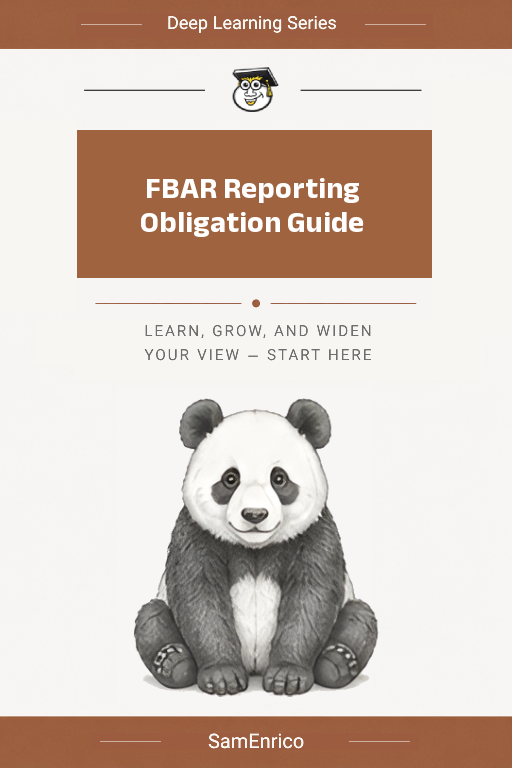
FBAR Reporting Obligation Guide eBook
File FinCEN Form 114 if foreign owned LLC has over
File FinCEN Form 114 if foreign owned LLC has over 10000 USD in non US accounts. Non resident members with signatory authority must report annually.
Formats
Free sample
Chapter 1: The Signature Trap...--The first time I saw a client cry over a signature card, I was sitting across from a 58‑year‑old nurse named Diane. She had worked in a Toronto hospital for three decades, paid her U.S. taxes on time every year, and never once thought of herself as a criminal. Then the letter came from the Internal Revenue Service.Diane was a U.S. citizen.
She had moved to Canada in her twenties, married a Canadian, raised two children, and become a permanent resident of Canada. But she never renounced her U.S. citizenship. That meant, for tax purposes, she was still a U.S. person living abroad.
Her father, aging and frail, had added her name to his Canadian trust account so she could pay his nursing home bills. She never deposited a penny of her own money. She never withdrew a dime for herself. She simply signed checks on his behalf.The IRS proposed a penalty of 82,000forfailingtofileaformshehadneverheardof:Fin CENForm114,commonlyknownasthe FBAR.Theformaskedhertoreportthatshehadsignatureauthorityoveraforeignfinancialaccount.Herfather′strustaccounthadabalanceofroughly82,000 for failing to file a form she had never heard of: Fin CEN Form 114, commonly known as the FBAR. The form asked her to report that she had signature authority over a foreign financial account.
Her father's trust account had a balance of roughly 82,000forfailingtofileaformshehadneverheardof:Fin CENForm114,commonlyknownasthe FBAR.Theformaskedhertoreportthatshehadsignatureauthorityoveraforeignfinancialaccount.Herfather′strustaccounthadabalanceofroughly180,000. Diane had no financial interest in that money. But she had signature authority. And that, under U.S. law, was enough.This chapter is about why Diane's story is not an outlier.
It is the new normal. And if you are reading this book, there is a meaningful chance that you are sitting on the same ticking time bomb without knowing it.The $10,000 Myth That Will Ruin Your Life Before we go any further, let me correct the single most dangerous misconception in FBAR compliance: the belief that you only need to file if you own foreign money.The average person, when asked about reporting foreign accounts, thinks about a wealthy executive with a Swiss numbered account. They think about tax evasion. They think about hiding money. That is not only wrong; it is actively dangerous for millions of ordinary people who have never broken a law in their lives.Here is the truth.
The FBAR is not a tax form. It is an anti‑money laundering form. Its purpose is to give the U.S. government visibility into who can move money across borders, not just who owns it. That is why the trigger for filing is not ownership.
The trigger is signature authority.Signature authority means the legal power to sign checks, approve wire transfers, withdraw funds, or give instructions to a financial institution regarding an account. If you can walk into a bank and move money, you have signature authority. It does not matter if that money belongs to your employer, your spouse, your parent, a trust, a charity, or a corporation. It does not matter if you have never actually exercised that power. It does not matter if you signed the signature card as a favor to a relative and have regretted it ever since.The moment your name is on that signature card, you have an FBAR filing obligation if the total of all foreign accounts over which you have signature authority (or in which you have a financial interest) exceeds the $10,000 aggregate threshold on any single day of the calendar year.Let me say that again because it is the most important sentence in this chapter.
Signature authority alone creates a filing obligation. Ownership is irrelevant.The Non‑Resident Reality Check: You Cannot Run from the Long Arm One of the most common questions I hear from readers is some variation of: "But I don't live in the United States anymore. Surely this doesn't apply to me."The answer is almost always yes, it applies to you.The FBAR applies to any U.S. person. And the definition of a U.S.
person for FBAR purposes is broader than most people realize. It includes three categories of individuals, none of which depends on your current physical address.First, U.S. citizens. This is the clearest category. If you were born in the United States or naturalized as a citizen, you are a U.S.
citizen for life unless you formally renounce your citizenship before a consular officer and pay the exit tax. You cannot lose your citizenship by moving abroad, marrying a foreign national, or living overseas for fifty years. I have advised clients who moved to Australia as children and have not set foot in the United States for four decades. They are still U.S. citizens.
They still must file FBARs.Second, lawful permanent residents. This is the green card holder category. If you hold a valid green card, you are a U.S. person for FBAR purposes regardless of where you live. I have worked with clients who obtained green cards, moved back to their home countries, and assumed that letting the green card expire meant they were done with U.S.
reporting. That assumption is wrong. The green card is considered surrendered only when you file formal paperwork with U.S. Citizenship and Immigration Services or when a U.S. administrative or judicial order terminates it.
Simply letting the plastic card expire does nothing.Third, resident aliens. These are individuals who meet the substantial presence test, generally spending 183 days or more in the United States during a calendar year using a weighted formula. Even if you are not a citizen and do not have a green card, you can become a U.S. person for FBAR purposes simply by spending enough time on U.S. soil.Physical location does not matter at all under any of these definitions.
A U.S. citizen living in Singapore, working for a British company, with signature authority over a Hong Kong bank account must file an FBAR. A green card holder living permanently in London must file. A resident alien who spends seven months of the year in Florida and five months in Costa Rica must file.The only non‑residents who avoid FBAR entirely are non‑resident aliens. That means individuals who are not U.S.
citizens, do not hold green cards, and do not meet the substantial presence test. If that is you, you can close this book. But if you are a U.S. citizen living abroad, keep reading.Financial Interest vs. Signature Authority: A Critical Distinction Now that we have established who must file, let us sharpen the distinction between the two legal triggers: financial interest and signature authority.Financial interest means you own the account, either directly (the account is in your name) or indirectly (the account is in the name of an entity you control).
Under FBAR rules, you have a financial interest in a foreign account if you are the owner of record, if the account is held for your benefit, or if you have more than a 50 percent ownership interest in the entity that owns the account. We will explore that 50 percent rule in depth in Chapter 3 when we discuss foreign LLCs and other entities.Signature authority, by contrast, has…
This is the end of the free sample. Get the eBook to keep going. Buy now
About this book
Details
- Author
- Helton Beckie
- Publisher
- SamEnrico
- Language
- English
- Genre
- Non-Fiction, Business Brief, FBAR
- Released
- 2026-06-01
- Pages (approx.)
- 140
- Available as
- eBook, Audiobook

Read better in the ZLOADR app
Your eBooks on your phone or tablet. Sign in with your SamEnrico account and start reading.
More by Helton Beckie
 Potassium Blood Pressure Control GuideHelton Beckie$11.99
 OCD Meditation GuideHelton Beckie$11.99
 Baby Tech Capital GuideHelton Beckie$11.99
 Winter Cabin Cozy VisualizationHelton Beckie$11.99
 MBSR for PostpartumHelton Beckie$11.99
 Parts Negotiation ScriptingHelton Beckie$11.99
 Time Blocking For ProcrastinatorsHelton Beckie$11.99
 The Social Worker Stress HandbookHelton Beckie$11.99
 Soft Start Up PracticeHelton Beckie$11.99
 The Dark Money Mirage: How a Shadowy Donor Reshaped an ElectionHelton Beckie$11.99
 The Medieval Star Chart: How a Forgotten Monk Mapped the CosmosHelton Beckie$11.99
 The Maroon Navigators: How Enslaved Africans Charted Freedom Across the CaribbeanHelton Beckie$11.99
You may also like
 Hong Kong Handover 1997Dunn Johnnie$11.99
 Zumba For Postnatal Recovery CourseNeal Christian$11.99
 Zumba for BeginnersLadner Nikia$11.99
 YouTube Comment Mining GuideHumes Pandora$12.99
 Worry Box MeditationCarlin Rudy$11.99
 Workplace Stress MeditationNguyen Lynn$11.99
 Workplace Stress and Sleep RepairHawley Ivory$11.99
 Workplace Perfectionism CureDelaney Jeffry$11.99
 Workplace Injustice Anger GuideWallen Isabelle$11.99
 Work Addiction and Burnout LinkGreenwood Ester$11.99
 Women in Yoga and WellnessBeattie Galina$11.99
 Women in Stand Up ComedyChun Evangeline$11.99