
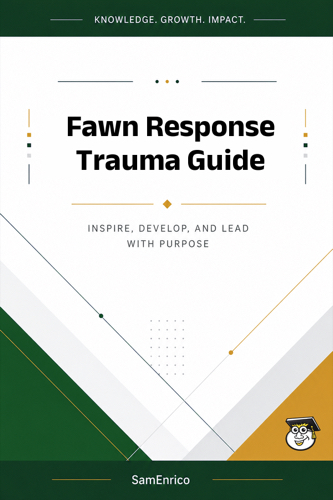
Non-FictionSelf-HelpCodependency
Fawn Response Trauma Guide eBook
Understand people-pleasing as a trauma response an
by Teal Tessa
Understand people-pleasing as a trauma response and set boundaries without guilt.
Formats
Free sample
Chapter 1: The Fourth F...--–- Sarah had just been promoted to vice president of operations at a regional healthcare network. She was thirty-four years old, earned a salary that would make her college classmates gasp, and ran a team of forty-seven people. From the outside, Sarah had arrived. But last Tuesday, at 7:43 PM, she found herself standing in front of her open refrigerator, door handle still in her hand, crying. Not because of the merger deadline.
Not because of the board presentation. Because her husband had asked her a simple question—”What do you want for dinner?”—and she could not produce an answer. Her mind raced through his preferences, the children’s allergies, what was leftover, what would cause the least cleanup, what would not make anyone disappointed. She calculated, optimized, and accommodated until the sheer weight of considering everyone else’s happiness collapsed into a single, humiliating tear sliding down her cheek. She was running a multimillion-dollar operation, but she could not pick a meal.If you recognized something of yourself in Sarah, you are not alone.
And more importantly, you are not broken.For decades, psychology has given us a neat map of how human beings respond to threat. When danger appears, we have three classic options: fight, flight, or freeze. We either confront the threat, run from it, or become immobile until it passes. These three responses have saved human lives for millions of years. But there is a fourth option, one that has only recently entered the mainstream conversation about trauma.
It is the strategy of the child who learns that fighting makes things worse, running is impossible, and freezing only delays the inevitable. That child discovers a different path: appeasement. Smile. Agree. Become useful.
Disappear into what everyone else needs. This is the fawn response, and if you are reading this book, there is a very good chance it has been running your life without your permission.The Paradox of the High-Functioning Pleaser Let me tell you about another person. Her name is Michelle, and she is a trial attorney. She has won cases that made local news. She stands before juries and delivers closing arguments with the kind of commanding presence that makes opposing counsel sweat.
Her fight response is fully intact—in the courtroom. But when her sister calls and says, “I need you to watch the kids this weekend, I know you’re busy but I really need a break,” Michelle’s voice changes. It becomes smaller. She says, “Of course, no problem, I’ll figure it out.” She does not mention that she has been working eighty-hour weeks. She does not mention that she has not slept through the night in a month.
She simply adds one more obligation to the pile and feels a vague, nameless resentment that she would never, ever say out loud.This is the paradox of the high-functioning people-pleaser. You can be competent, accomplished, and even intimidating in one arena of your life, while collapsing into compliance in another. You can run a department but not set a dinner boundary. You can negotiate million-dollar contracts but not ask your partner to load the dishwasher. The fawn response is not a measure of weakness or low intelligence.
It is a measure of where your nervous system learned that safety required self-erasure.If you are a fawn type, you have likely been called many things over the years. Codependent. Too nice. A pushover. Conflict-avoidant.
An over-giver. A doormat. These labels are not just unkind; they are clinically inaccurate. They mistake a survival strategy for a character flaw. They blame you for a pattern that kept you safe when you had no other options.
And they completely miss the truth: your people-pleasing is not a personality defect. It is a trauma response.The Biology of the Fourth FTo understand why you cannot stop saying yes, we have to go beneath psychology and into biology. Specifically, we have to talk about the autonomic nervous system—the part of your body that runs all the processes you do not have to think about, like breathing, digestion, and heart rate. It also runs your threat response, and it does so much faster than your conscious mind can intervene.The autonomic nervous system has two main branches. The sympathetic nervous system is your accelerator.
It gets you ready for action, increasing heart rate and sending blood to your large muscles. This is the fight or flight system. The parasympathetic nervous system is your brake. It slows things down, promotes rest and digestion, and can also shut everything down in a freeze response. Within the parasympathetic branch, there is a newer discovery called the polyvagal system, named after the vagus nerve that runs from your brainstem down through your chest and abdomen.Here is what matters for you: your body has a built-in threat-detection system called neuroception.
This is not perception, which is conscious noticing. Neuroception happens below your awareness. Your nervous system is constantly scanning your environment—and the people in it—for cues of safety or danger. A tone of voice. A facial expression.
A sigh. A shoulder turn. The tempo of someone’s breathing. All of this data is processed in milliseconds, long before your thinking brain has caught up.When your neuroception detects a threat, your nervous system responds in one of four ways. Fight says, “Push back.” Flight says, “Get out.” Freeze says, “Go limp and wait.” And fawn says, “Appease.
Please. Become what they need so they do not hurt you.”The fawn response is not a choice. It is not a moral failing. It is a biological survival strategy, as ancient and automatic as pulling your hand from a hot stove. The only difference is that the threat your nervous system is responding to is not a predator on the savanna.
It is a parent who punished your honesty. A teacher who withdrew affection when you disagreed. A caregiver whose love was conditional on your compliance. Your nervous system learned, through repeated experience, that the safest path through certain social encounters was to make yourself small, agreeable, and useful.Why the Fawn Response Gets Misdiagnosed One of the most damaging misunderstandings about the fawn response is that it gets mistaken for kindness. It is not kindness.
It is a fear-based survival strategy. Genuine kindness is a choice made from a place of abundance and safety. Fawning is a compulsion driven by a fear of annihilation. The difference is invisible from the outside but world-changing on the inside.Consider the difference between these two scenarios. A kind person sees a friend struggling and offers help because they have the capacity and the desire to give.
The help feels good to give. If the friend says no thank you, the kind person feels fine. A fawning person sees a friend struggling and feels a spike of anxiety. They immediately offer help—not primarily because they want to help, but because they cannot tolerate the discomfort of watching someone struggle. If the friend says no thank you, the fawning person feels rejected, anxious, or even panicky.
The offer was not an offering; it was a bid for safety.This distinction matters because the fawn response is often…
This is the end of the free sample. Get the eBook to keep going. Buy now
About this book
Details
- Author
- Teal Tessa
- Publisher
- SamEnrico
- Language
- English
- Genre
- Non-Fiction, Self-Help, Codependency
- Released
- 2026-06-11
- Pages (approx.)
- 135
- Available as
- eBook, Audiobook

Read better in the ZLOADR app
Your eBooks on your phone or tablet. Sign in with your SamEnrico account and start reading.
More by Teal Tessa
 Eye Fixation Induction ScriptsTeal Tessa$11.99
 Postpartum Mom Friends GuideTeal Tessa$11.99
 When You Can't Get Another PetTeal Tessa$11.99
 Physical Therapy NeuropathyTeal Tessa$11.99
 Alcohol Recovery Therapy OptionsTeal Tessa$11.99
 Wrinkle Filler Injection Aftercare GuideTeal Tessa$11.99
 Dreaming for Artistic IdeasTeal Tessa$11.99
 Into the Abyss: The Unsung Pioneers of the Pacific's Underwater CavesTeal Tessa$11.99
 The Birth of the 'Distracted Boyfriend' Meme: How One Photo Conquered the InternetTeal Tessa$11.99
 The Architect Kings of Nubia: Pyramids, Temples, and the Golden Age of KushTeal Tessa$11.99
 The Dancer's Guide to Western SwingTeal Tessa$11.99
 Monetizing Audiences with PatreonTeal Tessa$11.99
You may also like
 Hong Kong Handover 1997Dunn Johnnie$11.99
 Zumba For Postnatal Recovery CourseNeal Christian$11.99
 Zumba for BeginnersLadner Nikia$11.99
 YouTube Comment Mining GuideHumes Pandora$12.99
 Worry Box MeditationCarlin Rudy$11.99
 Workplace Stress MeditationNguyen Lynn$11.99
 Workplace Stress and Sleep RepairHawley Ivory$11.99
 Workplace Perfectionism CureDelaney Jeffry$11.99
 Workplace Injustice Anger GuideWallen Isabelle$11.99
 Work Addiction and Burnout LinkGreenwood Ester$11.99
 Women in Yoga and WellnessBeattie Galina$11.99
 Women in Stand Up ComedyChun Evangeline$11.99