
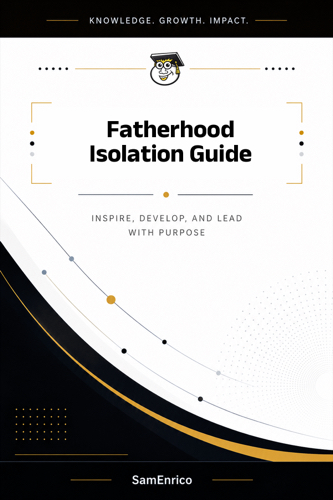
Non-FictionSelf-HelpFatherhood
Fatherhood Isolation Guide eBook
Overcome the unique loneliness of being a dad with
Overcome the unique loneliness of being a dad with few support systems.
Formats
Free sample
Chapter 1: The Silent Inheritance--–- The garage smelled like sawdust and old regret. I was twelve years old, sitting on a overturned bucket, watching my father change the oil on our family’s tan sedan. He didn’t speak for forty-five minutes. Neither did I. When he finished, he wiped his hands on a red rag, looked at me, and said exactly four words: “Hand me the funnel.” I handed him the funnel.
He nodded once. That was our conversation for the entire afternoon. And I remember thinking, even then: This is what men do. They stand near each other in silence. They complete tasks.
They do not ask how the other person is feeling. They do not say “I love you” unless someone is dying or leaving for war. This is normal.It took me twenty more years to realize that it wasn’t normal at all. It was a inheritance.Every father hands something down to his son. Sometimes it’s a watch, a trade, a last name.
Sometimes it’s a temper, a drinking problem, a fear of intimacy. But the most common inheritance—the one no one talks about, the one that doesn’t appear in any will—is a blueprint for loneliness. A set of instructions, never written down, that teaches a boy how to become a man who stands alone. Who carries everything. Who never admits that the weight is breaking his back because admitting it would mean he failed the first lesson: Men don’t complain.
Men provide. Men endure.This chapter is about that inheritance. It is about the conspiracy of silence that passes from father to son like a cursed heirloom. And it is about the first, most important step you will take in this entire book: naming it. Because you cannot break what you will not name.
And you cannot heal what you keep calling “normal.”The Conspiracy You Didn't Know You Joined Let me ask you a question, and I want you to answer it honestly—not out loud, unless you’re alone, but at least in the privacy of your own head. When was the last time you told another man that you were struggling? Not complaining about traffic or the price of lumber or your fantasy football team’s tragic losing streak. I mean really struggling. Lonely.
Overwhelmed. Unsure if you’re doing any of this fatherhood thing correctly. When was the last time you said those words out loud to another human being who wasn’t a paid professional or a partner you were worried about burdening?If you’re like most of the men I’ve spoken to while researching this book, the answer is somewhere between “I can’t remember” and “Never.”That’s not because you’re broken. That’s because you were trained.The conspiracy of silence is not a formal agreement. No group of fathers ever gathered in a lodge somewhere to sign a document promising never to share their feelings.
That’s not how these things work. The conspiracy is passed down the way most family traditions are: through observation, repetition, and a thousand small moments of nonverbal teaching. A father comes home from work exhausted and angry. He doesn’t say why. He sits in his chair.
He turns on the television. He doesn’t ask about your day. You learn: This is how you handle exhaustion. You swallow it.A father loses his job. You don’t find out from him.
You find out because your mother is crying in the kitchen and he’s in the garage with the door closed. You learn: Financial pain is private. You do not share it.A father’s own father dies. He doesn’t cry at the funeral—or if he does, he turns his face away quickly, as if he’s been caught doing something shameful. You learn: Grief is weakness.
Hide it.A father has no friends. Not real ones. He has coworkers, neighbors he waves at, maybe a guy he golfs with twice a year. But no one he calls when he’s scared. No one who knows his real salary or his real fears or the real state of his marriage.
You learn: Friendship is optional. Independence is strength.By the time you become a father yourself, you don’t even notice the blueprint anymore. It’s not a set of instructions you consult. It’s just the air you breathe. You don’t tell anyone you’re lonely because it wouldn’t occur to you that you’re allowed to.
You don’t reach out because reaching out feels like failure. You don’t admit that you have no one to call at 2 AM because admitting that would mean acknowledging that something is missing—and acknowledging absence feels too close to admitting inadequacy.So you stay silent. You stay busy. You stay useful. And you stay lonely.The Utility Trap: When Your Worth Becomes Your Output Here’s where the conspiracy gets particularly cruel.
It doesn’t just teach you to be silent. It teaches you that your silence is actually a virtue—as long as you’re producing something.Modern fatherhood has sold men a lie so persuasive that most of us don’t even recognize it as a lie anymore. The lie is this: Providing is the same as being present. If you bring home a paycheck, if you fix the leaky faucet, if you show up to the soccer game (even if you spend the whole time on your phone), you have done your job. You are a good father.
Your family doesn’t need anything else from you.This lie is the foundation of what I call the Utility Trap.The Utility Trap is the gradual, almost invisible process by which a man comes to believe that his value as a father and a human being is measured entirely by what he produces. Income. Repairs. Discipline. Logistics.
Solutions. These are the metrics. And because these metrics are measurable—you can see a paycheck, you can touch a fixed faucet, you can count the number of games you attended—they feel real. They feel like proof.But here’s what the Utility Trap steals from you: the knowledge that you have value outside of what you do.Think about the last time you felt genuinely appreciated by your family. What were you doing?
Were you sitting on the couch, relaxed, sharing a story about your own childhood? Or were you fixing something, paying for something, solving something? Most men I’ve interviewed can’t remember the last time they felt appreciated for being rather than doing. And that’s not an accident. That’s the trap.The Utility Trap doesn’t just affect how your family sees you.
It affects how you see yourself. When your entire identity is wrapped up in your output, any threat to that output becomes a threat to your existence. Lose your job? You haven’t just lost income. You’ve lost your reason for being.
Get sick? You’re not just sick—you’re failing at your primary function. Need a break? You’re not tired—you’re letting everyone down.This is…
This is the end of the free sample. Get the eBook to keep going. Buy now
About this book
Details
- Author
- Douglass Rudolf
- Publisher
- SamEnrico
- Language
- English
- Genre
- Non-Fiction, Self-Help, Fatherhood
- Released
- 2026-06-09
- Pages (approx.)
- 139
- Available as
- eBook, Audiobook

Read better in the ZLOADR app
Your eBooks on your phone or tablet. Sign in with your SamEnrico account and start reading.
More by Douglass Rudolf
 The Art of Doing NothingDouglass Rudolf$11.99
 Desert Sleep PracticeDouglass Rudolf$11.99
 Stand Your Ground Assertiveness GuideDouglass Rudolf$11.99
 The Morning Creative Ritual GuideDouglass Rudolf$11.99
 Speed and Silk: The Rise of African Swimming Legends and Their Fashion RevolutionDouglass Rudolf$11.99
 Webinar Pre Launch CommunityDouglass Rudolf$12.99
 Fastest MOOC Job CertificatesDouglass Rudolf$12.99
 Learn to Play the AlphornDouglass Rudolf$11.99
 Assembly AssociateDouglass Rudolf$11.99
 How to Start a Phosphates of Ammonium Carbonates Business (Beginners Guide)Douglass Rudolf$11.99
You may also like
 Hong Kong Handover 1997Dunn Johnnie$11.99
 Zumba For Postnatal Recovery CourseNeal Christian$11.99
 Zumba for BeginnersLadner Nikia$11.99
 YouTube Comment Mining GuideHumes Pandora$12.99
 Worry Box MeditationCarlin Rudy$11.99
 Workplace Stress MeditationNguyen Lynn$11.99
 Workplace Stress and Sleep RepairHawley Ivory$11.99
 Workplace Perfectionism CureDelaney Jeffry$11.99
 Workplace Injustice Anger GuideWallen Isabelle$11.99
 Work Addiction and Burnout LinkGreenwood Ester$11.99
 Women in Yoga and WellnessBeattie Galina$11.99
 Women in Stand Up ComedyChun Evangeline$11.99