
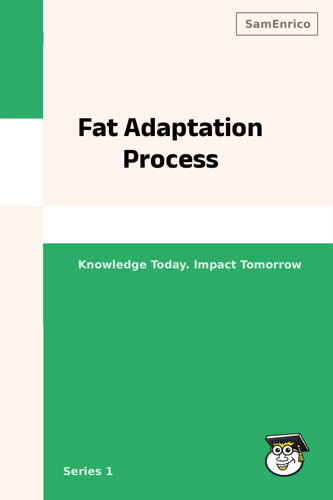
Non-FictionHealth & WellnessMetabolic Flexibility
Fat Adaptation Process eBook
Explains transition period from sugar to fat burne
by Doran Jenee
Explains transition period from sugar to fat burner.
Formats
Free sample
Chapter 1: The Invisible Fuel Tank--–- Imagine waking up tomorrow in a strange room. The room has no doors and no windows. On the floor, there is a small bottle of water and a single piece of bread. That is it. No other food.
No other drink. You are trapped. Your heart races. Your palms sweat. Panic sets in because you know—with absolute certainty—that you will run out of water in a day and food in a few hours.
You are staring at death, and death is staring back.Now imagine waking up in that same room, but this time, someone tells you that the walls are made of food. Not metaphorically. Literally. The bricks are compressed calories. The mortar is pure fat.
You are surrounded by weeks of energy. You could chip away at the walls and live for months. The only problem? You do not have a tool to break the walls open. Your fingernails cannot scratch the surface.
The food is there, inches from your skin, but you cannot reach it.This is your body.You are trapped in a metabolic prison, and the walls are made of your own body fat.Every day, you walk around carrying tens of thousands of calories of stored energy. That soft tissue around your midsection, your thighs, your hips, your upper arms—it is not useless decoration. It is not a punishment for past indulgences. It is not a moral failing made visible. It is a carefully engineered fuel depot, designed by millions of years of evolution to keep you alive during famines, through long winters, across endless savannahs where food was scarce and danger was constant.And yet, you cannot burn it.You reach for a snack two hours after breakfast.
You crave sugar at three in the afternoon. You wake up hungry in the middle of the night. You have 40,000 calories sitting on your body, and you are starving. This is not a contradiction. This is not a mystery.
This is the single most important biological fact about your metabolism, and no one has ever explained it to you.This chapter will explain it. You will learn why you have been hungry on a full stomach. You will learn why the calorie model of weight loss has failed you. You will learn about a hormone that acts as a gatekeeper, locking your fat cells shut and throwing away the key. And you will learn that the key is not lost.
It is simply in the wrong hands. By the end of this book, you will take it back.The Two Tanks Inside Your Body Let us begin with a simple framework that will guide everything that follows.Your body has two fuel tanks.Tank Number One: The Sugar Tank.This tank holds a substance called glycogen. Glycogen is a chain of glucose molecules—sugar—packed tightly together and stored in your liver and your muscles. The sugar tank is small. Very small.
The average person stores between 1,500 and 2,000 calories of glycogen in their liver and muscles combined. That is it. That is all the sugar energy your body can hold at one time.Two thousand calories sounds like a lot until you put it in perspective. Two thousand calories is roughly four bagels. Or six bananas.
Or a single large pepperoni pizza. Or three bowls of pasta. Or one very large burrito. You can empty your sugar tank in a single meal if you eat the right foods, or in a single afternoon if you skip lunch and go for a run.When your sugar tank runs low, you feel it immediately. Your energy drops.
Your concentration blurs. Your mood darkens. You become irritable, anxious, desperate for food. This is not a personality flaw. This is your brain detecting an emergency.
Your brain runs almost exclusively on glucose in a standard sugar-burning metabolism. When glucose drops, your brain panics. It sends emergency signals to your adrenal glands, which release cortisol and adrenaline. Those hormones make you feel stressed, hungry, and ready to do whatever it takes to find food.The sugar tank is fast, convenient, and immediately accessible. But it is tiny.
You can drain it in hours.Tank Number Two: The Fat Tank.This tank holds a substance called triglycerides. Triglycerides are molecules made of three fatty acids attached to a glycerol backbone. They are stored in your fat cells—adipose tissue—in quantities that would shock you if you ever bothered to calculate them.Consider an average person who weighs 180 pounds and has 25 percent body fat. That person carries forty-five pounds of fat. Forty-five pounds of fat contains approximately 180,000 calories of energy.
Even a lean person at 15 percent body fat carries over 100,000 calories. The average person reading this book has somewhere between 40,000 and 200,000 calories of fat energy stored on their body right now.The fat tank is enormous. It is slow, requires complex enzymatic reactions to access, and has been completely ignored by your metabolism for years. But it is virtually unlimited. Forty thousand calories is enough energy to walk from New York to Miami.
It is enough to run ten marathons back to back. It is enough to survive for thirty to forty days without eating a single bite of food.Here is the question that changes everything: If you have 40,000 calories of energy sitting on your body right now, why do you need to eat every three hours?The answer is not that you lack willpower. The answer is not that you are lazy or undisciplined or broken. The answer is that your fat tank is locked. And the key to that lock is a hormone called insulin.Insulin: The Gatekeeper Insulin is a hormone produced by your pancreas.
Its job is to regulate blood glucose—to keep your blood sugar from rising too high after a meal. When you eat carbohydrates, your digestive system breaks those carbohydrates down into glucose. Glucose enters your bloodstream. Your pancreas senses the rising glucose and releases insulin.Insulin then does three things. Understanding these three things is the single most important piece of metabolic knowledge you will ever acquire.First, insulin tells your muscles and liver to absorb glucose from the blood.
Some of that glucose will be used immediately for energy. The rest will be converted into glycogen and stored in your sugar tank for later.Second, insulin tells your liver to stop producing its own glucose. Your liver has the ability to create glucose from non-carbohydrate sources—a process called gluconeogenesis. But when you have plenty of glucose coming from your meal, insulin shuts this process down. No need to make more when there is already plenty.Third—and this is the one that matters most—insulin tells your fat cells to stop releasing fat.
Insulin directly inhibits an enzyme called hormone-sensitive lipase, or HSL. HSL is the key that unlocks your fat cells. When HSL is active, it breaks down triglycerides into free fatty acids, which then enter your bloodstream and travel to your muscles, heart, and other tissues to be burned for energy. When insulin is present, HSL is silenced. The lock stays shut.
The fat stays trapped.This means that as long as insulin is elevated in your bloodstream, your body is physically incapable…
This is the end of the free sample. Get the eBook to keep going. Buy now
About this book
Details
- Author
- Doran Jenee
- Publisher
- SamEnrico
- Language
- English
- Genre
- Non-Fiction, Health & Wellness, Metabolic Flexibility
- Released
- 2026-06-08
- Pages (approx.)
- 144
- Available as
- eBook, Audiobook

Read better in the ZLOADR app
Your eBooks on your phone or tablet. Sign in with your SamEnrico account and start reading.
More by Doran Jenee
 Carrying Heavy BoxesDoran Jenee$11.99Carrying Heavy BoxesDoran Jenee$11.99
 Meth Addiction Trauma Informed Recovery GuideDoran Jenee$11.99
 Stress and Herpes OutbreaksDoran Jenee$11.99
 Nobel Prize Immunology PioneersDoran Jenee$11.99
 Grief and Finances After SpouseDoran Jenee$11.99
 Loving Kindness for Wildlife RehabilitatorsDoran Jenee$11.99
 Action Planning HandbookDoran Jenee$11.99
 The Ghost of Route 1: Colombia's Mafia Turncoat and the Blood That Bought His SilenceDoran Jenee$11.99
 The Forger’s Canvas: How a Fake Masterpiece Exposed 18th-Century Europe’s Art ObsessionDoran Jenee$11.99
 How to Produce Manual ValvesDoran Jenee$11.99
 Service Providers Guide to SongwritersDoran Jenee$11.99
You may also like
 Hong Kong Handover 1997Dunn Johnnie$11.99
 Zumba For Postnatal Recovery CourseNeal Christian$11.99
 Zumba for BeginnersLadner Nikia$11.99
 YouTube Comment Mining GuideHumes Pandora$12.99
 Worry Box MeditationCarlin Rudy$11.99
 Workplace Stress MeditationNguyen Lynn$11.99
 Workplace Stress and Sleep RepairHawley Ivory$11.99
 Workplace Perfectionism CureDelaney Jeffry$11.99
 Workplace Injustice Anger GuideWallen Isabelle$11.99
 Work Addiction and Burnout LinkGreenwood Ester$11.99
 Women in Yoga and WellnessBeattie Galina$11.99
 Women in Stand Up ComedyChun Evangeline$11.99