
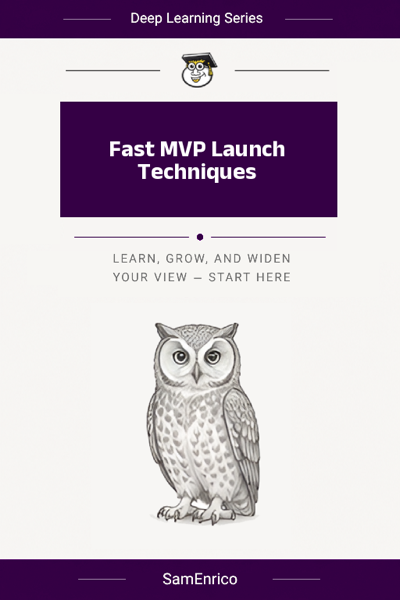
Non-FictionInformativeEducational
Fast MVP Launch Techniques eBook
A Coursebook on Fast MVP Launch Techniques
by Ly Criselda
A Coursebook on Fast MVP Launch Techniques
Formats
Free sample
Chapter 1: The Speed Trap--Most entrepreneurs believe they need more time. More research, more features, more polish, more funding. They treat speed as a compromise—something you accept when you can't afford the "right" way. This is the single most expensive mistake you will ever make.I learned this lesson the hard way. Eleven months into building a food delivery MVP, with forty-seven thousand dollars of my own money spent, I finally launched.
Three users showed up on day one. Two of them were my parents. The third was a college friend who signed up by accident. The post-launch silence was so loud I could hear my own heartbeat. I had built exactly what I planned.
Nobody wanted it.That failure wasn't bad luck. It was bad strategy. I had confused activity with progress. I had spent months adding features nobody asked for, optimizing code that would never run at scale, and perfecting a user interface for users who would never arrive. I was building a cathedral when I should have been building a raft.This book exists because I don't want you to make the same mistake.
But more than that, this book exists because the rules of software creation have fundamentally changed. What worked for founders in 2010—the year of the Lean Startup—is now dangerously slow. What worked in 2015—the rise of no-code—is now table stakes. The question is no longer "Can you build an MVP?" The question is "Can you launch before your courage runs out?"Let me show you what I mean.The Myth of the Year Zero In traditional software development, there is an unspoken assumption that great products require long, secret gestation periods. Call it the "Year Zero" model: twelve to eighteen months of stealth development, followed by a dramatic launch, followed by a quiet pivot when nobody shows up.This model is commercial suicide disguised as professionalism.Here is what actually happens during Year Zero.
Month one, you are excited. Month three, you discover a fundamental assumption was wrong, but you've already built on top of it, so you patch it instead of questioning it. Month six, you add a "small" feature that takes two months. Month nine, you realize your technology choice was suboptimal, but rewriting would delay launch by another quarter, so you keep going. Month eleven, you start cutting features just to ship something.
Month twelve, you launch to a market that has moved on without you.I have watched this movie hundreds of times. I have been the protagonist more than once. The Year Zero model fails not because the team is untalented or the idea is bad. It fails because it violates a fundamental law of software economics: the cost of building something nobody wants is exactly the same as the cost of building something everybody loves. But the learning from building the wrong thing is zero until you ship it.Speed, therefore, is not about working faster.
Speed is about reducing the time between an idea and evidence about that idea. Execution velocity is the only metric that matters before product-market fit.The False Choice Between Speed and Quality Objection: "If I launch fast, I'll launch crap. My users deserve better."I understand this objection because I made it myself. It feels noble. It feels responsible.
It is also completely wrong.The assumption hidden inside that objection is that quality is a single dimension, like temperature, and that every part of your product must be equally hot. But this is not how users experience software. Users experience your product through a single lens: does it solve my problem right now? They will forgive ugly design if the value is undeniable. They will forgive missing features if the core job works.
They will forgive bugs if you fix them quickly. What they will not forgive is waiting.Consider the most successful MVPs in history. Groupon launched as a Word Press blog with a PDF coupon. The founder manually emailed each coupon to buyers. It was slow, unscalable, and objectively "low quality" by any engineering standard.
But it solved a real problem for both businesses (fill empty tables) and customers (get cheap meals). The manual backend was a feature, not a bug, because it forced the founders to talk to every single user.Dropbox launched with a three-minute video. No code. No product. Just a demo of what they planned to build.
The video generated seventy thousand sign-ups overnight. Was that a "quality" MVP? By traditional metrics, it wasn't an MVP at all—it was a prototype. But it validated demand faster than any line of code could have.Buffer launched as a two-page website with a "Pricing" page and a "Sign Up" page. There was no product.
When users clicked "Sign Up," they saw a message: "We're still building. Leave your email." The founders collected enough emails to prove demand before writing a single line of the actual application.The pattern is unmistakable. Speed is not the enemy of quality. Speed is the engine of learning. And learning is the only path to actual quality—the quality of solving a real problem for real users.The Three Meanings of "Fast" (And Why Most People Get It Wrong)When entrepreneurs say they want to move fast, they usually mean one of three things.
Understanding the difference is the difference between shipping and stalling.The first meaning is calendar speed: launching on a specific date regardless of readiness. This is the "Ship It Anyway" approach. It produces a lot of output but often fails because the output was never connected to user needs. Calendar speed without learning is just busyness.The second meaning is development speed: writing code quickly using frameworks, libraries, and AI tools. This is valuable but insufficient.
You can build the wrong thing at record speed and still fail. Development speed is a multiplier, not a strategy.The third meaning—the one that matters for this book—is learning speed: how quickly you can turn an idea into validated knowledge about what users actually want. Learning speed is measured in days, not months. It is the only speed that protects you from building a cathedral that nobody visits.Here is the critical insight that separates successful MVPs from failures. Most teams optimize for calendar speed or development speed.
They set a launch date and work backward, or they adopt the latest framework and build as fast as possible. Both approaches miss the point. You should optimize for the speed of the feedback loop. Every day you spend building before you have evidence is a day you might be building the wrong thing.This means the fastest development team in the world is slow if they don't talk to users. And a slow development team with a tight feedback loop can outpace them by simply not building features that would have been wasted.The 72-Hour Constraint: What It Actually Means This book is built around a provocative question: "What could you launch this Friday if your company depended on it?"The 72-hour constraint is not a challenge to your engineering ability.
It is a challenge to your assumptions. It forces you to ask: what is the absolute smallest unit of value…
This is the end of the free sample. Get the eBook to keep going. Buy now
About this book
Details
- Author
- Ly Criselda
- Publisher
- SamEnrico
- Language
- English
- Genre
- Non-Fiction, Informative, Educational
- Released
- 2026-06-03
- Pages (approx.)
- 137
- Available as
- eBook, Audiobook

Read better in the ZLOADR app
Your eBooks on your phone or tablet. Sign in with your SamEnrico account and start reading.
More by Ly Criselda
 The Breath For Decision FatigueLy Criselda$11.99
 School Principal Stress HandbookLy Criselda$11.99
 New Manager Imposter GuideLy Criselda$11.99
 Avoiding Interruption UrgeLy Criselda$11.99
 Sundance Ceremony Leadership GuideLy Criselda$11.99
 Osmotic Laxatives GuideLy Criselda$11.99
 Pain Management ImageryLy Criselda$11.99
 Malcolm X BlackLy Criselda$11.99
 South Africa Jobs Fund GrantLy Criselda$11.99
 The Silk Road's Forgotten Empress: A Trade Empire ReimaginedLy Criselda$11.99
 The Lost Fleet of the Red Sea: Ancient Egypt's Underwater OdysseyLy Criselda$11.99
 Silent Shadows: The Untold Story of the First Drone Strike That Changed EverythingLy Criselda$11.99
You may also like
 Hong Kong Handover 1997Dunn Johnnie$11.99
 Zumba For Postnatal Recovery CourseNeal Christian$11.99
 Zumba for BeginnersLadner Nikia$11.99
 YouTube Comment Mining GuideHumes Pandora$12.99
 Worry Box MeditationCarlin Rudy$11.99
 Workplace Stress MeditationNguyen Lynn$11.99
 Workplace Stress and Sleep RepairHawley Ivory$11.99
 Workplace Perfectionism CureDelaney Jeffry$11.99
 Workplace Injustice Anger GuideWallen Isabelle$11.99
 Work Addiction and Burnout LinkGreenwood Ester$11.99
 Women in Yoga and WellnessBeattie Galina$11.99
 Women in Stand Up ComedyChun Evangeline$11.99