
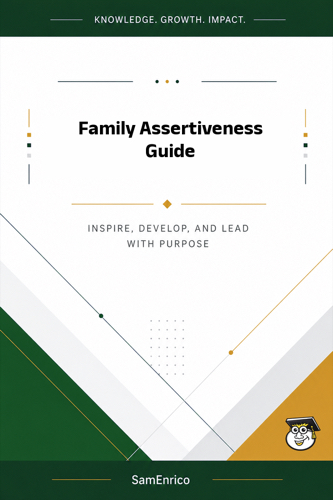
Non-FictionSelf-HelpFamily Dynamics
Family Assertiveness Guide eBook
Teaches boundary setting with parents, siblings, i
by Lackey Debi
Teaches boundary setting with parents, siblings, in laws, and during holidays.
Formats
Free sample
Chapter 1: The Polite Prison--–- The phone call came at 8:47 PM on a Tuesday. You didn’t want to answer it. You were tired, you had just sat down with dinner, and you could feel the familiar weight of obligation pressing against your chest before you even swiped accept. But you answered anyway. Because that’s what you do.
That’s what you’ve always done.By the time you hung up forty-five minutes later, you had agreed to host Thanksgiving, lend your sister $500, and drive your mother to a medical appointment that conflicts with a work presentation you’ve been preparing for three months. You sat in the silence of your own living room, food cold on the plate beside you, and felt nothing but a low, churning resentment. You weren’t angry at them. You were angry at yourself. And you had no idea how you kept ending up here.This is the Polite Prison.
It is not built with bars or locks. It is built with smiles you didn’t mean, with “of course” when you wanted to say “no,” with the quiet erosion of your own preferences in the name of keeping peace. The walls are made of other people’s expectations, and the floor is paved with your own unspoken exhaustion. Every family has one. And if you are reading this book, you have likely been living inside yours for years without even knowing it.The central paradox of family assertiveness is this: saying “yes” to family often feels like the most loving choice, yet it routinely leaves you feeling drained, angry, or secretly resentful.
You tell yourself you’re being helpful. You tell yourself that this is what good daughters, sons, siblings, and in-laws do. But somewhere beneath the politeness, something is quietly breaking. Not the relationships—those may look fine from the outside. What is breaking is your capacity to know what you actually want, separate from what everyone else needs.This chapter is not about turning you into a cold, boundary-obsessed recluse.
It is about recognizing the difference between performative niceness and authentic kindness. It is about learning to treat your own discomfort as data rather than as a signal to try harder. And it is about taking the first, most essential step toward assertiveness: admitting that your “yes” has been hurting you for a very long time.The Paradox of the Generous Yes We are raised on a diet of stories that equate self-sacrifice with love. The parent who gives up their career for their children. The sibling who always lends money despite never being repaid.
The in-law who swallows every criticism at the holiday table to keep the peace. These narratives are so deeply embedded in our cultural understanding of family that we rarely stop to question them. But here is the truth that no greeting card will ever print: generosity without limits is not love. It is self-erasure.When you say yes to everything, you are not being generous. You are being predictable.
You are training everyone around you to expect that your preferences do not matter. The problem is not that you love your family. The problem is that you have confused love with compliance. And your family, being human, has learned exactly how to ask for what they want without ever having to consider whether you have anything left to give.This dynamic does not make your family evil or manipulative in the pathological sense. Most families operate on unconscious patterns.
They ask because you have always said yes. They expect because you have always delivered. The person who is actually responsible for the pattern is not the person making the request. It is the person who keeps saying yes while secretly dying inside.Consider the following scenario, which may feel familiar: Your sibling calls and asks you to watch their children for the weekend because they have an emergency. You have plans.
You are exhausted from your own week. But you hear the urgency in their voice, and you remember the time they helped you move apartments six years ago. So you say yes. You cancel your plans. You spend the weekend exhausted and quietly furious.
On Monday, you complain to your partner about how selfish your sibling is. And by Tuesday, you have already forgotten that you were the one who said yes.This is the hidden cost of the generous yes. It is not that you did something kind. It is that you built resentment in the space where your own needs used to live. And resentment, unlike fatigue, does not go away with a good night’s sleep.
It accumulates. It calcifies. It becomes the background radiation of every family gathering, every phone call, every text message that makes your stomach clench before you even open it.Performative Niceness vs. Authentic Kindness To escape the Polite Prison, you must learn a distinction that will appear in every chapter of this book: the difference between performative niceness and authentic kindness.Performative niceness is the yes you give to avoid conflict, maintain peace, earn approval, or prevent someone else’s discomfort. It is driven by fear.
Fear of being seen as selfish. Fear of disappointing a parent. Fear of being the topic of conversation after you leave the room. Performative niceness feels like a trap closing around you even as you smile and agree. Its primary symptom is the Emotional Hangover—that specific, recognizable state of fatigue, irritability, or low-grade fury that follows agreeing to something you never wanted to do.Authentic kindness, by contrast, is the yes you give because it genuinely aligns with your capacity, your values, and your desires.
It is driven by choice, not obligation. It leaves you feeling energized, or at least neutral, rather than drained. Authentic kindness can still be hard—helping a parent through surgery is difficult even when you choose it freely. But the difficulty is accompanied by meaning, not resentment. You know the difference because you feel it in your body.
A performative yes sits in your chest like a stone. An authentic yes sits comfortably, even when it requires effort.The problem is that most of us have been trained to ignore the stone. We have been told, explicitly or implicitly, that family loyalty means prioritizing others’ needs over our own discomfort. We have learned to override the signal. And over time, we have stopped being able to hear it at all.This chapter is about turning the volume back up.The Emotional Hangover: Resentment as a Diagnostic Tool The single most useful concept in this entire book is the Emotional Hangover.
It is your built-in boundary violation alarm, and learning to read it will save you years of therapy and decades of silent suffering.An Emotional Hangover is exactly what it sounds like: the morning-after feeling of having overcommitted, overgiven, or overextended yourself in a family interaction. You might feel physically tired, even if you didn’t do anything strenuous. You might feel irritable with everyone around you, including people who had nothing to do with the original request. You might feel a quiet, simmering anger that you can’t quite justify because you “agreed” to whatever…
This is the end of the free sample. Get the eBook to keep going. Buy now
About this book
Details
- Author
- Lackey Debi
- Publisher
- SamEnrico
- Language
- English
- Genre
- Non-Fiction, Self-Help, Family Dynamics
- Released
- 2026-06-08
- Pages (approx.)
- 123
- Available as
- eBook, Audiobook

Read better in the ZLOADR app
Your eBooks on your phone or tablet. Sign in with your SamEnrico account and start reading.
More by Lackey Debi
 Validation for LeadersLackey Debi$11.99
 Vocabulary Palace MethodLackey Debi$11.99
 Falling Nightmare RescriptingLackey Debi$11.99
 The Alcohol and ED LinkLackey Debi$11.99
 Wholesaling Ethical PracticesLackey Debi$11.99
 Commute Time FreelancingLackey Debi$11.99
 Acupuncture Master GuideLackey Debi$11.99
 The Day the Sun Stood Still: The Great Solar Storm of 1859Lackey Debi$11.99
 The Cyber Siege: When a Ransomware Attack Turned Deadly in SeoulLackey Debi$11.99
 Antitrust Law: Monopolies, Cartels & CompetitionLackey Debi$11.99
 How to Produce Rhinestones and FlatbacksLackey Debi$11.99
 How to Produce Facial Tissue HoldersLackey Debi$11.99
You may also like
 Hong Kong Handover 1997Dunn Johnnie$11.99
 Zumba For Postnatal Recovery CourseNeal Christian$11.99
 Zumba for BeginnersLadner Nikia$11.99
 YouTube Comment Mining GuideHumes Pandora$12.99
 Worry Box MeditationCarlin Rudy$11.99
 Workplace Stress MeditationNguyen Lynn$11.99
 Workplace Stress and Sleep RepairHawley Ivory$11.99
 Workplace Perfectionism CureDelaney Jeffry$11.99
 Workplace Injustice Anger GuideWallen Isabelle$11.99
 Work Addiction and Burnout LinkGreenwood Ester$11.99
 Women in Yoga and WellnessBeattie Galina$11.99
 Women in Stand Up ComedyChun Evangeline$11.99