
Non-FictionTrue CrimePolice Interrogation
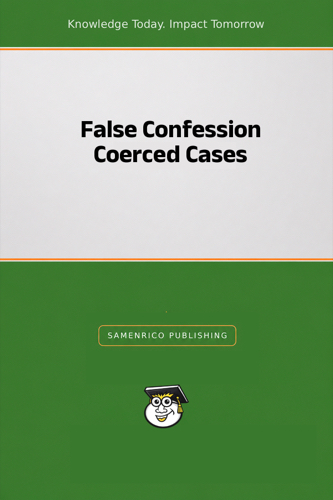
False Confession Coerced Cases Audiobook
Reveal how police interrogation tactics produced f
by Tarver Joane
Reveal how police interrogation tactics produced false confessions in these Innocence Project case studies.
Formats
Free sample
Chapter 1: The Boy Who Said Yes...--The fluorescent lights hummed overhead, a sound Huwe Burton would later describe as the most terrifying thing he had ever heard. Not the accusations. Not the threats. The lights. Because they never turned off.
For sixteen hours, they buzzed and flickered, casting the small interrogation room in a sickly green glow that made everything look unreal—like he was watching himself from outside his own body.Huwe was sixteen years old. He had never been in trouble. He had never spoken to a police officer beyond a polite "good morning." He had just lost his mother—stabbed to death in her own Bronx apartment—and instead of comfort, instead of investigation, he found himself alone in a windowless room with two detectives who were absolutely certain they already knew the truth.The only problem was that their truth was a lie.And Huwe Burton was about to confess to a murder he did not commit.This is the paradox that sits at the heart of the American criminal justice system. We believe, with an almost religious certainty, that no innocent person would ever confess to a crime they did not commit. It defies logic.
It defies self-interest. It defies every instinct for survival. And yet, across the past four decades, DNA technology has proven beyond any reasonable doubt that innocent people confess all the time. Not rarely. Not as a freak anomaly.
But as a predictable, pattern-based outcome of interrogation techniques that were designed to break people down and build them back up as confessors.The statistics are staggering. According to the Innocence Project's database, false confessions appear in approximately 25 to 30 percent of all DNA exoneration cases. That is nearly one in three. To put that number in perspective, false confessions are now ranked among the three leading causes of wrongful conviction in America, alongside eyewitness misidentification and faulty forensic science. Between 1989 and 2024, more than 375 innocent people were convicted in part because they confessed to crimes they did not commit.
Some of them were children. Some had intellectual disabilities. Some were simply exhausted after forty hours of interrogation. And some, like Huwe Burton, were grieving teenagers who just wanted the screaming to stop.But the public does not understand this. When news breaks that a suspect has confessed, the case is considered closed.
Jurors convict at astonishing rates when a confession is presented as evidence—often exceeding 80 percent, even when the confession contradicts…
This is the end of the free sample. Get the Audiobook to keep going. Buy now
About this book
Details
- Author
- Tarver Joane
- Publisher
- SamEnrico
- Language
- English
- Genre
- Non-Fiction, True Crime, Police Interrogation
- Released
- 2026-06-07
- Pages (approx.)
- 138
- Available as
- eBook, Audiobook

Listen in the VoxFlicks app
Audiobooks and audio dramas wherever you go. Sign in with your SamEnrico account and press play.
More by Tarver Joane
 Men's Fiber Heart Protection GuideTarver Joane$11.99
 Contingency Business Plan GuideTarver Joane$11.99
 Competitive Advantage Mapping GuideTarver Joane$11.99
 Outsourcing for HR DepartmentsTarver Joane$11.99
 The Billion-Dollar Bargain: How Super PACs Reshaped the 2012 ElectionTarver Joane$11.99
 Blood Moon: The Last Astronauts of Apollo 17Tarver Joane$11.99
 Understanding Chromosome 12, Trisomy 12qTarver Joane$17.99
 Meal Kit Retention PlaybookTarver Joane$12.99
 Middle East Vendor GuideTarver Joane$12.99
 Stock BrokerTarver Joane$11.99
 How to Start a Automatic Pianos Business (Beginners Guide)Tarver Joane$11.99
You may also like
 Hong Kong Handover 1997Dunn Johnnie$11.99
 Zumba For Postnatal Recovery CourseNeal Christian$11.99
 Zumba for BeginnersLadner Nikia$11.99
 YouTube Comment Mining GuideHumes Pandora$12.99
 Worry Box MeditationCarlin Rudy$11.99
 Workplace Stress MeditationNguyen Lynn$11.99
 Workplace Stress and Sleep RepairHawley Ivory$11.99
 Workplace Perfectionism CureDelaney Jeffry$11.99
 Workplace Injustice Anger GuideWallen Isabelle$11.99
 Work Addiction and Burnout LinkGreenwood Ester$11.99
 Women in Yoga and WellnessBeattie Galina$11.99
 Women in Stand Up ComedyChun Evangeline$11.99