
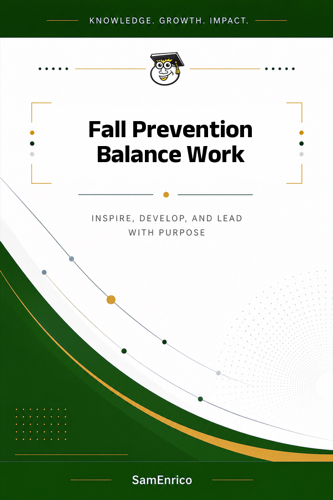
Non-FictionHealth & WellnessFall Prevention
Fall Prevention Balance Work eBook
Teaches standing and seated balance drills to redu
by Lawton Enda
Teaches standing and seated balance drills to reduce fall risk and hip fractures.
Formats
Free sample
Chapter 1: The $30,000 Stumble--–- The first time I watched an older adult refuse to use her walker because "people will think I'm old," I was a young physical therapist, barely two years out of school. Her name was Eleanor. She was 78, sharp as a tack, and had already fallen twice in the past year. The second fall had cracked her pelvis. She was lucky—no surgery, just eight weeks of pain every time she shifted in her chair.
When I gently suggested she use the walker her doctor prescribed, she looked at me like I had asked her to wear a sign that said "frail." She said: "I'd rather risk a fall than look like my mother."–- Eleanor was not being stubborn. She was being honest. And her honesty revealed something that most fall prevention books refuse to say out loud: The fear of falling is often more disabling than the fall itself.–- Three months after that conversation, Eleanor fell again. This time, she was reaching for a coffee mug on a high shelf. She didn't use her walker because she was only going "two steps." Those two steps cost her a hip fracture, surgery, six weeks of rehab, and a permanent move to an assisted living facility.
Her daughter later told me that Eleanor's last words before surgery were: "I should have used the damn walker."–- This chapter is not about walkers. It is about the $30,000 mistake that millions of Americans make every year—not the fall itself, but the belief that falls are caused by "weak legs" or "bad luck" or "just getting old." That belief is dangerous. It keeps people in their chairs. It silences conversations about prevention. And it turns a solvable mechanical problem into an inevitable tragedy.The Silent Epidemic No One Wants to Talk About–- Every eleven seconds, an older adult is treated in an emergency room for a fall-related injury.
Every nineteen minutes, an older adult dies from a fall. These are not statistics from a third-world country with poor healthcare. These are American numbers, year after year, and they have been getting worse, not better.–- According to the Centers for Disease Control and Prevention (CDC), falls are the leading cause of injury-related death among adults aged 65 and older. More than 3 million older adults are treated in emergency departments annually for fall injuries. One out of every five falls causes a serious injury—broken bones, traumatic brain injury, or deep lacerations.
And here is the number that should stop you cold: One in five hip fracture patients dies within twelve months of the injury.–- Not "one in twenty." One in five. Twenty percent.–- If you are over 65, your risk of falling this year is about one in four. If you have fallen once, your risk of falling again doubles. If you have fallen twice, your risk quadruples. This is not bad luck.
This is a predictable, preventable, mechanical cascade.–- And yet, when was the last time your primary care doctor asked you about your balance? When was the last time someone showed you how to test your own fall risk at home? When was the last time you heard a public health announcement that was not about heart disease or cancer, but about the thing that is more likely to put you in a nursing home than either of those conditions?–- The silence is deafening. And that silence is killing people.The Three Costs of a Fall (Only One of Them Is Financial)–- When we talk about falls, most people think about the immediate injury—a broken wrist, a bruised hip, a cut that needs stitches. But the true cost of a fall is three-dimensional, and two of those dimensions are almost never discussed in the waiting room.The Financial Cost–- Let us start with the one people do talk about, because it is staggering.
A ground-level fall (meaning you were not on a ladder or roof) that results in a hip fracture will generate an average of $30,000 to $40,000 in direct medical costs. That includes the ambulance, the emergency room, the surgery (hip pinning or replacement), the hospital stay (average five to seven days), and inpatient rehabilitation (average two to four weeks).–- But that is only the beginning. If you need skilled nursing facility care, add another $10,000 per month. If you need home modifications (grab bars, a ramp, a stairlift), add $5,000 to $15,000. If you need long-term care because you cannot return to independent living, add $50,000 to $100,000 per year.–- Medicare covers some of this, but not all.
Hip fracture patients are among the leading causes of "catastrophic medical debt" in older adults—the kind of debt that wipes out a lifetime of savings.The Physical Cost–- A broken bone is not just a broken bone when you are over 65. It is a cascade. After a hip fracture, you will be immobilized. Immobility leads to muscle atrophy—you can lose 5% of your muscle mass per day of bed rest. Muscle atrophy leads to worse balance.
Worse balance leads to fear. Fear leads to more sitting. More sitting leads to more atrophy.–- This is called the "post-fall syndrome," and it is a death spiral. Within six months of a hip fracture, 40% of patients cannot walk independently. Within one year, 20% are dead.
The cause of death is rarely the fracture itself. It is pneumonia from lying in bed. It is a blood clot from immobility. It is dehydration from being unable to reach the kitchen. It is depression from losing independence.–- A hip fracture is not an injury.
It is a gateway to decline.The Emotional Cost (The One No One Talks About)–- This is the cost that keeps people trapped in chairs long after their bones have healed. It has a name: ptophobia—the fear of falling. And it is contagious.–- After a fall, or even after a near-fall, the brain rewires itself. You stop taking risks. You avoid the stairs.
You stop walking to the mailbox. You ask your daughter to pick up groceries. You sit down in the shower. You stop going to church because the parking lot is uneven.–- Each avoidance behavior seems rational in isolation. "I'm just being careful," you tell yourself.
But the cumulative effect is catastrophic. Every time you avoid a movement, your brain learns that the movement is dangerous. Every time you sit instead of stand, your muscles get a little weaker. Every time you choose the safe path, your balance system gets a little less practice.–- Within six months, you have lost the ability to do things you could do last year—not because your body aged, but because your brain learned to be afraid. And here is the cruel irony: Fear makes you more likely to fall.
When you are afraid, you stiffen up. You take shorter steps. You hold your breath. You look at your feet instead of where you are going. All of these fear responses actually increase your fall risk.–- Eleanor was not wrong to be afraid.
She was wrong about what to do with that fear. She turned it inward, toward avoidance. This book will teach…
This is the end of the free sample. Get the eBook to keep going. Buy now
About this book
Details
- Author
- Lawton Enda
- Publisher
- SamEnrico
- Language
- English
- Genre
- Non-Fiction, Health & Wellness, Fall Prevention
- Released
- 2026-06-05
- Pages (approx.)
- 150
- Available as
- eBook, Audiobook

Read better in the ZLOADR app
Your eBooks on your phone or tablet. Sign in with your SamEnrico account and start reading.
More by Lawton Enda
 Presentation Rehearsal BlueprintLawton Enda$11.99
 Drug Addiction Financial RuinLawton Enda$11.99
 Body Language Interview SkillsLawton Enda$11.99
 The Tsar’s Arctic Gambit: The Great Northern Expedition of Vitus BeringLawton Enda$11.99
 How to Produce Canoe AccessoriesLawton Enda$11.99
 Pay What You Want Pricing StrategyLawton Enda$12.99
 Kremersite MiningLawton Enda$11.99
 How to Become a Mechanical EngineerLawton Enda$11.99
You may also like
 Hong Kong Handover 1997Dunn Johnnie$11.99
 Zumba For Postnatal Recovery CourseNeal Christian$11.99
 Zumba for BeginnersLadner Nikia$11.99
 YouTube Comment Mining GuideHumes Pandora$12.99
 Worry Box MeditationCarlin Rudy$11.99
 Workplace Stress MeditationNguyen Lynn$11.99
 Workplace Stress and Sleep RepairHawley Ivory$11.99
 Workplace Perfectionism CureDelaney Jeffry$11.99
 Workplace Injustice Anger GuideWallen Isabelle$11.99
 Work Addiction and Burnout LinkGreenwood Ester$11.99
 Women in Yoga and WellnessBeattie Galina$11.99
 Women in Stand Up ComedyChun Evangeline$11.99