
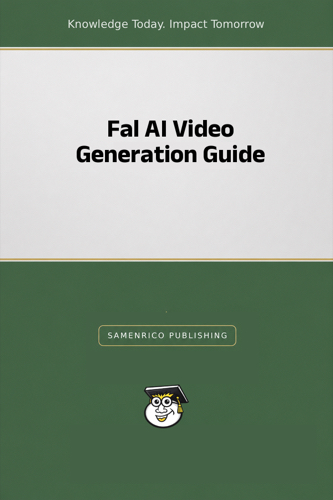
Fal AI Video Generation Guide
Generate and edit video using serverless AI models
Generate and edit video using serverless AI models, scaling on demand for high-volume production.
Formats
About this book
Free sample
Chapter 1: The Queue Revolution--–- In the basement of a struggling e-commerce startup in early 2022, a single engineer sat staring at a screen displaying a queue counter: 847 pending video jobs, 0 completed in the last hour. Their GPU server had crashed again. The marketing team needed 10,000 product videos by Monday. It was Thursday. This wasn't a hardware problem.
It wasn't a budget problem. It was a fundamental misunderstanding of how video production needed to evolve.That engineer was me. And this book is what I wish I had read before that week.The Death of Real-Time Thinking For decades, video production operated under a simple assumption: you press render, you wait, you get a video. Whether you were using Adobe Premiere on a laptop or a $500,000 render farm at Pixar, the mental model remained linear. Submit job.
Wait. Receive output. The relationship between effort and result was predictable, if not always fast.Then AI video generation arrived, and everything broke.The first text-to-video models in 2023 took thirty seconds to generate two seconds of footage. By 2024, that improved to five seconds for four seconds of footage. Today, state-of-the-art models like Stable Video Diffusion can generate a four-second clip in approximately ten seconds of inference time.
That sounds fast. It is fast. But here's the trap that catches every single engineer who starts with AI video generation: they try to treat it like a real-time system.Let me explain why that fails.Imagine you need ten thousand product videos. Each video takes ten seconds to generate. If you run them sequentially, that's one hundred thousand seconds of compute time—approximately twenty-eight hours.
But you don't have twenty-eight hours; you have a deadline. So you think, "I'll just scale up. I'll run fifty parallel requests."This is where the uninitiated discover concurrency limits. Your cloud GPU provider—whether it's fal.ai, Runway ML, or a custom Kubernetes cluster—has a default limit of five to ten simultaneous requests. That limit exists because GPU memory is finite.
Each model instance consumes eight to sixteen gigabytes of VRAM. A single A100 GPU has eighty gigabytes of VRAM, so…
This is the end of the free sample. Get the eBook to keep going. Buy now
Contents
- Chapter 1
- Chapter 2
- Chapter 3
- Chapter 4
- Chapter 5
- Chapter 6
- Chapter 7
- Chapter 8
- Chapter 9
- Chapter 10
- Chapter 11
- Chapter 12
Details
- Author
- Thurston Delfina
- Publisher
- SamEnrico
- Language
- English
- Genre
- Non-Fiction, AI Operator, Scalable Production
- Released
- 2026-06-08
- Pages (approx.)
- 125
- Available as
- eBook, Audiobook

Read better in the ZLOADR app
Your eBooks on your phone or tablet. Sign in with your SamEnrico account and start reading.
More by Thurston Delfina
 The Non Alcoholic Mixology HandbookThurston Delfina$11.99
 Phobia Relaxation SkillsThurston Delfina$11.99
 Nap Meditation For InsomniaThurston Delfina$11.99
 Benzo Tearfulness Recovery GuideThurston Delfina$11.99Benzo Tearfulness Recovery GuideThurston Delfina$11.99
 Quetzalcoatl’s Feathered Flight: The Serpent’s Divine RebellionThurston Delfina$11.99
 Understanding Infectious MyocarditisThurston Delfina$17.99
 Retainer Package BlueprintThurston Delfina$12.99
 Sports Fitness Spending GuideThurston Delfina$12.99
 Chain Sales ExecutiveThurston Delfina$11.99
 How to Become a DiggerThurston Delfina$11.99