
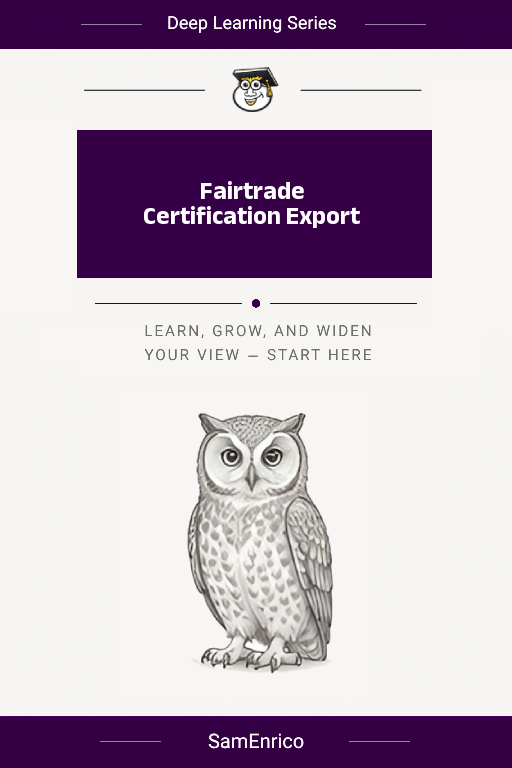
Non-FictionBusiness BriefEco-Compliance
Fairtrade Certification Export eBook
Get Fairtrade certification for ethical export pro
Get Fairtrade certification for ethical export products. Premium pricing and buyer requirements.
Formats
Free sample
Chapter 1: The Safety Net...--Most coffee farmers in the world live one bad season away from bankruptcy. That is not an opinion. It is a financial fact verified by decades of commodity market volatility. In 2021, global coffee prices dropped to levels that left smallholder farmers in Ethiopia, Colombia, and Vietnam unable to cover the cost of fertilizer, let alone school fees or healthcare. In 2024, cocoa prices spiked to historic highs, but the farmers in Ghana and Ivory Coast who grew that cocoa saw almost none of the windfall because they had sold forward at depressed prices months earlier.
The pattern is relentless: when markets crash, farmers bear the loss. When markets soar, middlemen capture the gain.This is the problem that Fairtrade was designed to solve. But after thirty years of certification, the Fairtrade Minimum Price remains the most misunderstood, underutilized, and potentially powerful tool available to ethical exporters. Most producers and traders treat it as a bureaucratic formality—a line item in a contract that they hope never to use. That is a catastrophic mistake.The Fairtrade Minimum Price is not a fixed "high price." It is not a guaranteed premium over market rates.
It is not a subsidy or a charity payment. It is a volatility shield. Think of it as an insurance policy that you hope never to claim, but that you desperately need when disaster strikes. When global commodity markets function normally and prices are fair, the Minimum Price sits quietly in the background, unactivated. When markets crash—as they do, cyclically and without warning—the Minimum Price activates automatically, catching the producer before they fall below a sustainable floor.This chapter will teach you exactly how that mechanism works, how to calculate whether the Minimum Price actually covers your costs, and how to use it as a negotiating tool rather than a defensive last resort.
By the end of this chapter, you will understand why the most successful Fairtrade exporters treat the Minimum Price not as a safety net for emergencies, but as the foundation of a completely different business model—one built on stability, planning, and long-term buyer relationships.1.1 The Anatomy of Commodity Market Volatility To understand the Fairtrade Minimum Price, you must first understand the problem it solves. Global commodity markets for coffee, cocoa, cotton, bananas, sugar, and other agricultural products are notoriously unstable. Prices are determined by futures exchanges in London, New York, and Shanghai, where traders speculate on weather patterns, political instability, currency fluctuations, and hedge fund activity. The actual farmer who grew the beans never sees that trading floor. They see only the price offered by a local middleman on a given morning—a price that can drop 30 percent in a single week because of a drought forecast in Brazil or a political crisis in a country thousands of miles away.Consider coffee.
Between 2015 and 2019, the International Coffee Agreement's composite indicator price fluctuated between 103 and 155 US cents per pound. That range alone represents a 50 percent swing. But the real damage comes from the crashes. In 2001, coffee prices fell to 45 cents per pound—well below the cost of production for most smallholders. In 2018, prices again dipped below the one-dollar mark, triggering protests and farmer suicides in Kenya and Tanzania.
In each case, farmers who were not covered by a Fairtrade contract had no recourse. They sold at a loss, went deeper into debt, and many abandoned farming altogether.Cocoa tells an even darker story. The world's largest cocoa producers in West Africa have seen prices consistently below the World Bank's estimated living income benchmark of 2.50perday.The2024pricespiketoover2.50 per day. The 2024 price spike to over 2.50perday.The2024pricespiketoover10,000 per ton made headlines, but the farmers who actually grew that cocoa had already sold their harvest months earlier at $2,500 per ton. The volatility does not average out over time.
It concentrates losses on the most vulnerable participants in the supply chain.The Fairtrade Minimum Price interrupts this cycle by establishing a floor. Not a ceiling. Not a target price. A floor. When the market price is above that floor, the market price governs the transaction.
When the market price falls below that floor, the Minimum Price automatically becomes the transaction price. The producer is protected from the worst of the crash. The buyer still pays a sustainable price. And the system continues to function without the catastrophic disruptions that poverty wages inevitably create.1.2 How the Minimum Price Actually Works The mechanics of the Fairtrade Minimum Price are precise, and precision matters. Every Fairtrade-certified product has a published Minimum Price, which varies by product, by form (e.g., green beans vs.
roasted beans, raw cotton vs. ginned cotton), and sometimes by geographic region. These prices are set by Fairtrade International's Pricing Unit, which conducts regular cost of production studies and consults with producer networks, traders, and independent economists. The prices are reviewed and updated periodically—typically every three to five years—to reflect changes in input costs, labor rates, and other economic fundamentals.When a buyer and a certified producer sign a Fairtrade contract, they must agree on a commercial price. That commercial price can be any amount above the Minimum Price.
It can be the current market price, a negotiated premium over market, or a fixed price for the duration of the contract. However, the contract must specify that if the agreed-upon reference price (typically a recognized commodity exchange price such as ICE Futures for coffee or cocoa) falls below the Fairtrade Minimum Price at the time of shipment or payment, the Minimum Price automatically becomes the transaction price.This automatic activation is critical. The producer does not have to renegotiate. The buyer does not have to approve an exception. The contract language triggers the floor mechanically.
This is why Fairtrade contracts are not optional niceties—they are legally binding instruments that must be written correctly to provide the intended protection.Let us walk through a concrete example. Suppose you are a coffee cooperative in Nicaragua with Fairtrade certification. You sign a contract with a European roaster for 10 metric tons of Arabica coffee. The contract specifies that the price will be the ICE Futures price for Arabica coffee on the date of shipment, plus a quality differential of 10 cents per pound, but never less than the Fairtrade Minimum Price for your region and product form, which is currently $1.40 per pound for washed Arabica.Scenario one: On the shipment date, ICE Futures are at 1.80perpound.Addingyour10−centdifferentialgives1.80 per pound. Adding your 10-cent differential gives 1.80perpound.Addingyour10−centdifferentialgives1.90 per pound.
That is above the Minimum Price, so the transaction proceeds at $1.90. You have captured the market upside.Scenario two: On the shipment date, ICE Futures have crashed to 1.10perpound.Addingyour10−centdifferentialgives1.10 per pound. Adding your 10-cent differential gives 1.10perpound.Addingyour10−centdifferentialgives1.20 per pound. That is below the Fairtrade Minimum Price of 1.40.Thecontract′sflooractivatesautomatically.Youarepaid1.40. The contract's floor activates automatically.
You are paid 1.40.Thecontract′sflooractivatesautomatically.Youarepaid1.40 per pound instead of $1.20. You have been protected from the worst of the crash.That 20-cent difference per pound may not sound like much. But on a 10-metric-ton contract (22,046 pounds), it represents $4,409 of additional revenue that you would not have received without the Minimum Price. For a small cooperative…
This is the end of the free sample. Get the eBook to keep going. Buy now
About this book
Details
- Author
- Gillette Ying
- Publisher
- SamEnrico
- Language
- English
- Genre
- Non-Fiction, Business Brief, Eco-Compliance
- Released
- 2026-05-30
- Pages (approx.)
- 154
- Available as
- eBook, Audiobook

Read better in the ZLOADR app
Your eBooks on your phone or tablet. Sign in with your SamEnrico account and start reading.
More by Gillette Ying
 Unicorn Recruitment SecretsGillette Ying$11.99
 Mindful Pet Time PracticeGillette Ying$11.99
 The Malala Yousafzai EducationGillette Ying$11.99
 The Yearning in Prolonged GriefGillette Ying$11.99
 Scrum Master CreativityGillette Ying$11.99
 Elizabeth I: The Virgin Queen and the Birth of a Global EmpireGillette Ying$11.99
 Convolutional Neural Network OperatorGillette Ying$11.99
 Understanding Strep ThroatGillette Ying$17.99
 How to Start a Calliopes Business (Beginners Guide)Gillette Ying$11.99
You may also like
 Hong Kong Handover 1997Dunn Johnnie$11.99
 Zumba For Postnatal Recovery CourseNeal Christian$11.99
 Zumba for BeginnersLadner Nikia$11.99
 YouTube Comment Mining GuideHumes Pandora$12.99
 Worry Box MeditationCarlin Rudy$11.99
 Workplace Stress MeditationNguyen Lynn$11.99
 Workplace Stress and Sleep RepairHawley Ivory$11.99
 Workplace Perfectionism CureDelaney Jeffry$11.99
 Workplace Injustice Anger GuideWallen Isabelle$11.99
 Work Addiction and Burnout LinkGreenwood Ester$11.99
 Women in Yoga and WellnessBeattie Galina$11.99
 Women in Stand Up ComedyChun Evangeline$11.99