
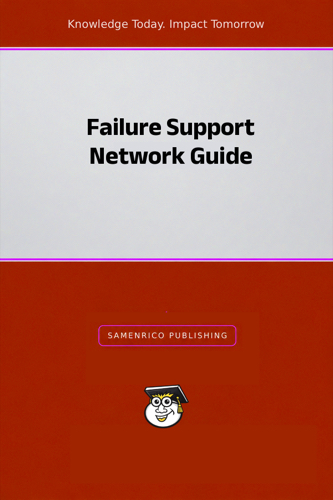
Failure Support Network Guide eBook
Build circle of people who cheer your attempts reg
by Roman Leif
Build circle of people who cheer your attempts regardless of outcomes.
Formats
Free sample
Chapter 1: The Vulnerability Paradox--–- The call came at 11:47 on a Tuesday night. My friend Lena was sobbing so hard I could barely understand her. She had just been fired from a job she hated—which, logically, should have been good news. But she wasn't crying about the firing. She was crying because she had spent the previous six months pretending everything was fine.
She had perfected the mask of "I've got this" so thoroughly that when the ceiling finally caved in, she realized she had no one to call—except me, someone she hadn't been honest with in half a year."I faked it so well that everyone thinks I'm still fine," she choked out. "And now I can't tell them the truth because they'll ask why I didn't say anything sooner."That night, I couldn't sleep. I kept turning over the tragic irony of her situation. She had done exactly what every self-help book, every career coach, and every motivational speaker had told her to do. She had projected confidence.
She had faked it until she supposedly would make it. She had hidden her struggles behind a wall of curated competence. And that wall, which was supposed to protect her, had become her prison.This chapter is about why the most popular advice in modern self-improvement is actually sabotaging your ability to build the one thing you need most: a circle of people who will cheer your attempts regardless of the outcome. We have been taught that vulnerability is weakness, that failure is shameful, and that the path to success is a solo journey of relentless positivity. All of that is wrong.
And the data, the stories, and the science prove it.The Lie We’ve All Swallowed Let me name the lie directly: "Fake it 'til you make it" is not a strategy for success. It is a strategy for isolation.The phrase has become so embedded in our cultural DNA that we repeat it without thinking. Show up like you belong. Act as if. Never let them see you sweat.
These instructions sound like wisdom, but they are actually prescriptions for loneliness. When you fake confidence you do not feel, you are not becoming stronger. You are becoming invisible.Think about the last time you were in a room with someone who was clearly struggling but pretending otherwise. Did you feel closer to them or more distant? Did you trust them more or less?
Most people report feeling a sense of unease around someone who is performing perfection. You cannot connect with a facade. You can only admire it from a distance.Bobby Bones, the nationally syndicated radio host and author of Fail Until You Don't, learned this lesson the hard way. Early in his career, he tried to project an image of effortless success. He thought that if people knew how hard he was grinding—how many interviews he had bombed, how many sponsors had rejected him, how many nights he had cried in his car—they would lose confidence in him.
Instead, he discovered the opposite. When he finally started sharing his failures publicly, his audience didn't shrink. It grew. People didn't think less of him. They thought, "Finally, someone who tells the truth."The reason is simple: humans are not built to trust perfection.
We are built to trust honesty. When you admit a mistake, you signal something powerful to the people around you. You signal that you are safe. You signal that you will not shame others for their failures because you do not shame yourself for yours. You signal that you are real.The Data on Loneliness and Connection Before we go any further, let me show you the stakes.
In 2023, the United States Surgeon General issued an advisory declaring loneliness a public health epidemic. The report stated that weak social connections reduce lifespan as much as smoking fifteen cigarettes a day. Let that land. Fifteen cigarettes a day. Chronic loneliness is not sad.
It is lethal.The same report found that even before the pandemic, about half of U.S. adults reported measurable levels of loneliness. Among young adults, the numbers were even worse. We are the most connected generation in human history—we have phones, social media, messaging apps, and video calls—and we are the loneliest. Something is broken.What is broken is not our technology.
What is broken is our philosophy of connection. We have been taught to present our best selves, not our real selves. We have been taught to hide our failures, not share them. We have been taught that vulnerability is something to manage, not something to leverage. And as a result, we have built networks of acquaintances—people who like our posts but would not answer our 3 a.m.
phone calls.A 2021 study published in the Journal of Personality and Social Psychology found that people consistently underestimate how much others appreciate vulnerability. In the study, participants were asked to share something difficult about themselves with a stranger. Beforehand, they predicted that the stranger would judge them negatively. Afterward, the strangers reported feeling closer to the participants, not more distant. The researchers called this the "beautiful mess effect." We think our imperfections repel people.
They actually attract them.The Difference Between Safety Nets and Cheer Squads Before we go further, I need to introduce a distinction that will shape everything that follows in this book. It is a distinction that most people have never considered, and it is the reason you feel unsupported even when you have plenty of friends.Most people have what I call Safety Nets. A safety net is someone who catches you after you fall. Safety nets are essential. They are the friends who say, "Call me when it crashes." They are the family members who bring soup after a breakup.
They are the colleagues who say, "That sucks, let me know if you need anything." Safety nets activate after failure. They are reactive. They are comfort.But safety nets, no matter how loving, cannot do the thing that actually changes your life. They cannot cheer you before you try. They cannot stand at the edge of the cliff and yell, "Jump again, higher this time!" That requires a different kind of person.
That requires what I call a Cheer Squad.A Cheer Squad friend is someone who says, "Text me right before you hit send on the scary email. I will text back a fire emoji no matter what." A Cheer Squad friend is someone who celebrates the attempt, not just the outcome. A Cheer Squad friend is someone who asks, "What are you trying that might fail this week?"—and actually wants to hear the answer.Here is the problem: most people have plenty of safety nets and almost no cheer squads. Why? Because asking for a safety net only requires admitting that something already went wrong.
Asking for a cheer squad requires admitting that something might go wrong in the future. That is far more vulnerable. That requires saying, "I am about to try something hard, and I might look foolish, and I need you to see me try anyway."Most of us cannot bring ourselves to say…
This is the end of the free sample. Get the eBook to keep going. Buy now
About this book
Details
- Author
- Roman Leif
- Publisher
- SamEnrico
- Language
- English
- Genre
- Non-Fiction, Self-Help
- Released
- 2026-06-09
- Pages (approx.)
- 136
- Available as
- eBook, Audiobook

Read better in the ZLOADR app
Your eBooks on your phone or tablet. Sign in with your SamEnrico account and start reading.
More by Roman Leif
 Financial Scarcity Mindset ShiftRoman Leif$11.99
 Alternative Explanation GeneratorRoman Leif$11.99
 Sleep Growth Hormone ReleaseRoman Leif$11.99
 Letting Go of Ex PartnerRoman Leif$11.99
 Talking About Pregnancy LossRoman Leif$11.99
 HIIT for DepressionRoman Leif$11.99
 HIIT Metabolic AfterburnRoman Leif$11.99
 The Maestro of the Mississippi: William Grant Still and the Symphony of Black Classical BrillianceRoman Leif$11.99
 The Iron Spires of Prussia: Frederick the Great and the Birth of Modern WarfareRoman Leif$11.99
 Poppy Seed: Breadseed PoppyRoman Leif$11.99
 How to Start a Manganese Oxide Business (Beginners Guide)Roman Leif$11.99
 Knowledge Worker Screen Break CourseRoman Leif$12.99
You may also like
 Workplace Stress MeditationNguyen Lynn$11.99
 Volcano Monitoring ScientistCox Alexis$11.99
 The Tech Professional NetAguiar Nevada$11.99
 The Morning Metta RitualCanales Anya$11.99
 The Chunking Memory TechniqueClanton Hyacinth$11.99
 The Beginner Mistake FixAmmons Cassondra$11.99
 Surrendering to What IsGrimm Reatha$11.99
 Self Hypnosis for Fear of FireBillups Eli$11.99
 Road Rage for Professional DriversBrackett Janise$11.99
 Psychiatric Ward Nurse StressDunning Wyatt$11.99
 Observation vs Evaluation NVCTimmons Alda$11.99
 Networking for Nonprofit ProfessionalsPoole Jesse$11.99